
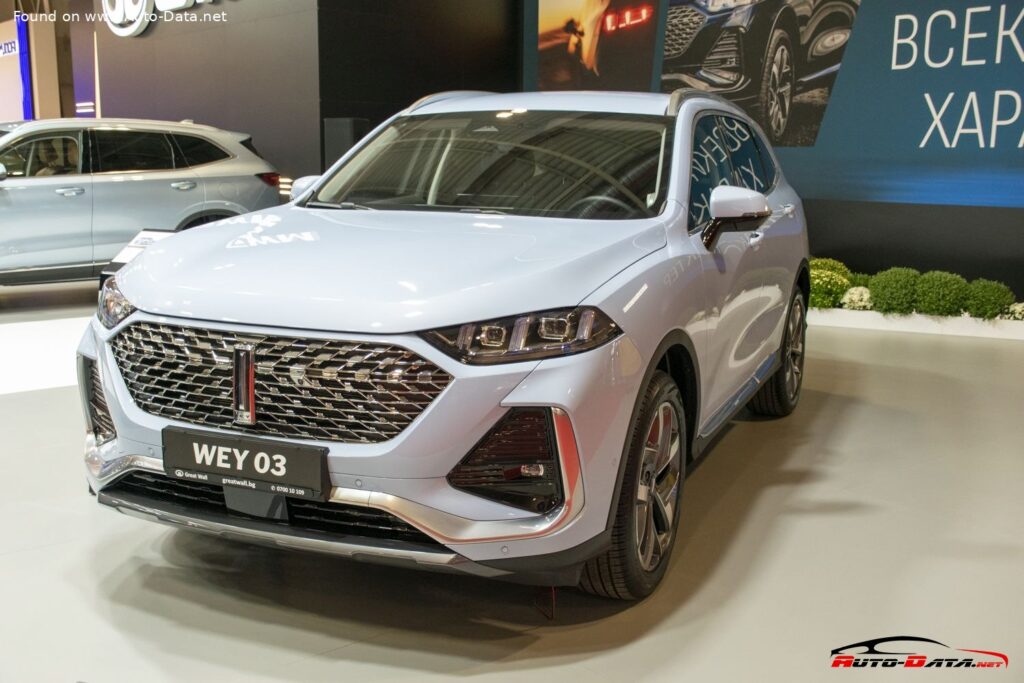
The WEY 03 2.0L is a plug-in hybrid SUV produced by WEY, a luxury automotive brand owned by Great Wall Motors. Launched in March 2024, the 03 represents WEY’s entry into the competitive compact SUV segment, primarily targeted towards the Chinese domestic market. While not currently sold in the United States, it showcases the growing sophistication of Chinese automotive engineering and the increasing adoption of plug-in hybrid technology globally. The vehicle aims to balance performance, fuel efficiency, and modern features, appealing to consumers seeking a premium SUV experience.
WEY 03: A Detailed Overview
The WEY brand was established in 2017, positioned as Great Wall Motors’ premium offering, similar in concept to Lexus for Toyota or Acura for Honda. The 03 model is a key component of WEY’s strategy to expand its market share with technologically advanced vehicles. It distinguishes itself through a combination of a turbocharged gasoline engine and an electric motor, offering both all-electric driving capability and the extended range provided by the internal combustion engine. The vehicle is a five-seater, five-door SUV designed to cater to families and individuals prioritizing comfort and versatility.
Engine & Performance
The WEY 03 2.0L is powered by a 2.0-liter turbocharged inline-four cylinder gasoline engine paired with an electric motor and a 34 kWh battery pack. The gasoline engine produces 204 horsepower and 320 Nm (236.02 lb.-ft.) of torque. The electric motor contributes an additional 163 horsepower and 325 Nm (239.71 lb.-ft.) of torque. Combined, the powertrain delivers a system output of 367 horsepower and 500 Nm (368.78 lb.-ft.) of torque. This allows for a 0-60 mph acceleration time of approximately 6.9 seconds and a top speed of 230 km/h (142.92 mph). The vehicle utilizes a 9-speed dual-clutch transmission (DCT) to efficiently manage power delivery. A key feature is its plug-in hybrid architecture, enabling an all-electric range of 130 km (80.78 miles) based on WLTP testing. The combined fuel consumption is rated at an impressive 0.5 l/100 km (470.4 US mpg), with CO2 emissions of just 15 g/km, adhering to the stringent Euro 6e emission standard.
Design & Features
The WEY 03 boasts a modern and stylish exterior design, typical of contemporary SUVs. It features a prominent grille, sleek headlights, and a streamlined silhouette. The vehicle’s dimensions are 4668 mm (183.78 in) in length, 1890 mm (74.41 in) in width, and 1730 mm (68.11 in) in height, with a wheelbase of 2745 mm (108.07 in). Inside, the 03 offers a spacious and well-appointed cabin with seating for five passengers. The trunk space ranges from 517 liters (18.26 cu. ft.) with the rear seats up to 1289 liters (45.52 cu. ft.) with the seats folded down. Standard features include an electric parking brake, ABS (Anti-lock Braking System), and electric power steering. The suspension system comprises independent McPherson struts at the front and an independent multi-link setup at the rear, providing a comfortable and controlled ride. Safety features are comprehensive, reflecting modern automotive standards. The vehicle also offers a respectable towing capacity, with a maximum braked trailer load of 2000 kg (4409.25 lbs).
Technical Specifications
| Brand | WEY |
| Model | 03 |
| Generation | 03 |
| Type (Engine) | 2.0L (367 Hp) Plug-in Hybrid DCT |
| Start of production | March, 2024 |
| Powertrain Architecture | PHEV (Plug-in Hybrid Electric Vehicle) |
| Body type | SUV |
| Seats | 5 |
| Doors | 5 |
| Combined fuel consumption (WLTP) | 0.5 l/100 km (470.4 US mpg, 565 UK mpg, 200 km/l) |
| CO2 emissions (WLTP) | 15 g/km |
| Fuel Type | Petrol / electricity |
| Acceleration 0 – 100 km/h | 7.3 sec |
| Acceleration 0 – 62 mph | 7.3 sec |
| Acceleration 0 – 60 mph | 6.9 sec |
| Maximum speed | 230 km/h (142.92 mph) |
| Emission standard | Euro 6e |
| Weight-to-power ratio | 5.7 kg/Hp, 174.8 Hp/tonne |
| Weight-to-torque ratio | 4.2 kg/Nm, 238.1 Nm/tonne |
| Gross battery capacity | 34 kWh |
| Net (usable) battery capacity | 28.9 kWh |
| Battery technology | Lithium nickel manganese cobalt oxides (Li-NMC) |
| All-electric range (WLTP) | 130 km (80.78 mi) |
| Average Energy consumption (WLTP) | 25.2 kWh/100 km (40.56 kWh/100 mi, 83 MPGe, 4 km/kWh, 2.5 mi/kWh) |
| Electric motor power | 163 Hp |
| Electric motor Torque | 325 Nm (239.71 lb.-ft.) |
| Electric motor location | Front axle, Transverse |
| Electric motor type | Synchronous |
| System power | 367 Hp |
| System torque | 500 Nm (368.78 lb.-ft.) |
| Power | 204 Hp |
| Torque | 320 Nm (236.02 lb.-ft.) |
| Engine layout | Front, Transverse |
| Engine Model/Code | E20N |
| Engine displacement | 1998 cm3 (121.93 cu. in.) |
| Number of cylinders | 4 |
| Engine configuration | Inline |
| Number of valves per cylinder | 4 |
| Fuel injection system | Direct injection |
| Engine aspiration | Turbocharger, Intercooler |
| Kerb Weight | 2100 kg (4629.71 lbs.) |
| Max. weight | 2550 kg (5621.79 lbs.) |
| Max load | 450 kg (992.08 lbs.) |
| Trunk (boot) space – minimum | 517 l (18.26 cu. ft.) |
| Trunk (boot) space – maximum | 1289 l (45.52 cu. ft.) |
| Fuel tank capacity | 55 l (14.53 US gal | 12.1 UK gal) |
| Permitted trailer load with brakes (12%) | 2000 kg (4409.25 lbs.) |
| Permitted trailer load without brakes | 750 kg (1653.47 lbs.) |
| Permitted towbar download | 100 kg (220.46 lbs.) |
| Length | 4668 mm (183.78 in.) |
| Width | 1890 mm (74.41 in.) |
| Height | 1730 mm (68.11 in.) |
| Wheelbase | 2745 mm (108.07 in.) |
| Drive wheel | Front wheel drive |
| Number of gears and type of gearbox | 9 gears, automatic transmission DCT |
| Front suspension | Independent type McPherson |
| Rear suspension | Independent multi-link suspension |
| Front brakes | Ventilated discs |
| Rear brakes | Ventilated discs |
| Tires size | 235/55 R19; 235/50 R20 |
| Wheel rims size | 7.5J x 19; 7.5J x 20 |
The WEY 03 2.0L Plug-in Hybrid represents a significant step forward for Chinese automotive manufacturing, demonstrating a commitment to both performance and environmental responsibility. While its availability is currently limited to the Chinese market, it serves as an indicator of the evolving global automotive landscape and the increasing competitiveness of Chinese automakers.
