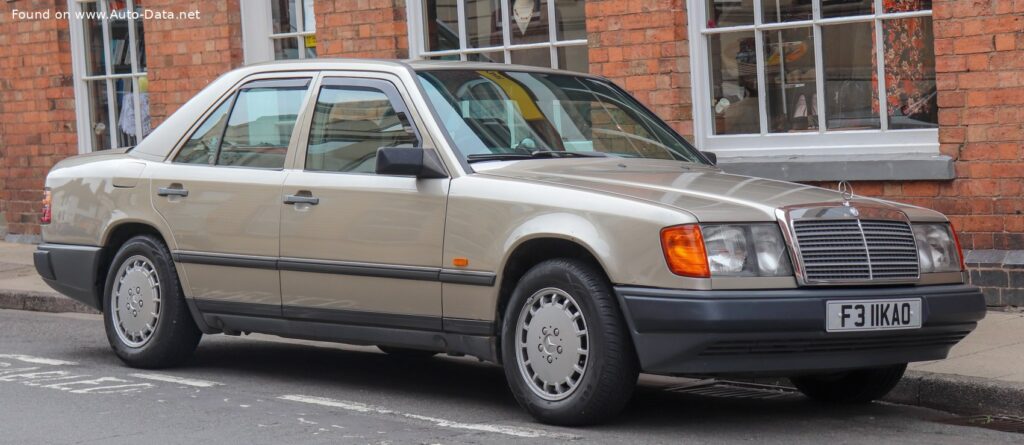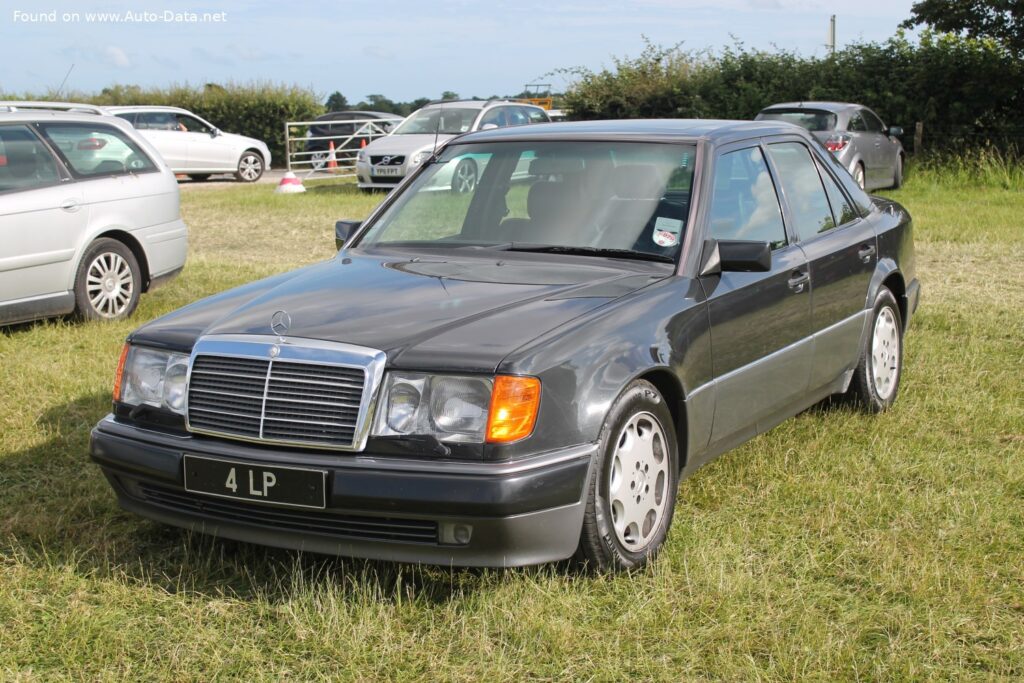
The Mercedes-Benz W124 500 E, produced from 1992 to 1993, represents a high-performance iteration of the popular W124 sedan. Often referred to as the “Wolf in Sheep’s Clothing,” this model combined the understated elegance of the W124 with the potent power of a V8 engine. While the W124 series was sold globally, the 500 E was primarily marketed in Europe and North America to customers seeking a blend of luxury, performance, and engineering excellence. It served as a precursor to the later AMG-developed models, showcasing Mercedes-Benz’s capability for creating high-performance sedans.
Mercedes-Benz W124 500 E: A Performance Sedan
The W124 series, produced from 1985 to 1996, was a significant model for Mercedes-Benz, known for its robust build quality, advanced engineering, and comfortable ride. The 500 E, introduced as a facelifted version in 1989, stood out due to its powerful engine and subtle performance enhancements. It wasn’t a full-fledged AMG model initially, but it was developed with significant input from AMG, who were responsible for the engine installation and some chassis modifications. This collaboration laid the groundwork for the closer relationship between Mercedes-Benz and AMG that would follow.
Engine & Performance
The heart of the 500 E is its 4.973-liter (303.47 cu. in.) M119 E 50 V8 engine. This naturally aspirated powerplant produced 326 horsepower at 5700 rpm and 480 Nm (354.03 lb.-ft.) of torque at 3900 rpm. The engine featured multi-port fuel injection and a double overhead camshaft (DOHC) valvetrain with four valves per cylinder. This configuration allowed for a high power-to-liter ratio of 65.6 hp/l. Power is delivered to the rear wheels via a four-speed automatic transmission. The 500 E could accelerate from 0 to 100 km/h (0-62 mph) in 6.1 seconds, and 0 to 60 mph in a calculated 5.8 seconds. Top speed was electronically limited to 250 km/h (155.34 mph). The weight-to-power ratio of 5.2 kg/hp and a weight-to-torque ratio of 3.5 kg/Nm contributed to its responsive driving experience.
Design & Features
The 500 E retained the classic W124 sedan body style – a four-door, four-seater configuration. However, subtle visual cues distinguished it from other W124 models. These included a more aggressive front spoiler, side skirts, and a rear spoiler. The suspension was also modified, featuring a lowered ride height and stiffer springs for improved handling. Inside, the 500 E offered a luxurious interior with high-quality materials and comfortable seating. Standard features included leather upholstery, power windows, power locks, and an advanced climate control system. Safety features, while not as comprehensive as modern standards, included ABS (Anti-lock Braking System) which was a significant advancement for the time. The car’s design prioritized a blend of understated elegance and sporty performance, appealing to drivers who wanted a high-performance vehicle without attracting undue attention.
Technical Specifications
| Brand | Mercedes-Benz |
| Model | W124 |
| Generation | W124 (facelift 1989) |
| Type (Engine) | 500 E V8 (326 Hp) Automatic |
| Start of production | October, 1992 |
| End of production | July, 1993 |
| Powertrain Architecture | Internal Combustion engine |
| Body type | Sedan |
| Seats | 4 |
| Doors | 4 |
| Fuel consumption (economy) – urban | 17.5 l/100 km (13.4 US mpg / 16.1 UK mpg / 5.7 km/l) |
| Fuel consumption (economy) – extra urban | 10.7 l/100 km (22 US mpg / 26.4 UK mpg / 9.3 km/l) |
| Fuel Type | Petrol (Gasoline) |
| Acceleration 0 – 100 km/h | 6.1 sec |
| Acceleration 0 – 62 mph | 6.1 sec |
| Acceleration 0 – 60 mph | 5.8 sec |
| Maximum speed | 250 km/h (155.34 mph) |
| Weight-to-power ratio | 5.2 kg/Hp |
| Weight-to-torque ratio | 3.5 kg/Nm |
| Power | 326 Hp @ 5700 rpm |
| Power per litre | 65.6 Hp/l |
| Torque | 480 Nm @ 3900 rpm (354.03 lb.-ft. @ 3900 rpm) |
| Engine layout | Front, Longitudinal |
| Engine Model/Code | M 119 E 50 / 119.974 |
| Engine displacement | 4973 cm3 (303.47 cu. in.) |
| Number of cylinders | 8 |
| Engine configuration | V-engine |
| Cylinder Bore | 96.5 mm (3.8 in.) |
| Piston Stroke | 85 mm (3.35 in.) |
| Compression ratio | 10:1 |
| Number of valves per cylinder | 4 |
| Fuel injection system | Multi-port manifold injection |
| Engine aspiration | Naturally aspirated engine |
| Valvetrain | DOHC |
| Engine oil capacity | 8 l (8.45 US qt | 7.04 UK qt) |
| Coolant | 15.5 l (16.38 US qt | 13.64 UK qt) |
| Kerb Weight | 1700 kg (3747.86 lbs.) |
| Max. weight | 2150 kg (4739.94 lbs.) |
| Max load | 450 kg (992.08 lbs.) |
| Trunk (boot) space – minimum | 520 l (18.36 cu. ft.) |
| Fuel tank capacity | 90 l (23.78 US gal | 19.8 UK gal) |
| Max. roof load | 100 kg (220.46 lbs.) |
| Permitted trailer load with brakes (12%) | 1900 kg (4188.78 lbs.) |
| Permitted trailer load without brakes | 750 kg (1653.47 lbs.) |
| Length | 4750 mm (187.01 in.) |
| Width | 1796 mm (70.71 in.) |
| Height | 1410 mm (55.51 in.) |
| Wheelbase | 2800 mm (110.24 in.) |
| Front track | 1538 mm (60.55 in.) |
| Rear (Back) track | 1529 mm (60.2 in.) |
| Minimum turning circle (turning diameter) | 11.7 m (38.39 ft.) |
| Drivetrain Architecture | The Internal combustion engine (ICE) drives the rear wheels of the vehicle. |
| Drive wheel | Rear wheel drive |
| Number of gears and type of gearbox | 4 gears, automatic transmission |
| Front suspension | Wishbone |
| Rear suspension | Hydro-pneumatic element, Independent multi-link suspension, Transverse stabilizer |
| Front brakes | Ventilated discs |
| Rear brakes | Ventilated discs |
| Assisting systems | ABS (Anti-lock braking system) |
| Steering type | Cone worm with recirculation balls |
| Power steering | Hydraulic Steering |
| Tires size | 225/55 R16 |
| Wheel rims size | 8J x 16 |
The Mercedes-Benz W124 500 E remains a sought-after classic, appreciated for its combination of luxury, performance, and engineering prowess. It represents a pivotal moment in Mercedes-Benz’s history, bridging the gap between traditional luxury sedans and the high-performance AMG models that would become synonymous with the brand.