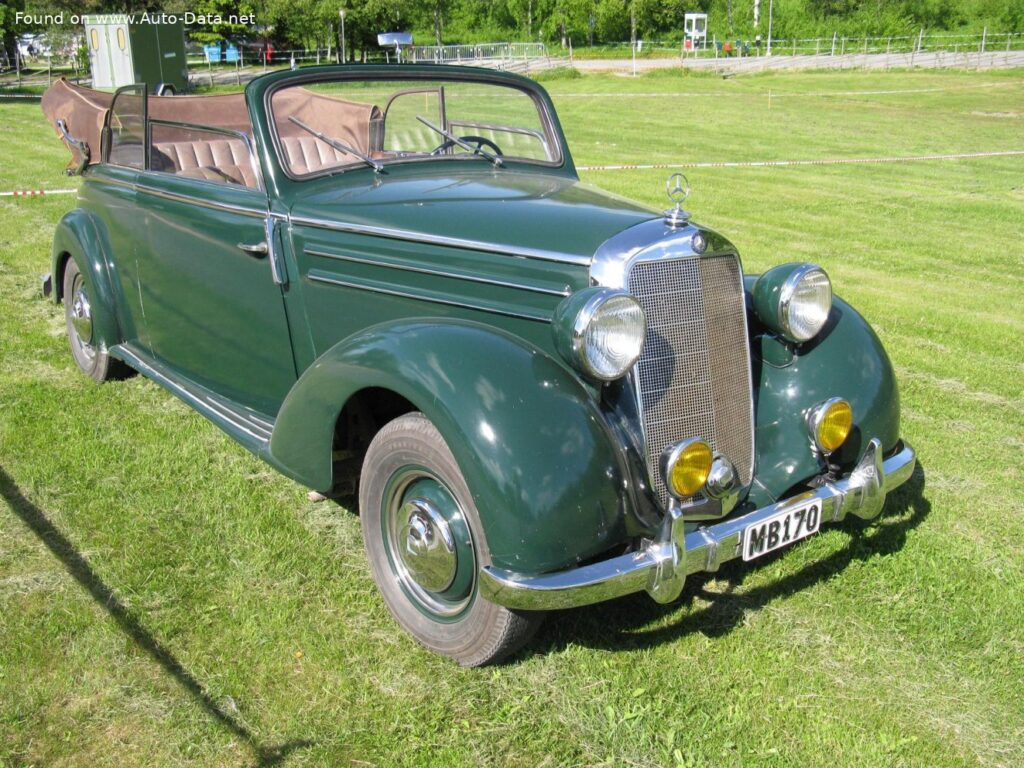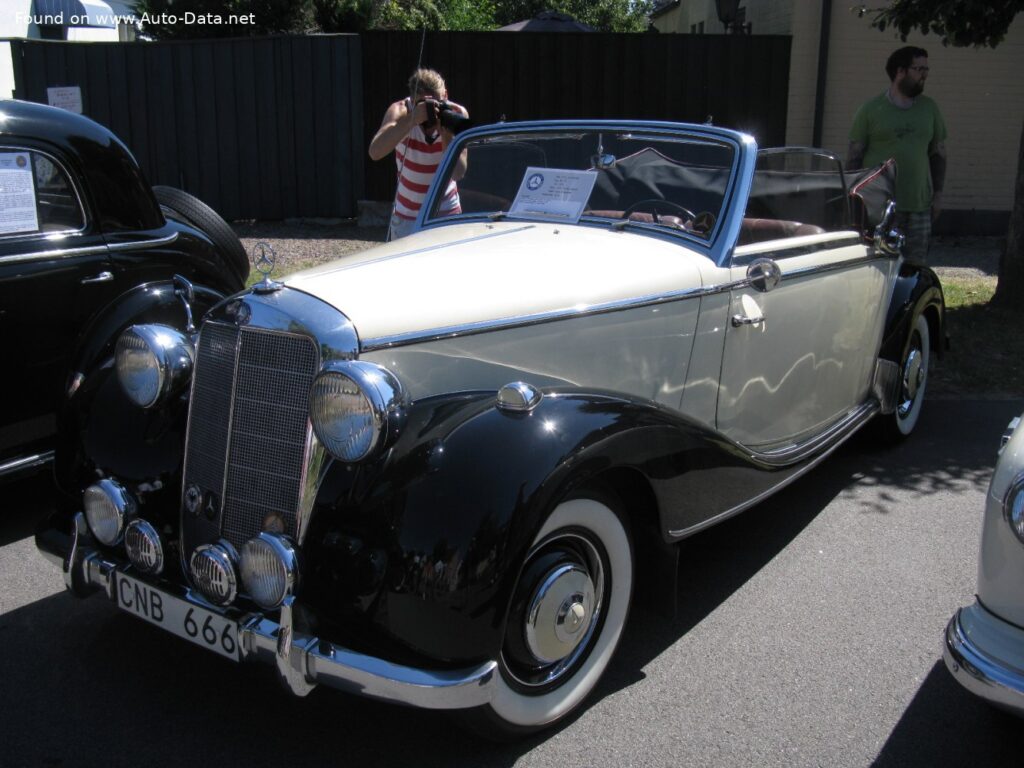
The Mercedes-Benz W136, produced from 1936 to 1955, represents a pivotal era for the German automaker. Emerging from the pre-war 170 series, the W136 was Mercedes-Benz’s entry-level offering, designed to provide comfortable and reliable transportation for the burgeoning middle class. The Cabriolet A 170 S, produced from May 1949 to November 1951, was a particularly elegant iteration of the W136, embodying post-war optimism and a return to civilian production. This model, powered by a 1.8-liter inline-four engine producing 52 horsepower, offered a blend of style and practicality, becoming a symbol of aspirational motoring in a recovering Europe.
The Mercedes-Benz W136 Cabriolet A 170 S
The W136 series underwent significant revisions following World War II. Production resumed in 1949 with the 170 S, featuring a modernized engine and improved chassis. The Cabriolet A variant, with its two-door, two-seat configuration and folding soft top, was a popular choice for those seeking open-air motoring. While not a high-performance vehicle by modern standards, the 170 S Cabriolet A offered a refined driving experience and a level of luxury uncommon in its price range. It was primarily sold in Europe and did not see significant sales in the United States, where the post-war automotive market was dominated by American manufacturers.
Engine & Performance
The heart of the W136 Cabriolet A 170 S is its 1767 cc (107.83 cu. in.) inline-four cylinder engine, designated the M 136 III / 136.922. This naturally aspirated engine, equipped with a single carburetor, produced 52 horsepower at 4000 rpm and 112 Nm (82.61 lb.-ft.) of torque at 1800 rpm. The engine’s overhead valve (OHV) valvetrain, with two valves per cylinder, was a common configuration for the period. Power is delivered to the rear wheels via a four-speed manual transmission. Acceleration from 0 to 100 km/h (0-62 mph) took approximately 32 seconds, and the vehicle had a top speed of 120 km/h (74.56 mph). While these figures may seem modest today, they were respectable for a vehicle of its size and class in the late 1940s and early 1950s. The power-to-weight ratio of 24.4 kg/Hp and torque-to-weight ratio of 11.3 kg/Nm reflect the car’s balanced, if not particularly sporty, character. Fuel consumption was rated at 9.7 l/100 km (24.2 US mpg).
Design & Features
The W136 Cabriolet A 170 S boasts a classic, elegant design characteristic of the late 1940s. Its flowing lines, rounded fenders, and upright grille contribute to a timeless aesthetic. The two-door cabriolet body style, with its manually operated folding soft top, provided an open-air driving experience. The interior was relatively spartan by modern standards, but offered comfortable seating for two passengers. Features were focused on practicality and durability rather than advanced technology. Drum brakes were employed on all four wheels, and steering was accomplished via a worm-reduction unit. Suspension utilized a double wishbone setup with a transverse stabilizer at the front and a trailing arm configuration at the rear. Safety features were limited by the standards of the time, with a focus on robust construction and reliable mechanical components. The vehicle’s dimensions – 4510 mm (177.56 in.) in length, 1684 mm (66.3 in.) in width, and 1560 mm (61.42 in.) in height – positioned it as a relatively compact vehicle for its era.
Technical Specifications
| Brand | Mercedes-Benz |
| Model | W136 |
| Generation | W136 Cabriolet A |
| Type (Engine) | 170 S (52 Hp) |
| Start of production | May, 1949 |
| End of production | November, 1951 |
| Powertrain Architecture | Internal Combustion engine |
| Body type | Cabriolet |
| Seats | 2 |
| Doors | 2 |
| Fuel consumption (combined) | 9.7 l/100 km |
| Fuel consumption (US mpg) | 24.2 US mpg |
| Fuel consumption (UK mpg) | 29.1 UK mpg |
| Fuel consumption (km/l) | 10.3 km/l |
| Fuel Type | Petrol (Gasoline) |
| Acceleration 0 – 100 km/h | 32 sec |
| Acceleration 0 – 62 mph | 32 sec |
| Acceleration 0 – 60 mph | 30.4 sec |
| Maximum speed | 120 km/h |
| Maximum speed (mph) | 74.56 mph |
| Weight-to-power ratio | 24.4 kg/Hp |
| Hp/tonne | 40.9 Hp/tonne |
| Weight-to-torque ratio | 11.3 kg/Nm |
| Nm/tonne | 88.2 Nm/tonne |
| Power | 52 Hp @ 4000 rpm |
| Power per litre | 29.4 Hp/l |
| Torque | 112 Nm @ 1800 rpm |
| Torque (lb.-ft.) | 82.61 lb.-ft. @ 1800 rpm |
| Engine layout | Front, Longitudinal |
| Engine Model/Code | M 136 III / 136.922 |
| Engine displacement | 1767 cm3 |
| Engine displacement (cu. in.) | 107.83 cu. in. |
| Number of cylinders | 4 |
| Engine configuration | Inline |
| Cylinder Bore | 75 mm |
| Cylinder Bore (in.) | 2.95 in. |
| Piston Stroke | 100 mm |
| Piston Stroke (in.) | 3.94 in. |
| Compression ratio | 6.5:1 |
| Number of valves per cylinder | 2 |
| Fuel injection system | Carburettor |
| Engine aspiration | Naturally aspirated engine |
| Valvetrain | OHV |
| Kerb Weight | 1270 kg |
| Kerb Weight (lbs.) | 2799.87 lbs. |
| Max. weight | 1530 kg |
| Max. weight (lbs.) | 3373.07 lbs. |
| Max load | 260 kg |
| Max load (lbs.) | 573.2 lbs. |
| Fuel tank capacity | 47 l |
| Fuel tank capacity (US gal) | 12.42 US gal |
| Fuel tank capacity (UK gal) | 10.34 UK gal |
| Length | 4510 mm |
| Length (in.) | 177.56 in. |
| Width | 1684 mm |
| Width (in.) | 66.3 in. |
| Height | 1560 mm |
| Height (in.) | 61.42 in. |
| Wheelbase | 2845 mm |
| Wheelbase (in.) | 112.01 in. |
| Front track | 1315 mm |
| Front track (in.) | 51.77 in. |
| Rear (Back) track | 1420 mm |
| Rear (Back) track (in.) | 55.91 in. |
| Drivetrain Architecture | The Internal combustion engine (ICE) drives the rear wheels of the vehicle. |
| Drive wheel | Rear wheel drive |
| Number of gears and type of gearbox | 4 gears, manual transmission |
| Front suspension | Double wishbone, Transverse stabilizer |
| Rear suspension | Trailing arm |
| Front brakes | Drum |
| Rear brakes | Drum |
| Steering type | Worm-reduction unit |