
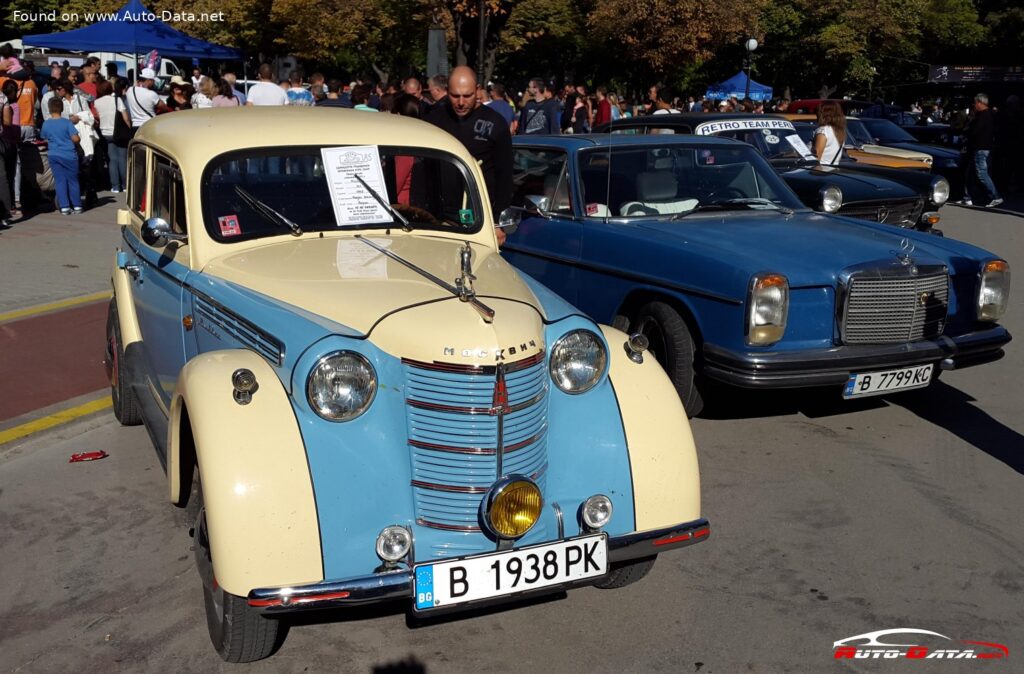
The Moskvich 401 was a Soviet-built automobile produced from 1954 to 1956. Representing a significant step forward for the Soviet automotive industry, the 401 was intended to provide a modern, reliable vehicle for the burgeoning post-war Soviet populace. While never officially exported to the United States, the Moskvich 401 holds a notable place in automotive history as a symbol of Soviet engineering and design during the Cold War era. It was a key model in establishing Moskvich as a prominent car manufacturer within the Eastern Bloc, and served as a foundation for subsequent models.
Moskvich 401: A Soviet Automotive Milestone
The Moskvich 401 emerged from a period of reconstruction and industrialization in the Soviet Union. Following World War II, there was a growing demand for personal transportation, but limited domestic production capacity. The 401 was designed to address this need, drawing inspiration from contemporary Western designs, particularly those from Germany. It was a relatively simple, robust vehicle intended for everyday use, prioritizing durability and ease of maintenance over luxury or high performance. The model was produced at the Moscow Automobile Plant (Moskvich), hence the name.
Engine & Performance
The Moskvich 401 was powered by a 1.1-liter (1070 cm3 or 65.3 cu. in.) inline four-cylinder engine. This engine produced 26 horsepower at 4000 rpm and 58 Nm (42.78 lb.-ft.) of torque at 2200 rpm. While modest by modern standards, this output was considered adequate for the vehicle’s intended purpose and weight. The engine featured a compression ratio of 6.27:1 and utilized a carburetor fuel injection system. Power delivery was managed through a three-speed manual transmission, driving the rear wheels. The car’s top speed was approximately 90 km/h (55.92 mph). The weight-to-power ratio was 30 kg/Hp, and the weight-to-torque ratio was 13.4 kg/Nm. Fuel consumption was rated at 9 liters per 100 kilometers (26.1 US mpg or 31.4 UK mpg).
Design & Features
The Moskvich 401 was a four-door sedan with a relatively streamlined body for its time. Its design incorporated elements of both pre-war and contemporary automotive styling. The body was constructed using a steel unibody, a relatively advanced feature for a Soviet-built car of the era. The interior was spartan but functional, offering seating for four passengers. Features were minimal, reflecting the car’s focus on practicality and affordability. Braking was provided by drum brakes on all four wheels. The steering system employed a cone worm with recirculation balls. Suspension consisted of a trailing arm setup at the front and leaf springs at the rear. The vehicle’s dimensions were 3855 mm (151.77 in.) in length, 1400 mm (55.12 in.) in width, and 1555 mm (61.22 in.) in height, with a wheelbase of 2340 mm (92.13 in.).
Technical Specifications
| Brand | Moskvich |
| Model | 401 |
| Generation | 401 |
| Type (Engine) | 1.1 (26 Hp) |
| Start of production | 1954 |
| End of production | 1956 |
| Powertrain Architecture | Internal Combustion engine |
| Body type | Sedan |
| Seats | 4 |
| Doors | 4 |
| Fuel consumption (combined) | 9 l/100 km (26.1 US mpg, 31.4 UK mpg, 11.1 km/l) |
| Fuel Type | Petrol (Gasoline) |
| Maximum speed | 90 km/h (55.92 mph) |
| Weight-to-power ratio | 30 kg/Hp |
| Weight-to-torque ratio | 13.4 kg/Nm |
| Power | 26 Hp @ 4000 rpm |
| Power per litre | 24.3 Hp/l |
| Torque | 58 Nm @ 2200 rpm (42.78 lb.-ft. @ 2200 rpm) |
| Engine layout | Front, Longitudinal |
| Engine displacement | 1070 cm3 (65.3 cu. in.) |
| Number of cylinders | 4 |
| Engine configuration | Inline |
| Cylinder Bore | 67.5 mm (2.66 in.) |
| Piston Stroke | 75 mm (2.95 in.) |
| Compression ratio | 6.27:1 |
| Number of valves per cylinder | 2 |
| Fuel injection system | Carburettor |
| Engine aspiration | Naturally aspirated engine |
| Kerb Weight | 780 kg (1719.61 lbs.) |
| Max. weight | 1155 kg (2546.34 lbs.) |
| Max load | 375 kg (826.73 lbs.) |
| Fuel tank capacity | 31 l (8.19 US gal | 6.82 UK gal) |
| Length | 3855 mm (151.77 in.) |
| Width | 1400 mm (55.12 in.) |
| Height | 1555 mm (61.22 in.) |
| Wheelbase | 2340 mm (92.13 in.) |
| Front track | 1105 mm (43.5 in.) |
| Rear track | 1168 mm (45.98 in.) |
| Drivetrain Architecture | Rear wheel drive (ICE) |
| Drive wheel | Rear wheel drive |
| Number of gears and type of gearbox | 3 gears, manual transmission |
| Front suspension | Trailing arm |
| Rear suspension | Leaf spring |
| Front brakes | Drum |
| Rear brakes | Drum |
| Steering type | Cone worm with recirculation balls |
| Tires size | 130/80 R16 |
| Wheel rims size | 16 |
The Moskvich 401, though relatively simple in its design and performance, played a crucial role in the motorization of the Soviet Union. It provided a much-needed affordable and reliable means of transportation for a growing segment of the population. While quickly superseded by later, more advanced Moskvich models, the 401 remains a significant artifact of Soviet automotive history, representing a period of post-war recovery and industrial development.
