
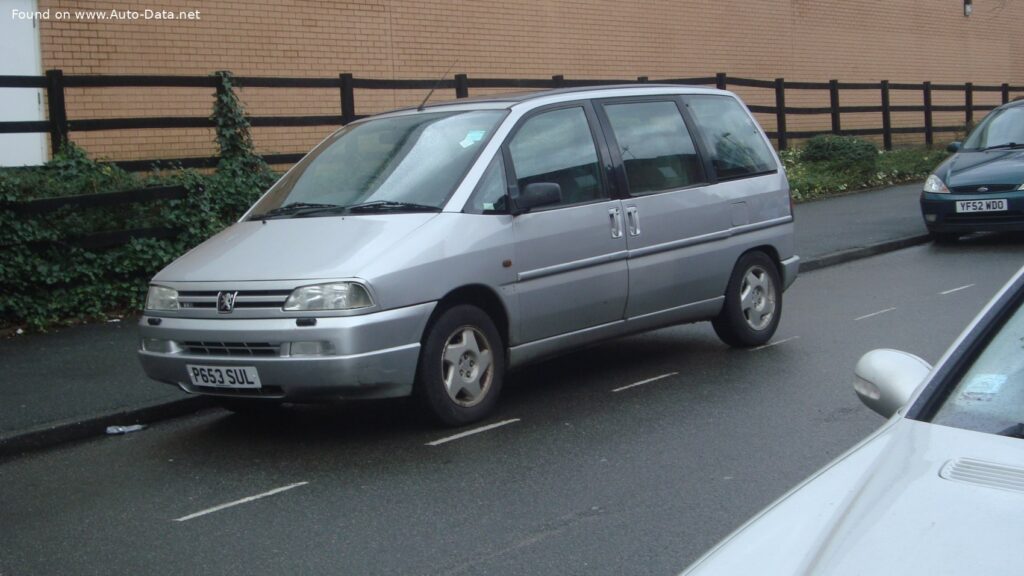
The Peugeot 806, produced between 1995 and 2002, represents a significant entry by Peugeot into the increasingly popular European minivan segment. Designated as the ‘221’ series, the 806 was designed as a spacious and practical vehicle aimed at families and those requiring versatile passenger or cargo carrying capabilities. While never officially sold in the United States, the 806 was a key competitor to models like the Renault Espace and Citroën Evasion (which shared much of its underlying engineering) in the European market. This article details the specifications and characteristics of the 806 equipped with the 1.8-liter, 99 horsepower engine.
Peugeot 806 (221) 1.8: A Detailed Overview
The Peugeot 806 was part of a collaborative effort between Peugeot and Citroën, resulting in the shared development of the 806 and its sister vehicle, the Citroën Evasion (and later, the Citroën Synergie). This collaboration allowed both manufacturers to share development costs and benefit from economies of scale. The 806 distinguished itself with Peugeot’s styling cues and interior appointments. The 1.8-liter engine variant was positioned as the entry-level option, prioritizing fuel economy and affordability over outright performance. It served as a practical choice for buyers who valued space and functionality above all else.
Engine & Performance
The Peugeot 806 1.8 utilizes a 1762 cc (107.52 cubic inches) inline four-cylinder gasoline engine, designated the LFW XU7JP. This naturally aspirated engine produces 99 horsepower at 5750 rpm and 147 Nm (108.42 lb.-ft.) of torque at 2600 rpm. The engine features a multi-port fuel injection system and a double overhead camshaft (DOHC) valvetrain with two valves per cylinder. While not a performance-oriented engine, it provided adequate power for everyday driving and load-carrying duties. Acceleration from 0 to 100 km/h (0-62 mph) takes 16.2 seconds, and 0 to 60 mph is achieved in approximately 15.4 seconds. The top speed is rated at 165 km/h (102.53 mph). The power-to-weight ratio is 14.6 kg/Hp, and the torque-to-weight ratio is 9.8 kg/Nm. Fuel consumption is rated at 13.2 l/100 km (17.8 US mpg) in urban conditions and 8.6 l/100 km (27.4 US mpg) on the extra-urban cycle.
Design & Features
The Peugeot 806 is a five-door minivan with a seating capacity of five passengers. Its body style prioritizes interior space and practicality. A key feature of the 806 is its modular interior, allowing for flexible seating configurations and a substantial cargo area. The rear seats can be folded, tumbled, or even removed entirely to maximize cargo capacity, ranging from a minimum of 340 liters (12.01 cubic feet) to a maximum of 3300 liters (116.54 cubic feet) with all rear seats removed. The 806 offered a relatively high level of equipment for its time, including hydraulic power steering and an anti-lock braking system (ABS). The design, while functional, was typical of the mid-1990s, with a focus on maximizing interior volume rather than aggressive styling. The large windows and upright design contribute to good visibility for both the driver and passengers.
Technical Specifications
| Brand | Peugeot |
| Model | 806 |
| Generation | 806 (221) |
| Type (Engine) | 1.8 (99 Hp) |
| Start of production | 1995 |
| End of production | 2002 |
| Powertrain Architecture | Internal Combustion engine |
| Body type | Minivan |
| Seats | 5 |
| Doors | 5 |
| Fuel consumption (urban) | 13.2 l/100 km (17.8 US mpg) |
| Fuel consumption (extra urban) | 8.6 l/100 km (27.4 US mpg) |
| Fuel Type | Petrol (Gasoline) |
| Acceleration 0 – 100 km/h | 16.2 sec |
| Acceleration 0 – 62 mph | 16.2 sec |
| Acceleration 0 – 60 mph | 15.4 sec |
| Maximum speed | 165 km/h (102.53 mph) |
| Weight-to-power ratio | 14.6 kg/Hp |
| Weight-to-torque ratio | 9.8 kg/Nm |
| Power | 99 Hp @ 5750 rpm |
| Torque | 147 Nm @ 2600 rpm (108.42 lb.-ft. @ 2600 rpm) |
| Engine layout | Front, Transverse |
| Engine Model/Code | LFW XU7JP |
| Engine displacement | 1762 cm3 (107.52 cu. in.) |
| Number of cylinders | 4 |
| Engine configuration | Inline |
| Cylinder Bore | 83 mm (3.27 in.) |
| Piston Stroke | 81.4 mm (3.2 in.) |
| Compression ratio | 9.25:1 |
| Number of valves per cylinder | 2 |
| Fuel injection system | Multi-port manifold injection |
| Engine aspiration | Naturally aspirated |
| Valvetrain | DOHC |
| Engine oil capacity | 4.25 l (4.49 US qt | 3.74 UK qt) |
| Coolant capacity | 8.5 l (8.98 US qt | 7.48 UK qt) |
| Kerb Weight | 1445 kg (3185.68 lbs.) |
| Max. weight | 2085 kg (4596.64 lbs.) |
| Max load | 640 kg (1410.96 lbs.) |
| Trunk (boot) space – minimum | 340 l (12.01 cu. ft.) |
| Trunk (boot) space – maximum | 3300 l (116.54 cu. ft.) |
| Fuel tank capacity | 80 l (21.13 US gal | 17.6 UK gal) |
| Length | 4454 mm (175.35 in.) |
| Width | 1834 mm (72.2 in.) |
| Height | 1714 mm (67.48 in.) |
| Wheelbase | 2824 mm (111.18 in.) |
| Front track | 1534 mm (60.39 in.) |
| Rear track | 1540 mm (60.63 in.) |
| Drivetrain Architecture | Front wheel drive |
| Number of gears | 5 |
| Gearbox type | Manual transmission |
| Front suspension | Wishbone |
| Rear suspension | Coil spring |
| Front brakes | Ventilated discs |
| Rear brakes | Drum |
| Assisting systems | ABS (Anti-lock braking system) |
| Steering type | Steering rack and pinion |
| Power steering | Hydraulic |
| Tires size | 195/70 R14 |
The Peugeot 806, particularly the 1.8-liter variant, offered a practical and spacious solution for families in Europe during the late 1990s and early 2000s. While not known for its performance, its versatility, comfortable ride, and relatively affordable price point made it a popular choice in its segment. Its collaborative development with Citroën demonstrated a forward-thinking approach to automotive manufacturing, allowing both brands to compete effectively in the growing minivan market.
