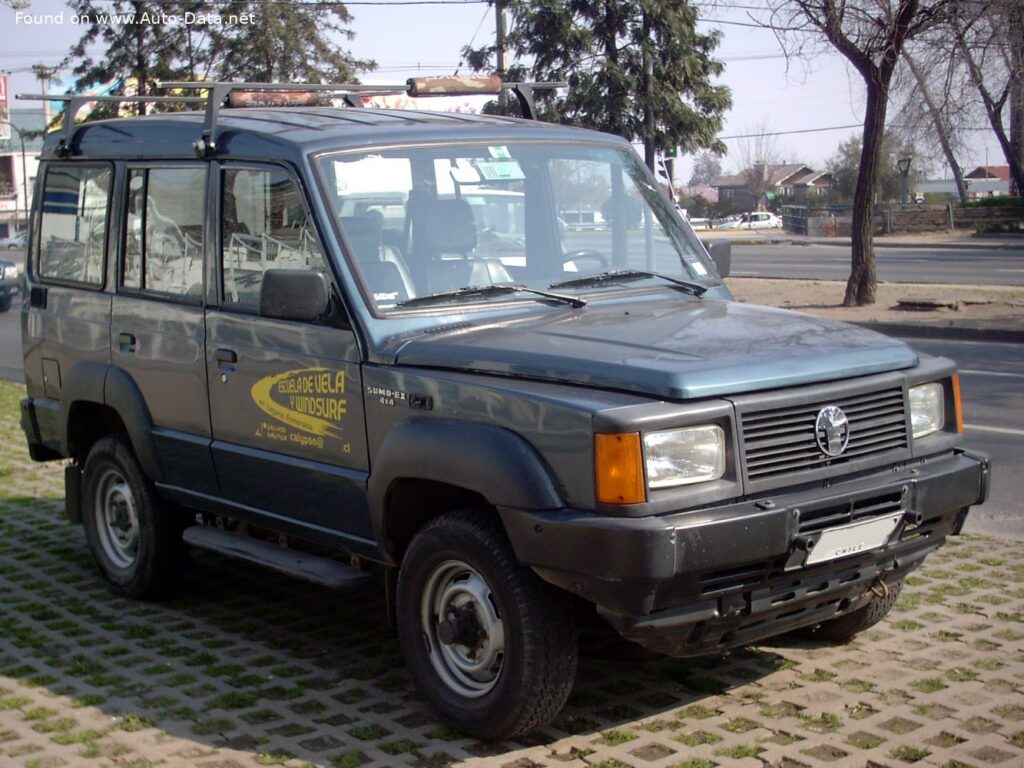
The Tata Sumo 1.9 D is a utility vehicle produced by the Indian manufacturer Tata Motors from 1996 to 2004. While largely unknown in North American markets, the Sumo played a significant role in the Indian automotive landscape, offering a robust and affordable transportation solution, particularly in rural areas and as a commercial vehicle. It was designed to cater to the demand for a multi-purpose vehicle capable of handling both passenger and cargo duties on varied terrains. The Sumo was not intended as a luxury vehicle, but rather as a practical and durable workhorse, and its design reflected this purpose.
The Tata Sumo 1.9 D: A Versatile Utility Vehicle
The Tata Sumo 1.9 D occupied a unique niche in the Indian market. It wasn’t directly comparable to American SUVs of the same era, but rather filled a role similar to a stripped-down, body-on-frame van or a rugged station wagon. It was popular with families, businesses, and as a shared transport option in regions where paved roads were less common. The vehicle’s success stemmed from its relatively low cost, simple mechanical design, and ability to withstand harsh operating conditions. It represented a significant step in providing accessible motorized transport to a wider segment of the Indian population.
Engine & Performance
The heart of the Tata Sumo 1.9 D was a 1.9-liter inline-four cylinder diesel engine. This engine produced 68 horsepower at 4500 rpm and 118 Nm (87.03 lb.-ft.) of torque at 2500 rpm. While these figures are modest by modern standards, they were adequate for the vehicle’s intended purpose and the road conditions prevalent in its primary market. The engine featured precombustion chamber injection, a common diesel technology of the time, and a naturally aspirated configuration. The engine’s longitudinal front-engine layout contributed to its robust drivetrain. The Sumo’s power-to-weight ratio was approximately 25 kg/Hp (40 Hp/tonne), and its torque-to-weight ratio was 14.4 kg/Nm (69.4 Nm/tonne). The vehicle had a top speed of 106 km/h (65.87 mph). Fuel economy figures were 14 l/100 km (16.8 US mpg, 20.2 UK mpg, 7.1 km/l) in urban settings, 9 l/100 km (26.1 US mpg, 31.4 UK mpg, 11.1 km/l) on the open road, and a combined figure of 9.9 l/100 km (23.8 US mpg, 28.5 UK mpg, 10.1 km/l).
Design & Features
The Tata Sumo 1.9 D was a four-door, five-seat off-road vehicle with a body-on-frame construction. This construction method, common in trucks and older SUVs, provided significant durability and off-road capability. The vehicle’s styling was utilitarian, prioritizing functionality over aesthetics. It featured a relatively boxy shape, maximizing interior space. The Sumo’s all-wheel-drive (4×4) system, coupled with its robust suspension – a double wishbone setup in the front and coil springs in the rear – allowed it to navigate challenging terrain. Braking was handled by disc brakes in the front and drum brakes in the rear, with an Anti-lock Braking System (ABS) included as a safety feature. The Sumo’s tires were size 195/80 R15. The vehicle’s dimensions were 4450 mm (175.2 in) in length, 1765 mm (69.49 in) in width, and 2080 mm (81.89 in) in height, with a wheelbase of 2400 mm (94.49 in). The front and rear tracks measured 1468 mm (57.8 in) and 1450 mm (57.09 in) respectively.
Technical Specifications
| Brand | Tata |
| Model | Sumo |
| Generation | Sumo |
| Type (Engine) | 1.9 D (68 Hp) |
| Start of production | 1996 |
| End of production | 2004 |
| Powertrain Architecture | Internal Combustion engine |
| Body type | Off-road vehicle |
| Seats | 5 |
| Doors | 4 |
| Fuel consumption (urban) | 14 l/100 km (16.8 US mpg, 20.2 UK mpg, 7.1 km/l) |
| Fuel consumption (extra urban) | 9 l/100 km (26.1 US mpg, 31.4 UK mpg, 11.1 km/l) |
| Fuel consumption (combined) | 9.9 l/100 km (23.8 US mpg, 28.5 UK mpg, 10.1 km/l) |
| Fuel Type | Diesel |
| Maximum speed | 106 km/h (65.87 mph) |
| Weight-to-power ratio | 25 kg/Hp |
| Weight-to-torque ratio | 14.4 kg/Nm |
| Power | 68 Hp @ 4500 rpm |
| Torque | 118 Nm @ 2500 rpm (87.03 lb.-ft. @ 2500 rpm) |
| Engine layout | Front, Longitudinal |
| Engine displacement | 1948 cm3 (118.87 cu. in.) |
| Number of cylinders | 4 |
| Engine configuration | Inline |
| Cylinder Bore | 83 mm (3.27 in.) |
| Piston Stroke | 90 mm (3.54 in.) |
| Compression ratio | 22.5:1 |
| Number of valves per cylinder | 2 |
| Fuel injection system | Precombustion chamber injection |
| Engine aspiration | Naturally aspirated |
| Valvetrain | OHC |
| Kerb Weight | 1700 kg (3747.86 lbs.) |
| Max. weight | 2150 kg (4739.94 lbs.) |
| Max load | 450 kg (992.08 lbs.) |
| Fuel tank capacity | 50 l (13.21 US gal | 11 UK gal) |
| Length | 4450 mm (175.2 in.) |
| Width | 1765 mm (69.49 in.) |
| Height | 2080 mm (81.89 in.) |
| Wheelbase | 2400 mm (94.49 in.) |
| Front track | 1468 mm (57.8 in.) |
| Rear track | 1450 mm (57.09 in.) |
| Drive wheel | All wheel drive (4×4) |
| Number of gears | 5 |
| Gearbox type | Manual transmission |
| Front suspension | Double wishbone |
| Rear suspension | Coil spring |
| Front brakes | Disc |
| Rear brakes | Drum |
| Assisting systems | ABS (Anti-lock braking system) |
| Tires size | 195/80 R15 |
The Tata Sumo 1.9 D, while not a sophisticated vehicle by modern standards, served a vital role in the Indian transportation sector. Its durability, affordability, and all-wheel-drive capability made it a popular choice for those needing a reliable and versatile vehicle capable of handling challenging conditions. It represents a significant chapter in the development of the Indian automotive industry and the increasing accessibility of personal transportation.