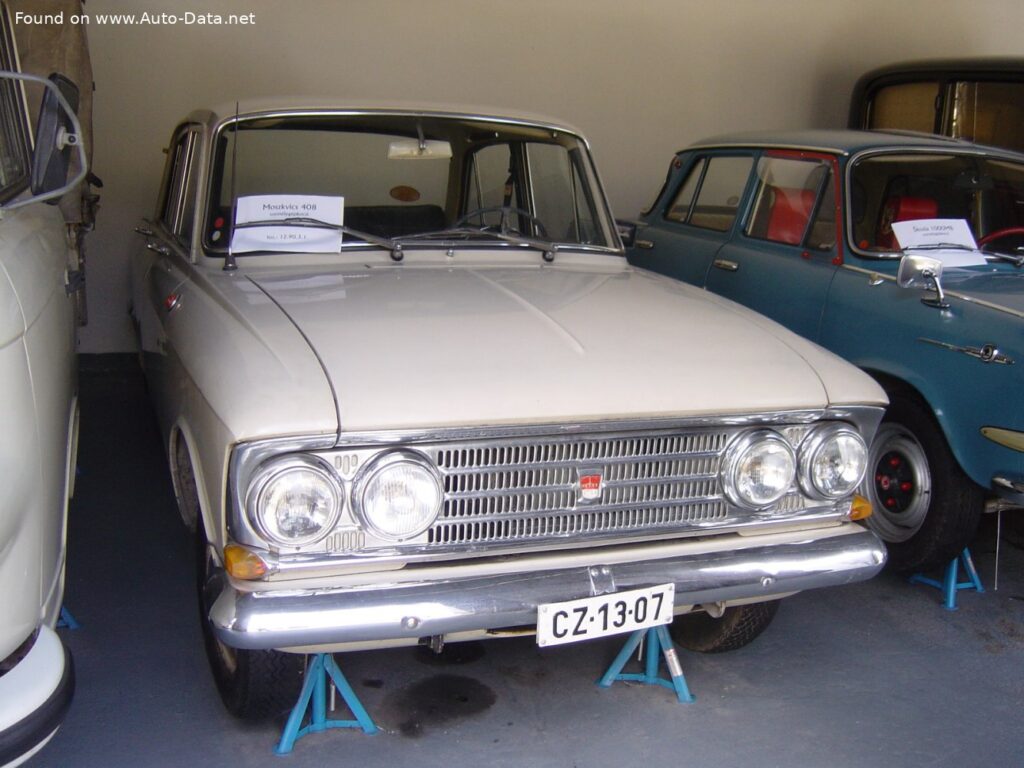
The Moskvich 408 IE 1.4, producing 50 horsepower, was a significant automobile in the Soviet automotive landscape, manufactured from 1969 to 1975. Representing a modernization of the earlier Moskvich 403 and 407 models, the 408 aimed to provide a more comfortable and reliable vehicle for the Soviet populace. While never officially exported to the United States, the Moskvich 408 found a niche in Eastern European markets and served as a symbol of Soviet engineering during the Cold War era. It occupied the compact family sedan segment, offering basic transportation for a growing urban population.
The Moskvich 408 IE: A Soviet Family Sedan
The “IE” designation in the 408 IE signifies an improved export version, featuring refinements in trim and equipment compared to domestically-marketed models. Though basic by Western standards, the 408 represented a step forward in Soviet automotive design, incorporating features like a more spacious interior and improved suspension. It was intended to be a practical and durable vehicle, capable of withstanding the harsh road conditions prevalent in many parts of the Soviet Union. The car’s design reflected the aesthetic trends of the late 1960s, with a boxy silhouette and chrome detailing.
Engine & Performance
The Moskvich 408 IE was powered by a 1.4-liter (1358 cc) inline-four cylinder engine, designated the AZ L K-408. This engine produced 50 horsepower at 4750 rpm and 92 Nm (67.86 lb.-ft.) of torque at 2750 rpm. While modest by modern standards, this output was typical for vehicles in its class during the late 1960s and early 1970s. The engine featured a 7:1 compression ratio and utilized a carburetor fuel injection system. Power was delivered to the rear wheels via a four-speed manual transmission. The car’s longitudinal front-engine, rear-wheel-drive layout was conventional for the period.
Performance figures reflected the car’s modest power output. Acceleration from 0 to 100 km/h (0-62 mph) took approximately 33 seconds, while 0 to 60 mph was achieved in around 31.4 seconds. The top speed was limited to 120 km/h (74.56 mph). The weight-to-power ratio was 19.8 kg/Hp, or 50.5 Hp/tonne, indicating a relatively heavy vehicle for its power. The weight-to-torque ratio was 10.8 kg/Nm, or 92.9 Nm/tonne. These figures highlight the car’s focus on durability and practicality rather than outright performance.
Design & Features
The Moskvich 408 IE was a four-door sedan with a five-seat capacity. Its body style was characterized by a boxy shape, typical of Soviet automotive design of the era. The car’s exterior featured chrome trim around the windows, bumpers, and grille. The interior was relatively spartan, with simple instrumentation and durable upholstery. While not luxurious, the 408 offered a reasonable level of comfort for its intended purpose.
Safety features were limited by the standards of the time. The car was equipped with drum brakes on all four wheels, and lacked features such as seatbelts or airbags. Suspension consisted of a double wishbone setup at the front and a leaf spring arrangement at the rear. The car’s relatively simple construction made it relatively easy to maintain and repair, a crucial consideration in the Soviet Union where access to specialized automotive services was often limited. The fuel tank capacity was 46 liters (12.15 US gallons).
Technical Specifications
| Brand | Moskvich |
| Model | 408 |
| Generation | 408 IE |
| Type (Engine) | 1.4 (50 Hp) |
| Start of production | 1969 |
| End of production | 1975 |
| Powertrain Architecture | Internal Combustion engine |
| Body type | Sedan |
| Seats | 5 |
| Doors | 4 |
| Fuel Type | Petrol (Gasoline) |
| Acceleration 0 – 100 km/h | 33 sec |
| Acceleration 0 – 62 mph | 33 sec |
| Acceleration 0 – 60 mph | 31.4 sec |
| Maximum speed | 120 km/h / 74.56 mph |
| Weight-to-power ratio | 19.8 kg/Hp |
| Weight-to-torque ratio | 10.8 kg/Nm |
| Power | 50 Hp @ 4750 rpm |
| Power per litre | 36.8 Hp/l |
| Torque | 92 Nm @ 2750 rpm / 67.86 lb.-ft. @ 2750 rpm |
| Engine layout | Front, Longitudinal |
| Engine Model/Code | AZ L K-408 |
| Engine displacement | 1358 cm3 / 82.87 cu. in. |
| Number of cylinders | 4 |
| Engine configuration | Inline |
| Cylinder Bore | 76 mm / 2.99 in. |
| Piston Stroke | 75 mm / 2.95 in. |
| Compression ratio | 7:1 |
| Number of valves per cylinder | 2 |
| Fuel injection system | Carburettor |
| Engine aspiration | Naturally aspirated engine |
| Kerb Weight | 990 kg / 2182.58 lbs |
| Max. weight | 1330 kg / 2932.15 lbs |
| Max load | 340 kg / 749.57 lbs |
| Fuel tank capacity | 46 l / 12.15 US gal | 10.12 UK gal |
| Length | 4090 mm / 161.02 in. |
| Width | 1550 mm / 61.02 in. |
| Height | 1480 mm / 58.27 in. |
| Wheelbase | 2400 mm / 94.49 in. |
| Front track | 1237 mm / 48.7 in. |
| Rear (Back) track | 1277 mm / 50.28 in. |
| Drivetrain Architecture | The Internal combustion engine (ICE) drives the rear wheels of the vehicle. |
| Drive wheel | Rear wheel drive |
| Number of gears and type of gearbox | 4 gears, manual transmission |
| Front suspension | Double wishbone |
| Rear suspension | Leaf spring |
| Front brakes | Drum |
| Rear brakes | Drum |
The Moskvich 408 IE, while not a technological marvel, played an important role in providing affordable transportation to millions of people in the Soviet Union and its satellite states. Its simple design, durability, and ease of maintenance made it a popular choice for families and individuals alike. Though largely unknown in the West, the 408 remains a significant piece of automotive history, representing a unique chapter in the development of the automobile industry behind the Iron Curtain.