
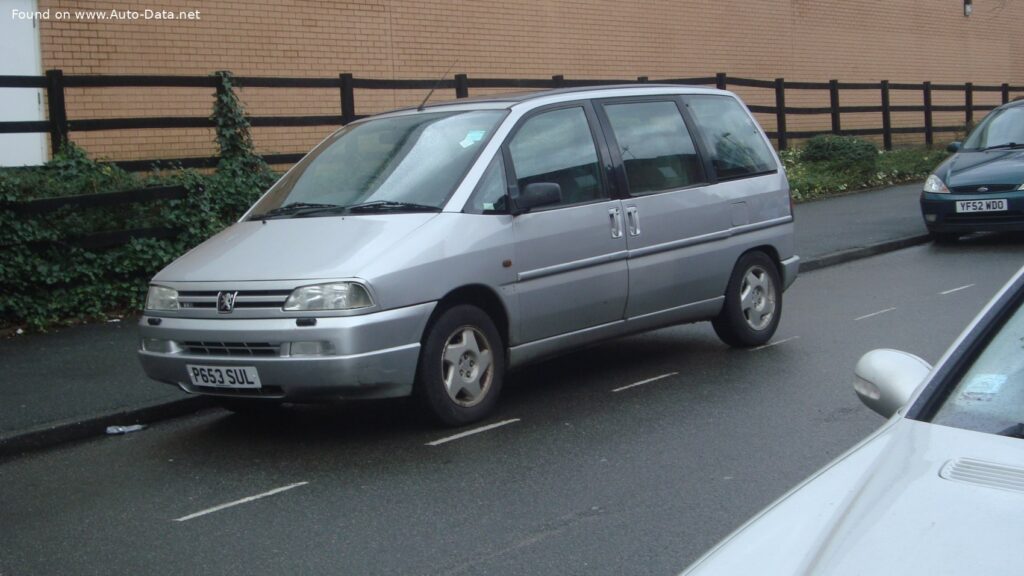
The Peugeot 806, produced between 1994 and 2002, represents a significant entry by Peugeot into the large, multi-purpose vehicle (MPV) segment. Designed as a spacious and practical family vehicle, the 806 was a collaborative effort with Fiat and Lancia, resulting in the closely related Fiat Ulysse and Lancia Zeta. While not officially sold in the United States, the 806 was a popular choice in Europe for families needing a versatile vehicle capable of carrying passengers and cargo comfortably. The 806 (221) designation refers to a specific iteration of the model, powered by a 2.0-liter gasoline engine producing 121 horsepower.
Peugeot 806 (221): A European MPV
The Peugeot 806 aimed to provide a comfortable and functional alternative to traditional station wagons and vans. It distinguished itself with a focus on passenger comfort and a relatively refined driving experience for its class. The MPV segment was gaining traction in Europe during the 1990s, driven by changing family needs and a desire for vehicles that could handle both daily commutes and weekend adventures. The 806, along with its sister vehicles, helped define the early standards for this growing market segment. Its modular interior, with configurable seating, was a key selling point, allowing owners to adapt the vehicle to various needs.
Engine & Performance
The 806 (221) is equipped with a 1.998-liter inline four-cylinder gasoline engine, designated RFU XU10J2C. This naturally aspirated engine produces 121 horsepower at 5750 rpm and 176 Nm (129.81 lb-ft) of torque at 2750 rpm. Power delivery is managed through a five-speed manual transmission, driving the front wheels. Performance figures reflect the vehicle’s focus on practicality rather than outright speed. Acceleration from 0 to 100 km/h (0-62 mph) takes 14.6 seconds, while 0 to 60 mph is achieved in 13.9 seconds. The top speed is rated at 177 km/h (109.98 mph). The engine’s power-to-weight ratio is 13.1 kg/Hp, and the torque-to-weight ratio is 9 kg/Nm. Fuel consumption is rated at 14.1 l/100 km (16.7 US mpg) in urban conditions and 8.6 l/100 km (27.4 US mpg) on the open road.
Design & Features
The Peugeot 806 is a five-door minivan with a spacious interior designed to accommodate up to five passengers. Its body style prioritizes maximizing interior volume and accessibility. Key design features include a high roofline, large windows, and sliding rear doors, facilitating easy entry and exit, particularly in tight parking spaces. The interior is characterized by its modularity, with seats that can be folded, tumbled, or even removed entirely to create a large cargo area. The trunk space ranges from a minimum of 340 liters (12.01 cu. ft.) with all seats in place to a maximum of 3300 liters (116.54 cu. ft.) with the rear seats folded or removed. Safety features for the era included an Anti-lock Braking System (ABS), which was becoming increasingly common on European vehicles during the mid-1990s. The steering utilizes a hydraulic power steering system for ease of maneuverability, and the suspension consists of wishbone front suspension and coil springs in the rear. The vehicle rides on 195/65 R15 tires.
Technical Specifications
| Brand | Peugeot |
| Model | 806 |
| Generation | 806 (221) |
| Type (Engine) | 2.0 (121 Hp) |
| Start of production | 1994 |
| End of production | 2002 |
| Powertrain Architecture | Internal Combustion engine |
| Body type | Minivan |
| Seats | 5 |
| Doors | 5 |
| Fuel consumption (urban) | 14.1 l/100 km (16.7 US mpg, 20 UK mpg, 7.1 km/l) |
| Fuel consumption (extra urban) | 8.6 l/100 km (27.4 US mpg, 32.8 UK mpg, 11.6 km/l) |
| Fuel Type | Petrol (Gasoline) |
| Acceleration 0 – 100 km/h | 14.6 sec |
| Acceleration 0 – 62 mph | 14.6 sec |
| Acceleration 0 – 60 mph | 13.9 sec |
| Maximum speed | 177 km/h (109.98 mph) |
| Weight-to-power ratio | 13.1 kg/Hp |
| Weight-to-torque ratio | 9 kg/Nm |
| Power | 121 Hp @ 5750 rpm |
| Torque | 176 Nm @ 2750 rpm (129.81 lb.-ft. @ 2750 rpm) |
| Engine layout | Front, Transverse |
| Engine Model/Code | RFU XU10J2C |
| Engine displacement | 1998 cm3 (121.93 cu. in.) |
| Number of cylinders | 4 |
| Engine configuration | Inline |
| Cylinder Bore | 86 mm (3.39 in.) |
| Piston Stroke | 86 mm (3.39 in.) |
| Compression ratio | 9.5:1 |
| Number of valves per cylinder | 2 |
| Fuel injection system | Multi-port manifold injection |
| Engine aspiration | Naturally aspirated |
| Valvetrain | OHC |
| Engine oil capacity | 4.5 l (4.76 US qt | 3.96 UK qt) |
| Coolant capacity | 8.5 l (8.98 US qt | 7.48 UK qt) |
| Kerb Weight | 1585 kg (3494.33 lbs.) |
| Max. weight | 2300 kg (5070.63 lbs.) |
| Max load | 715 kg (1576.31 lbs.) |
| Trunk (boot) space – minimum | 340 l (12.01 cu. ft.) |
| Trunk (boot) space – maximum | 3300 l (116.54 cu. ft.) |
| Fuel tank capacity | 80 l (21.13 US gal | 17.6 UK gal) |
| Length | 4454 mm (175.35 in.) |
| Width | 1834 mm (72.2 in.) |
| Height | 1714 mm (67.48 in.) |
| Wheelbase | 2824 mm (111.18 in.) |
| Front track | 1534 mm (60.39 in.) |
| Rear track | 1540 mm (60.63 in.) |
| Drivetrain Architecture | Front wheel drive |
| Number of gears | 5 |
| Gearbox type | Manual transmission |
| Front suspension | Wishbone |
| Rear suspension | Coil spring |
| Front brakes | Ventilated discs |
| Rear brakes | Drum |
| Assisting systems | ABS (Anti-lock braking system) |
| Steering type | Steering rack and pinion |
| Power steering | Hydraulic |
| Tires size | 195/65 R15 |
The Peugeot 806, while never officially available in the US market, remains a notable example of European MPV design. Its focus on practicality, spaciousness, and a relatively comfortable driving experience made it a popular choice for families during its production run. The 806’s collaborative development with Fiat and Lancia also highlights the increasing trend of platform sharing within the automotive industry during the 1990s.
