
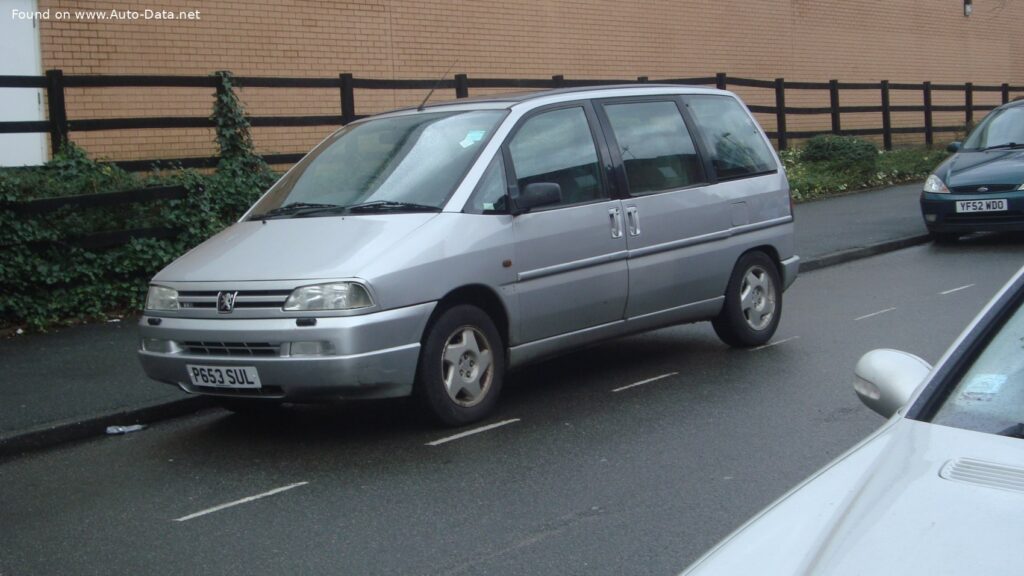
The Peugeot 806, produced between 1994 and 2002, was a large multi-purpose vehicle (MPV) designed to compete with offerings like the Renault Espace and Chrysler Voyager. While not officially sold in the United States, the 806 was a significant vehicle in the European market, offering a spacious and practical alternative to traditional station wagons and vans. The 2.0 HDI (221) variant, manufactured from 1999 to 2002, represented a move towards more fuel-efficient diesel technology, becoming a popular choice for families and those requiring a versatile vehicle. This article details the specifications and characteristics of the Peugeot 806 (221) 2.0 HDI (109 Hp) model.
Peugeot 806 (221) 2.0 HDI: Overview and Market Position
The 806 was part of a collaborative effort with Fiat and PSA (Peugeot Société Anonyme and Citroën), resulting in the shared development of the Eurovan platform. This platform underpinned not only the Peugeot 806 but also the Fiat Ulysse and Citroën Evasion/Synergie. The collaboration allowed for shared development costs and economies of scale. The 2.0 HDI version, introduced in 1999, capitalized on the growing demand for diesel engines in Europe, offering improved fuel economy and torque compared to earlier gasoline-powered models. The 806 aimed to provide a comfortable and practical solution for larger families or those needing to transport significant amounts of cargo, blending the space of a van with the comfort and features of a passenger car.
Engine & Performance
The Peugeot 806 (221) 2.0 HDI is powered by a 1,997 cc (121.86 cubic inches) inline-four cylinder diesel engine. This engine, designated RHZ DW10ATED, produces 109 horsepower at 4,000 rpm and 250 Nm (184.39 lb-ft) of torque at 1,750 rpm. The engine utilizes a turbocharger and a diesel common rail fuel injection system to optimize performance and fuel efficiency. The engine’s power-to-liter ratio is 54.6 hp/l. Acceleration from 0 to 100 km/h (0-62 mph) takes 15.8 seconds, while 0 to 60 mph is achieved in approximately 15 seconds. The vehicle has a maximum speed of 175 km/h (108.74 mph). The weight-to-power ratio is 15.3 kg/Hp, and the weight-to-torque ratio is 6.7 kg/Nm. The engine’s transverse mounting and front-wheel-drive configuration contribute to its packaging efficiency within the MPV body.
Design & Features
The Peugeot 806 is a five-door minivan capable of seating up to eight passengers. Its design prioritizes practicality and space, with a high roofline and a large interior volume. The rear seats can be folded or removed to create a substantial cargo area, ranging from a minimum of 340 liters (12.01 cubic feet) to a maximum of 3,300 liters (116.54 cubic feet) with all rear seats removed. The 806 features a relatively simple, functional interior design typical of the late 1990s and early 2000s. Standard features included power steering (hydraulic), and ABS (Anti-lock Braking System). Safety features, while not as comprehensive as modern vehicles, were considered adequate for the time. The 806’s design focused on maximizing interior space and usability, making it a popular choice for families and those needing a versatile vehicle for both passenger and cargo transport.
Technical Specifications
| Brand | Peugeot |
| Model | 806 |
| Generation | 806 (221) |
| Type (Engine) | 2.0 HDI (109 Hp) |
| Start of production | 1999 |
| End of production | 2002 |
| Powertrain Architecture | Internal Combustion engine |
| Body type | Minivan |
| Seats | 8 |
| Doors | 5 |
| Fuel consumption (combined) | 6.6 l/100 km (35.6 US mpg, 42.8 UK mpg, 15.2 km/l) |
| Fuel Type | Diesel |
| Acceleration 0 – 100 km/h | 15.8 sec |
| Acceleration 0 – 62 mph | 15.8 sec |
| Acceleration 0 – 60 mph | 15 sec |
| Maximum speed | 175 km/h (108.74 mph) |
| Weight-to-power ratio | 15.3 kg/Hp |
| Weight-to-torque ratio | 6.7 kg/Nm |
| Power | 109 Hp @ 4000 rpm |
| Power per litre | 54.6 Hp/l |
| Torque | 250 Nm @ 1750 rpm (184.39 lb.-ft. @ 1750 rpm) |
| Engine layout | Front, Transverse |
| Engine Model/Code | RHZ DW10ATED |
| Engine displacement | 1997 cm3 (121.86 cu. in.) |
| Number of cylinders | 4 |
| Engine configuration | Inline |
| Cylinder Bore | 85 mm (3.35 in.) |
| Piston Stroke | 88 mm (3.46 in.) |
| Compression ratio | 18:1 |
| Number of valves per cylinder | 2 |
| Fuel injection system | Diesel Commonrail |
| Engine aspiration | Turbocharger |
| Valvetrain | DOHC |
| Engine oil capacity | 4.5 l (4.76 US qt | 3.96 UK qt) |
| Coolant | 8 l (8.45 US qt | 7.04 UK qt) |
| Kerb Weight | 1670 kg (3681.72 lbs.) |
| Max. weight | 2395 kg (5280.07 lbs.) |
| Max load | 725 kg (1598.35 lbs.) |
| Trunk (boot) space – minimum | 340 l (12.01 cu. ft.) |
| Trunk (boot) space – maximum | 3300 l (116.54 cu. ft.) |
| Fuel tank capacity | 80 l (21.13 US gal | 17.6 UK gal) |
| Length | 4454 mm (175.35 in.) |
| Width | 1834 mm (72.2 in.) |
| Height | 1714 mm (67.48 in.) |
| Wheelbase | 2825 mm (111.22 in.) |
| Front track | 1534 mm (60.39 in.) |
| Rear (Back) track | 1540 mm (60.63 in.) |
| Drivetrain Architecture | Front wheel drive |
| Number of gears and type of gearbox | 5 gears, manual transmission |
| Front suspension | Wishbone |
| Rear suspension | Coil spring |
| Front brakes | Ventilated discs |
| Rear brakes | Disc |
| Assisting systems | ABS (Anti-lock braking system) |
| Steering type | Steering rack and pinion |
| Power steering | Hydraulic Steering |
| Tires size | 205/65R15 |
The Peugeot 806 2.0 HDI, while not a performance vehicle, offered a compelling combination of space, practicality, and fuel efficiency. Its collaborative development and focus on family needs cemented its position as a popular MPV in the European market during its production run.
