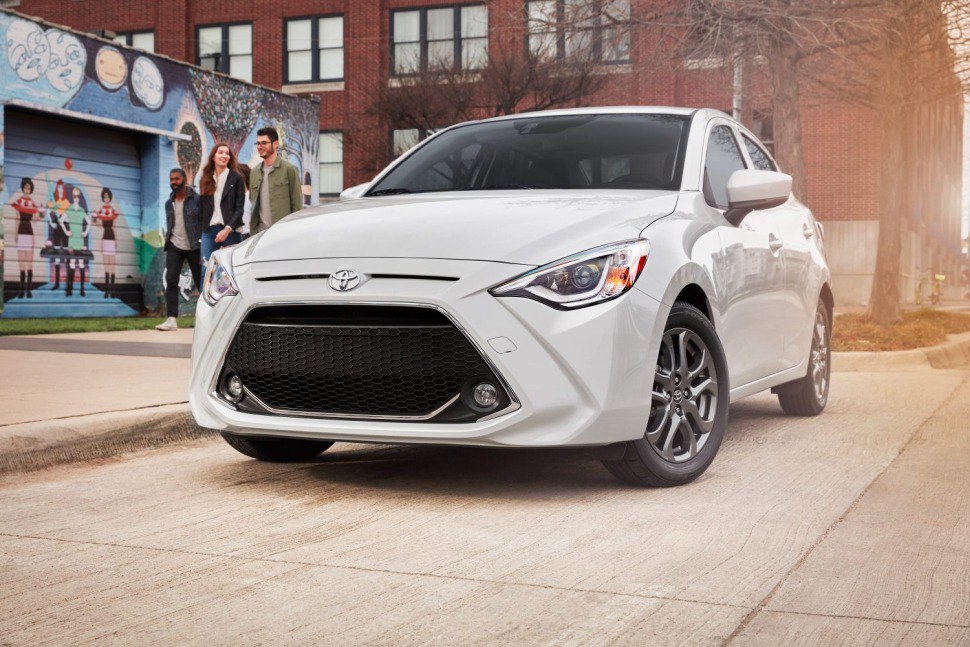
The Toyota Yaris Sedan, specifically the facelifted version introduced for the 2019 model year, represents Toyota’s entry into the subcompact sedan market in the United States. While the Yaris nameplate has a long history globally, the sedan variant was primarily aimed at buyers seeking an affordable and fuel-efficient vehicle. This generation, produced from 2019 to 2020, was a rebadged version of the Mazda2 sedan, a result of Toyota’s partnership with Mazda. It occupied a crucial position for Toyota, offering a lower-priced alternative to the Corolla and appealing to first-time buyers or those prioritizing economy.
Toyota Yaris Sedan (USA) Facelift: An Overview
The 2019 facelift brought minor cosmetic updates to the Yaris Sedan, primarily focusing on the front fascia. These changes aimed to modernize the vehicle’s appearance and align it more closely with Toyota’s current design language. The Yaris Sedan competed with other subcompacts like the Nissan Versa, Kia Rio, and Hyundai Accent, emphasizing value and practicality. It was offered with a single engine and transmission combination, simplifying the buying process for consumers.
Engine & Performance
Powering the 2019-2020 Toyota Yaris Sedan is a 1.5-liter, naturally aspirated inline-four cylinder engine designated the 2NR-FE. This engine produces 106 horsepower at 6000 rpm and 140 Nm (103.26 lb.-ft.) of torque at 4000 rpm. While not designed for blistering acceleration, the engine provides adequate power for everyday driving situations. The engine’s power-to-weight ratio is 94.1 Hp/tonne, and the torque-to-weight ratio is 124.3 Nm/tonne. The engine features a double overhead camshaft (DOHC) valvetrain with Toyota’s VVT-i (Variable Valve Timing-intelligent) technology, optimizing efficiency and responsiveness. The engine is transversely mounted at the front of the vehicle and is paired exclusively with a six-speed automatic transmission, delivering smooth and convenient gear changes. Fuel economy figures are respectable, with combined fuel consumption rated at 6.7 l/100 km (35.1 US mpg, 42.2 UK mpg, 14.9 km/l). Urban driving yields 7.4 l/100 km (31.8 US mpg, 38.2 UK mpg, 13.5 km/l), while extra-urban driving achieves 5.9 l/100 km (39.9 US mpg, 47.9 UK mpg, 16.9 km/l).
Design & Features
The Toyota Yaris Sedan is a traditional four-door sedan with a relatively conservative design. The 2019 facelift brought a revised front grille, bumper, and headlights, giving the car a slightly more modern appearance. The interior is functional and straightforward, prioritizing practicality over luxury. It comfortably seats five passengers and offers a trunk capacity of 382 liters (13.49 cu. ft.). Standard features typically included air conditioning, power windows and locks, and a basic audio system. Safety features, while not as comprehensive as those found in larger vehicles, generally included anti-lock brakes (ABS) and airbags. The Yaris Sedan’s dimensions are as follows: length 4348 mm (171.18 in.), width 1694 mm (66.69 in.), and height 1486 mm (58.5 in.). The wheelbase measures 2570 mm (101.18 in.), and the front and rear tracks are 1496 mm (58.9 in.) and 1486 mm (58.5 in.), respectively. Ground clearance is 140 mm (5.51 in.).
Technical Specifications
| Brand | Toyota |
| Model | Yaris |
| Generation | Yaris Sedan (USA) (facelift 2019) |
| Type (Engine) | 1.5 (106 Hp) Automatic |
| Start of production | 2019 |
| End of production | 2020 |
| Powertrain Architecture | Internal Combustion engine |
| Body type | Sedan |
| Seats | 5 |
| Doors | 4 |
| Fuel consumption (urban) | 7.4 l/100 km (31.8 US mpg, 38.2 UK mpg, 13.5 km/l) |
| Fuel consumption (extra urban) | 5.9 l/100 km (39.9 US mpg, 47.9 UK mpg, 16.9 km/l) |
| Fuel consumption (combined) | 6.7 l/100 km (35.1 US mpg, 42.2 UK mpg, 14.9 km/l) |
| Fuel Type | Petrol (Gasoline) |
| Weight-to-power ratio | 10.6 kg/Hp |
| Power | 106 Hp @ 6000 rpm |
| Torque | 140 Nm @ 4000 rpm (103.26 lb.-ft. @ 4000 rpm) |
| Engine layout | Front, Transverse |
| Engine Model/Code | 2NR-FE |
| Engine displacement | 1496 cm3 (91.29 cu. in.) |
| Number of cylinders | 4 |
| Engine configuration | Inline |
| Number of valves per cylinder | 4 |
| Engine aspiration | Naturally aspirated |
| Valvetrain | DOHC, D-VVT-i |
| Engine oil capacity | 3.4 l (3.59 US qt | 2.99 UK qt) |
| Coolant capacity | 5.4 l (5.71 US qt | 4.75 UK qt) |
| Kerb Weight | 1126 kg (2482.41 lbs.) |
| Trunk (boot) space | 382 l (13.49 cu. ft.) |
| Fuel tank capacity | 44 l (11.62 US gal | 9.68 UK gal) |
| Length | 4348 mm (171.18 in.) |
| Width | 1694 mm (66.69 in.) |
| Height | 1486 mm (58.5 in.) |
| Wheelbase | 2570 mm (101.18 in.) |
| Minimum turning circle | 9.81 m (32.19 ft.) |
| Drivetrain | Front wheel drive |
| Number of gears | 6 |
| Gearbox type | Automatic transmission |
The Toyota Yaris Sedan (USA) facelifted version of 2019-2020, while not a groundbreaking vehicle, served a valuable purpose in the American market. It provided an affordable, reliable, and fuel-efficient option for budget-conscious buyers. Its discontinuation after the 2020 model year reflects a shift in Toyota’s strategy, with a greater focus on larger and more profitable models. However, the Yaris Sedan remains a noteworthy example of Toyota’s commitment to offering a diverse range of vehicles to meet the needs of various consumers.