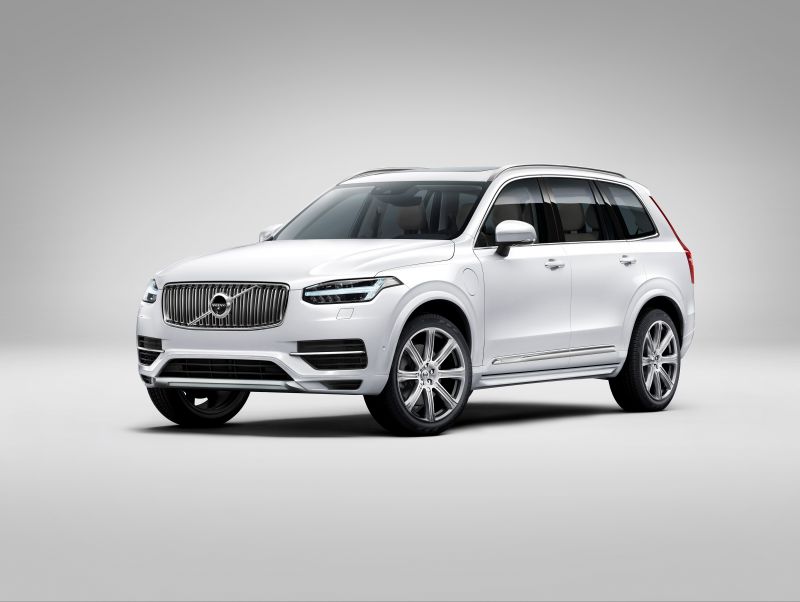
The Volvo XC90 II 2.0 D5 (235 Hp) AWD Automatic represents the second generation of Volvo’s flagship seven-seat SUV, launched in 2016. This model marked a significant departure for Volvo, introducing a new scalable product architecture (SPA) and a focus on Scandinavian luxury and advanced safety technology. While the XC90 was a mainstay in the European market, its second generation saw increased sales and recognition globally, including in the United States, where it competed with premium SUVs like the Audi Q7, BMW X5, and Mercedes-Benz GLE. The “D5” designation indicates a diesel engine variant, specifically tailored for markets where diesel fuel remained popular. Production of this specific configuration ran from 2016 to 2018.
Volvo XC90 II: A New Era of Scandinavian Luxury
The XC90 II was a pivotal model for Volvo, signaling a new design language and technological direction under the ownership of Geely. It moved away from the more angular designs of previous generations, embracing a softer, more sculpted aesthetic inspired by Scandinavian design principles. The interior prioritized minimalist elegance, high-quality materials, and a user-friendly infotainment system. The emphasis on safety, a long-standing Volvo hallmark, was further enhanced with a suite of advanced driver-assistance systems.
Engine & Performance
The 2.0 D5 variant of the XC90 II is powered by a 2.0-liter inline four-cylinder diesel engine, producing 235 horsepower at 4000 rpm and 480 Nm (354.03 lb.-ft.) of torque between 1750 and 2250 rpm. This engine utilizes twin-turbocharging and an intercooler to optimize performance and efficiency. Despite its relatively small displacement, the engine delivers ample power and torque for comfortable highway cruising and confident acceleration. The engine’s power-to-liter ratio is 119.3 Hp/l. Paired with an eight-speed automatic transmission and Volvo’s all-wheel-drive (AWD) system, the XC90 D5 achieves a 0-60 mph (0-96 km/h) time of approximately 7.4 seconds and a top speed of 136.7 mph (220 km/h). Fuel economy is rated at 5.7 l/100 km combined (41.3 US mpg, 49.6 UK mpg, 17.5 km/l), with urban consumption at 6.2 l/100 km (37.9 US mpg) and extra-urban at 5.4 l/100 km (43.6 US mpg). The engine meets Euro 6 emission standards and incorporates a particulate filter to reduce harmful emissions.
Design & Features
The Volvo XC90 II is a five-door SUV offering seating for up to seven passengers, depending on the configuration. Its exterior design is characterized by clean lines, a prominent grille with the Volvo iron mark, and distinctive “Thor’s Hammer” LED daytime running lights. The interior is a standout feature, boasting a minimalist dashboard, a large vertically-oriented touchscreen infotainment system, and premium materials such as leather, wood, and metal accents. Standard features typically included leather upholstery, power-adjustable front seats, a panoramic sunroof, and a premium sound system.
Safety was paramount in the XC90 II’s design. It came equipped with a comprehensive suite of driver-assistance systems, including City Safety (collision avoidance), Pilot Assist (semi-autonomous driving), Lane Keeping Aid, and Blind Spot Information System. These technologies contributed to the XC90’s excellent safety ratings. The vehicle’s dimensions are substantial, with a length of 4950 mm (194.88 in), a width of 2008 mm (79.06 in) with mirrors folded, and a height of 1776 mm (69.92 in). The wheelbase measures 2984 mm (117.48 in), providing a spacious cabin. The XC90 II also offers a maximum roof load capacity of 100 kg (220.46 lbs) and a fuel tank capacity of 71 liters (18.76 US gal).
Technical Specifications
| Brand | Volvo |
| Model | XC90 |
| Generation | XC90 II |
| Type (Engine) | 2.0 D5 (235 Hp) AWD Automatic |
| Start of production | 2016 |
| End of production | 2018 |
| Powertrain Architecture | Internal Combustion engine |
| Body type | SUV |
| Seats | 5-7 |
| Doors | 5 |
| Fuel consumption (urban) | 6.2 l/100 km (37.9 US mpg) |
| Fuel consumption (extra urban) | 5.4 l/100 km (43.6 US mpg) |
| Fuel consumption (combined) | 5.7 l/100 km (41.3 US mpg) |
| CO2 emissions | 149 g/km |
| Fuel Type | Diesel |
| Acceleration 0 – 100 km/h | 7.8 sec |
| Acceleration 0 – 62 mph | 7.8 sec |
| Acceleration 0 – 60 mph | 7.4 sec |
| Maximum speed | 220 km/h (136.7 mph) |
| Emission standard | Euro 6 |
| Power | 235 Hp @ 4000 rpm |
| Torque | 480 Nm @ 1750-2250 rpm (354.03 lb.-ft.) |
| Engine layout | Front, Transverse |
| Engine Model/Code | D4204T23 |
| Engine displacement | 1969 cm3 (120.16 cu. in.) |
| Number of cylinders | 4 |
| Engine configuration | Inline |
| Cylinder Bore | 82 mm (3.23 in.) |
| Piston Stroke | 93.2 mm (3.67 in.) |
| Compression ratio | 15.8:1 |
| Number of valves per cylinder | 4 |
| Fuel injection system | Diesel Commonrail |
| Engine aspiration | Twin-Turbo, Intercooler |
| Engine oil capacity | 5.2 l (5.49 US qt | 4.58 UK qt) |
| Fuel tank capacity | 71 l (18.76 US gal | 15.62 UK gal) |
| Max. roof load | 100 kg (220.46 lbs.) |
| Length | 4950 mm (194.88 in.) |
| Width with mirrors folded | 2008 mm (79.06 in.) |
| Width including mirrors | 2140 mm (84.25 in.) |
| Height | 1776 mm (69.92 in.) |
| Wheelbase | 2984 mm (117.48 in.) |
| Front track | 1665-1676 mm (65.55 – 65.98 in.) |
| Rear track | 1667-1679 mm (65.63 – 66.1 in.) |
| Ride height (ground clearance) | 227-267 mm (8.94 – 10.51 in.) |
| Drag coefficient (Cd) | 0.29 |
| Drive wheel | All wheel drive (4×4) |
| Number of gears and type of gearbox | 8 gears, automatic transmission |
| Front suspension | Double wishbone |
| Rear suspension | Independent coil spring |
| Front brakes | Ventilated discs |
| Rear brakes | Disc |
| Assisting systems | ABS (Anti-lock braking system) |
| Steering type | Steering rack and pinion |
| Power steering | Electric Steering |