
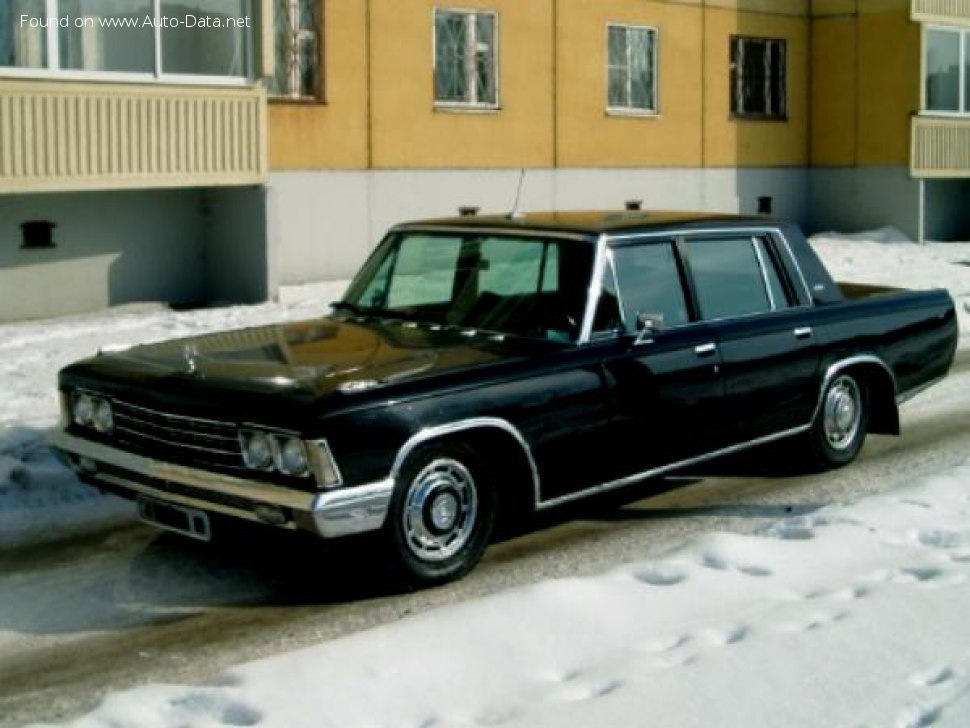
The ZIL 117, produced between 1971 and 1985, was a large, luxury sedan manufactured by the ZIL automotive factory in the Soviet Union. Representing a significant step down in size and complexity from the preceding ZIL 114, the 117 was intended to serve as a more practical and mass-producible vehicle while still maintaining a high level of comfort and prestige. The 7.0 V8 (303 Hp) variant, the focus of this article, occupied the top position within the 117 lineup, offering the highest level of performance and refinement available. It was positioned as a vehicle for high-ranking government officials and party members, as well as select members of the Soviet elite.
ZIL 117 7.0 V8 (303 Hp): Overview and Positioning
The ZIL 117 was developed as part of a broader effort to modernize the Soviet automotive industry. While the ZIL 114 was a hand-built, highly exclusive vehicle, the 117 aimed for a degree of series production, though it remained a relatively low-volume model. The 7.0 V8 variant was the flagship, distinguished by its larger engine and more luxurious appointments. Lower-specification 117s were equipped with smaller engines, primarily the ZIL 117 with a 5.5-liter V8, making the 7.0L version the most desirable and powerful option.
Comparison to Other 117 Variants
Compared to the 5.5-liter V8-equipped ZIL 117, the 7.0 V8 offered a substantial increase in power and torque. This translated to noticeably quicker acceleration and a higher top speed. While the 5.5L engine prioritized fuel economy (relatively speaking for a vehicle of this size), the 7.0L focused on providing effortless performance. The 7.0L also typically featured more comprehensive trim and comfort features, solidifying its position as the premium offering. Maintenance costs were higher for the 7.0L due to the larger engine and its associated components, but this was generally not a concern for the intended clientele.
Powertrain & Engine Architecture
The heart of the ZIL 117 7.0 V8 was its 6960 cc (424.73 cu. in.) naturally aspirated V8 engine. Designated as a ZIL-7.0, this engine featured a cast iron block and aluminum cylinder heads. It employed a carburetor fuel injection system, a common practice for Soviet automotive engineering of the period. The engine produced 303 horsepower at 4400 rpm and 570 Nm (420.41 lb.-ft.) of torque at 2700 rpm. The engine’s configuration was a 90-degree V8, with 2 valves per cylinder. Bore and stroke dimensions were 108 mm (4.25 in.) and 95 mm (3.74 in.) respectively, resulting in a compression ratio of 9.5:1.
The engine was longitudinally mounted in the front of the vehicle, driving the rear wheels. Power was transmitted through a 3-speed automatic transmission. This automatic gearbox, while providing convenience, was not known for its sophistication or efficiency. It was a robust unit designed for durability rather than sporty performance. The transmission’s gear ratios were optimized for smooth cruising and effortless acceleration, rather than maximizing fuel economy.
Driving Characteristics
The ZIL 117 7.0 V8 offered a driving experience characterized by smooth power delivery and a comfortable ride. The large displacement V8 provided ample torque throughout the rev range, making overtaking and hill climbing effortless. Acceleration from 0 to 62 mph (0-100 km/h) took approximately 13 seconds, which was respectable for a vehicle of its size and weight in the 1970s and 80s. The automatic transmission, while not particularly quick-shifting, contributed to the overall smoothness of the driving experience.
Compared to a hypothetical manual transmission version (which was not offered), the automatic would have resulted in some power loss and slower acceleration. However, the target audience for the 117 7.0 V8 prioritized comfort and ease of use over outright performance. The car’s substantial weight (2880 kg / 6349.31 lbs.) and relatively soft suspension tuning further emphasized its focus on comfort rather than sporty handling.
Equipment & Trim Levels
The ZIL 117 7.0 V8 was generously equipped, reflecting its status as a luxury vehicle. Standard features included power steering, power brakes, and a comprehensive instrument panel. The interior was typically upholstered in high-quality leather, with wood trim accents. The car comfortably seated seven passengers. Optional extras included a radio, air conditioning, and a sunroof. The exterior featured chrome trim and distinctive styling cues that set it apart from more mundane vehicles.
The dashboard layout was relatively conventional for the period, with a large speedometer and fuel gauge dominating the instrument cluster. The interior was designed to provide a sense of spaciousness and luxury, with ample legroom and headroom for all passengers.
Chassis & Braking
The ZIL 117 featured a body-on-frame construction, providing a robust and durable chassis. The front suspension utilized coil springs, while the rear suspension employed leaf springs. This combination provided a comfortable ride, but it also resulted in some body roll during cornering. The car was equipped with disc brakes on the front wheels and drum brakes on the rear wheels. An anti-lock braking system (ABS) was included as a standard feature, a relatively advanced addition for a Soviet-built vehicle of the era.
Tires were typically 235/70 R15, providing a good balance of comfort and grip. The steering was power-assisted, making it relatively easy to maneuver the large vehicle.
Market Reception & Comparison
The ZIL 117 7.0 V8 was not subject to widespread public review in the same way as Western automobiles. Its target audience was limited to a select group of individuals, and reviews were primarily found in internal publications and government reports. Generally, the car was viewed favorably for its comfort, spaciousness, and smooth performance. However, its fuel consumption (19 l/100 km / 12.4 US mpg) was considered high, even by the standards of the time. Reliability was generally good, but maintenance could be complex and expensive due to the car’s specialized components.
Compared to Western luxury cars of the same era, such as the Mercedes-Benz S-Class or the Rolls-Royce Silver Shadow, the ZIL 117 7.0 V8 was less refined in terms of its engineering and build quality. However, it offered a unique blend of Soviet engineering and luxury, and it served as a symbol of status and prestige within the Soviet Union.
Technical Specifications
| Brand | ZIL |
| Model | 117 |
| Generation | 117 |
| Type (Engine) | 7.0 V8 (303 Hp) |
| Start of production | 1971 year |
| End of production | 1985 year |
| Fuel consumption (economy) – urban | 19 l/100 km |
| Fuel consumption (economy) – urban (US mpg) | 12.4 US mpg |
| Fuel consumption (economy) – urban (UK mpg) | 14.9 UK mpg |
| Fuel consumption (economy) – urban (km/l) | 5.3 km/l |
| Fuel Type | Petrol (Gasoline) |
| Acceleration 0 – 100 km/h | 13 sec |
| Acceleration 0 – 62 mph | 13 sec |
| Acceleration 0 – 60 mph | 12.4 sec |
| Maximum speed | 200 km/h |
| Maximum speed (mph) | 124.27 mph |
| Weight-to-power ratio | 9.5 kg/Hp |
| Weight-to-power ratio (Hp/tonne) | 105.2 Hp/tonne |
| Weight-to-torque ratio | 5.1 kg/Nm |
| Weight-to-torque ratio (Nm/tonne) | 197.9 Nm/tonne |
| Power | 303 Hp @ 4400 rpm |
| Power per litre | 43.5 Hp/l |
| Torque | 570 Nm @ 2700 rpm |
| Torque (lb.-ft.) | 420.41 lb.-ft. @ 2700 rpm |
| Engine layout | Front, Longitudinal |
| Engine displacement | 6960 cm3 |
| Engine displacement (cu. in.) | 424.73 cu. in. |
| Number of cylinders | 8 |
| Engine configuration | V-engine |
| Cylinder Bore | 108 mm |
| Cylinder Bore (in.) | 4.25 in. |
| Piston Stroke | 95 mm |
| Piston Stroke (in.) | 3.74 in. |
| Compression ratio | 9.5:1 |
| Number of valves per cylinder | 2 |
| Fuel injection system | Carburettor |
| Engine aspiration | Naturally aspirated engine |
| Kerb Weight | 2880 kg |
| Kerb Weight (lbs.) | 6349.31 lbs. |
| Fuel tank capacity | 120 l |
| Fuel tank capacity (US gal) | 31.7 US gal |
| Fuel tank capacity (UK gal) | 26.4 UK gal |
| Length | 5725 mm |
| Length (in.) | 225.39 in. |
| Width | 2068 mm |
| Width (in.) | 81.42 in. |
| Height | 1520 mm |
| Height (in.) | 59.84 in. |
| Wheelbase | 3300 mm |
| Wheelbase (in.) | 129.92 in. |
| Front track | 1603 mm |
| Front track (in.) | 63.11 in. |
| Rear (Back) track | 1663 mm |
| Rear (Back) track (in.) | 65.47 in. |
| Drivetrain Architecture | The Internal combustion engine (ICE) drives the rear wheels of the vehicle. |
| Drive wheel | Rear wheel drive |
| Number of gears and type of gearbox | 3 gears, automatic transmission |
| Front suspension | Coil spring |
| Rear suspension | Leaf spring |
| Front brakes | Disc |
| Rear brakes | Drum |
| Assisting systems | ABS (Anti-lock braking system) |
| Tires size | 235/70 R15 |
Legacy
The ZIL 117 7.0 V8, while not a high-volume production vehicle, holds a significant place in Soviet automotive history. It represents a period of attempted modernization and a desire to provide a luxurious and comfortable vehicle for the Soviet elite. Today, surviving examples are highly sought after by collectors, representing a unique and increasingly rare piece of automotive heritage. The 7.0L V8 engine, while relatively complex for its time, proved to be durable and reliable when properly maintained. However, finding parts and qualified mechanics can be a challenge in the modern era. The car’s legacy endures as a symbol of a bygone era, representing the aspirations and contradictions of the Soviet Union.
