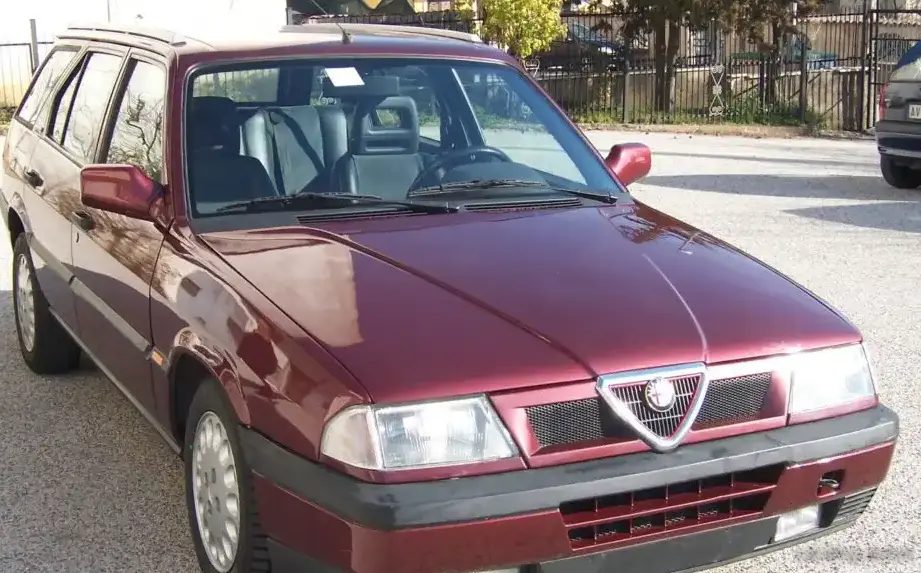
The Alfa Romeo 33 Sport Wagon 1.7 i.e., produced between 1990 and 1992, represents a unique offering within the 907B generation of the 33 series. Positioned as a practical and stylish estate version of the popular hatchback, the Sport Wagon aimed to broaden the 33’s appeal to families and those requiring increased cargo capacity. The 1.7 i.e. variant, equipped with a 107 horsepower engine, served as a mid-range option, balancing performance with affordability. It occupied a space between the base 1.4-liter models and the more potent 1.7 Quadrifoglio and V6 versions.
Technical Specifications
| Brand | Alfa Romeo |
| Model | 33 |
| Generation | 33 Sport Wagon (907B) |
| Type (Engine) | 1.7 i.e. (107 Hp) |
| Start of production | 1990 |
| End of production | 1992 |
| Powertrain Architecture | Internal Combustion engine |
| Body type | Station wagon (estate) |
| Seats | 5 |
| Doors | 5 |
| Fuel consumption (urban) | 9.9 l/100 km (23.8 US mpg) |
| Fuel Type | Petrol (Gasoline) |
| Acceleration 0 – 100 km/h | 9.9 sec |
| Acceleration 0 – 62 mph | 9.9 sec |
| Acceleration 0 – 60 mph | 9.4 sec |
| Maximum speed | 186 km/h (115.58 mph) |
| Weight-to-power ratio | 9.2 kg/Hp |
| Weight-to-torque ratio | 6.6 kg/Nm |
| Power | 107 Hp @ 5800 rpm |
| Power per litre | 62.5 Hp/l |
| Torque | 149 Nm @ 4500 rpm (109.9 lb.-ft. @ 4500 rpm) |
| Engine layout | Front, Transverse |
| Engine Model/Code | 307.36 |
| Engine displacement | 1712 cm3 (104.47 cu. in.) |
| Number of cylinders | 4 |
| Engine configuration | Boxer |
| Cylinder Bore | 87 mm (3.43 in.) |
| Piston Stroke | 72 mm (2.83 in.) |
| Compression ratio | 9.5:1 |
| Number of valves per cylinder | 2 |
| Fuel injection system | Multi-port manifold injection |
| Engine aspiration | Naturally aspirated engine |
| Valvetrain | OHC |
| Engine oil capacity | 4 l (4.23 US qt | 3.52 UK qt) |
| Coolant capacity | 7.3 l (7.71 US qt | 6.42 UK qt) |
| Kerb Weight | 985 kg (2171.55 lbs.) |
| Max. weight | 1405 kg (3097.49 lbs.) |
| Max load | 420 kg (925.94 lbs.) |
| Trunk (boot) space – minimum | 430 l (15.19 cu. ft.) |
| Trunk (boot) space – maximum | 1350 l (47.67 cu. ft.) |
| Fuel tank capacity | 50 l (13.21 US gal | 11 UK gal) |
| Length | 4200 mm (165.35 in.) |
| Width | 1615 mm (63.58 in.) |
| Height | 1350 mm (53.15 in.) |
| Wheelbase | 2475 mm (97.44 in.) |
| Front track | 1365 mm (53.74 in.) |
| Rear track | 1365 mm (53.74 in.) |
| Drivetrain Architecture | Front wheel drive |
| Number of gears | 5 |
| Gearbox type | Manual transmission |
| Front suspension | Coil spring |
| Rear suspension | Coil spring |
| Front brakes | Ventilated discs |
| Rear brakes | Disc |
| Assisting systems | ABS (Anti-lock braking system) |
| Steering type | Steering rack and pinion |
| Power steering | Hydraulic Steering |
| Tires size | 185/60 R14 |
Powertrain & Engine Architecture
The heart of the 33 Sport Wagon 1.7 i.e. is the Alfa Romeo 307.36 engine, a 1712cc, four-cylinder, boxer engine. This configuration, relatively uncommon in mainstream production cars, contributes to a lower center of gravity, enhancing handling characteristics. The engine utilizes a multi-port fuel injection system, providing precise fuel delivery for improved efficiency and performance. The engine features a single overhead camshaft (OHC) valvetrain operating two valves per cylinder. The boxer layout, while offering inherent balance, can present challenges in terms of packaging and maintenance. The 5-speed manual transmission was the standard offering, providing drivers with full control over the engine’s power band. The transmission’s gear ratios were tuned for a balance of acceleration and fuel economy, prioritizing usability over outright performance.
Driving Characteristics
The 1.7 i.e. Sport Wagon delivers a driving experience that is best described as engaging and refined. With 107 horsepower, acceleration from 0 to 60 mph takes approximately 9.4 seconds, and it reaches a top speed of 115.58 mph. While not a sports car by any means, the engine provides sufficient power for everyday driving and occasional highway overtaking. The boxer engine provides a unique engine note and smooth power delivery. The manual transmission allows for precise gear selection, enabling drivers to maximize the engine’s potential. Compared to the more powerful Quadrifoglio and V6 models, the 1.7 i.e. offers a more relaxed and fuel-efficient driving experience. The front-wheel-drive layout provides predictable handling, although it can exhibit some understeer when pushed hard.
Equipment & Trim Levels
The 1.7 i.e. Sport Wagon typically came equipped with a reasonable level of standard features. Interior appointments included cloth upholstery, a basic instrument cluster, and manual windows and door locks. Power steering was standard, enhancing ease of maneuverability. Optional extras included alloy wheels, a sunroof, and upgraded audio systems. The interior design, while functional, was relatively spartan compared to some of its competitors. The focus was on providing a practical and durable interior that could withstand the rigors of family use.
Chassis & Braking
The 33 Sport Wagon utilizes a coil spring suspension system at both the front and rear, providing a comfortable ride quality. The front suspension features independent coil springs, while the rear utilizes a torsion beam setup. Braking duties are handled by ventilated discs at the front and solid discs at the rear. An Anti-lock Braking System (ABS) was included as standard, enhancing safety and control during emergency braking situations. The chassis was designed to provide a balance of rigidity and weight, contributing to the car’s handling characteristics. The relatively lightweight construction of the 33 Sport Wagon helps to offset the limitations of the 1.7 i.e. engine’s power output.
Market Reception & Comparison
The Alfa Romeo 33 Sport Wagon 1.7 i.e. was generally well-received by automotive critics. It was praised for its stylish design, practical interior, and engaging driving experience. However, some critics noted that the engine lacked the outright performance of its more powerful siblings. Fuel economy was considered to be reasonable for the time, although it was not class-leading. Compared to other estate cars in the same segment, such as the Ford Escort Estate and the Vauxhall Astra Estate, the 33 Sport Wagon offered a more distinctive and sophisticated driving experience. However, it was often more expensive to purchase and maintain.
Legacy
The Alfa Romeo 33 Sport Wagon 1.7 i.e. has developed a loyal following among enthusiasts. The boxer engine, while requiring more specialized maintenance, is known for its durability and unique character. The car’s stylish design and practical interior have also contributed to its enduring appeal. Today, well-maintained examples of the 33 Sport Wagon 1.7 i.e. are becoming increasingly collectible. The 307.36 engine, while not without its quirks, is generally considered to be a reliable unit when properly maintained. Parts availability can be a challenge, but a dedicated network of Alfa Romeo specialists and enthusiasts helps to keep these cars on the road.