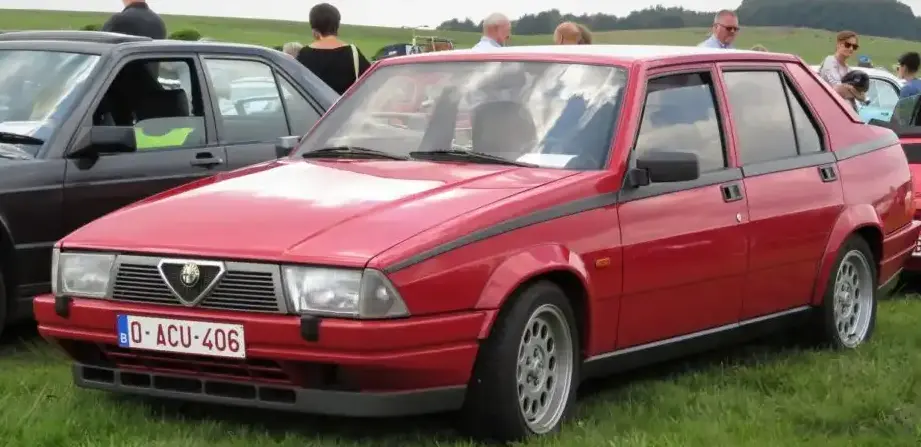
The Alfa Romeo 75, known as the Milano in some markets, was a compact executive car produced by the Italian manufacturer from 1985 to 1992. The 1.8 Turbo i.e. variant, produced from 1986 to 1987, represented a significant step up in performance for the 75 range, offering a blend of Italian styling and turbocharged power. This model occupied a mid-range position within the 75 lineup, bridging the gap between the more economical naturally aspirated engines and the flagship 2.8-liter V6. It was primarily aimed at drivers seeking a sporty and engaging driving experience without sacrificing everyday usability.
Technical Specifications
| Brand | Alfa Romeo |
| Model | 75 |
| Generation | 75 (162 B) |
| Type (Engine) | 1.8 Turbo i.e. (155 Hp) |
| Start of production | 1986 |
| End of production | 1987 |
| Powertrain Architecture | Internal Combustion engine |
| Body type | Sedan |
| Seats | 5 |
| Doors | 4 |
| Fuel consumption (urban) | 9.7 l/100 km (24.2 US mpg) |
| Fuel consumption (extra urban) | 7 l/100 km (33.6 US mpg) |
| Fuel consumption (combined) | 8.6 l/100 km (27.4 US mpg) |
| Fuel Type | Petrol (Gasoline) |
| Acceleration 0 – 100 km/h | 7.6 sec |
| Acceleration 0 – 62 mph | 7.6 sec |
| Acceleration 0 – 60 mph | 7.2 sec |
| Maximum speed | 210 km/h (130.49 mph) |
| Weight-to-power ratio | 7.3 kg/Hp |
| Weight-to-torque ratio | 5 kg/Nm |
| Power | 155 Hp @ 5800 rpm |
| Torque | 226 Nm @ 2600 rpm (166.69 lb.-ft. @ 2600 rpm) |
| Engine layout | Front, Longitudinal |
| Engine Model/Code | 061.34, 062.02 |
| Engine displacement | 1779 cm3 (108.56 cu. in.) |
| Number of cylinders | 4 |
| Engine configuration | Inline |
| Cylinder Bore | 80 mm (3.15 in.) |
| Piston Stroke | 88.5 mm (3.48 in.) |
| Compression ratio | 7.5:1 |
| Number of valves per cylinder | 2 |
| Fuel injection system | Multi-port manifold injection |
| Engine aspiration | Turbocharger |
| Engine oil capacity | 5.6 l (5.92 US qt | 4.93 UK qt) |
| Coolant | 10 l (10.57 US qt | 8.8 UK qt) |
| Kerb Weight | 1130 kg (2491.22 lbs.) |
| Max. weight | 1555 kg (3428.19 lbs.) |
| Max load | 425 kg (936.96 lbs.) |
| Trunk (boot) space – minimum | 500 l (17.66 cu. ft.) |
| Fuel tank capacity | 49 l (12.94 US gal | 10.78 UK gal) |
| Length | 4330 mm (170.47 in.) |
| Width | 1630 mm (64.17 in.) |
| Height | 1400 mm (55.12 in.) |
| Wheelbase | 2510 mm (98.82 in.) |
| Front track | 1400 mm (55.12 in.) |
| Rear (Back) track | 1390 mm (54.72 in.) |
| Drag coefficient (Cd) | 0.36 |
| Minimum turning circle | 10.9 m (35.76 ft.) |
| Drivetrain Architecture | Rear wheel drive |
| Drive wheel | Rear wheel drive |
| Number of gears | 5 gears, manual transmission |
| Front brakes | Ventilated discs |
| Rear brakes | Disc |
| Steering type | Steering rack and pinion |
| Tires size | 195/60 R14 |
| Wheel rims size | 14 |
INTRODUCTION
The Alfa Romeo 75 1.8 Turbo i.e. was introduced in 1986 as a performance-oriented variant of the 75 sedan. Built on the 162B platform, shared with the Alfa 90, it aimed to deliver a more engaging driving experience than the base models. The “i.e.” designation signified fuel injection, a relatively modern feature for the time. This model year saw a refinement of the original 75 design, with subtle styling updates and a focus on improving the driving dynamics. The 75, in general, was Alfa Romeo’s attempt to create a modern, sporty sedan that could compete with offerings from BMW and Mercedes-Benz in the European market.
Powertrain & Engine Architecture
At the heart of the 1.8 Turbo i.e. lies the Alfa Romeo 1779cc inline-four cylinder engine, designated as either 061.34 or 062.02 depending on minor variations. This engine featured a single overhead camshaft (SOHC) valvetrain with two valves per cylinder. The key feature, of course, was the turbocharger, which significantly boosted power output. The engine utilized Bosch mechanical fuel injection, a system known for its reliability and tunability. The turbocharger itself was a Garrett unit, providing approximately 8.5 psi of boost. The engine’s relatively low 7.5:1 compression ratio was necessary to accommodate the forced induction. Power was delivered to the rear wheels via a five-speed manual transmission, the only gearbox option available for this variant. The engine’s longitudinal mounting further contributed to the car’s balanced handling characteristics.
Driving Characteristics
The 1.8 Turbo i.e. offered a noticeable performance upgrade over the naturally aspirated 75 models. The 155 horsepower and 226 Nm (166.69 lb-ft) of torque provided brisk acceleration, with a 0-60 mph time of around 7.2 seconds and a top speed of 210 km/h (130.49 mph). The turbocharger did introduce a degree of turbo lag, meaning there was a slight delay between pressing the accelerator and feeling the full surge of power. However, once the turbo spooled up, the engine delivered a strong and linear powerband. The rear-wheel-drive layout and well-tuned suspension contributed to a balanced and engaging driving experience. Compared to the higher-output 2.8-liter V6, the 1.8 Turbo offered a lighter and more nimble feel, making it a favorite among drivers who prioritized handling over outright power.
Equipment & Trim Levels
The 1.8 Turbo i.e. was generally well-equipped for its time. Standard features included power-assisted steering, ventilated front disc brakes, and cloth upholstery. The interior featured a sporty three-spoke steering wheel and a comprehensive instrument cluster. Optional extras included electric windows, central locking, and a sunroof. The trim level was typically positioned as a step above the base models, offering a more refined interior and a higher level of standard equipment. While not as luxurious as the V6 models, the 1.8 Turbo i.e. provided a comfortable and well-appointed cabin.
Chassis & Braking
The Alfa Romeo 75 featured an independent suspension system all around, with MacPherson struts at the front and a semi-trailing arm setup at the rear. This suspension configuration provided a good balance between ride comfort and handling precision. The 1.8 Turbo i.e. typically came equipped with ventilated disc brakes at the front and solid discs at the rear, providing adequate stopping power. The car’s relatively light weight, at 1130 kg (2491.22 lbs), further enhanced its braking performance. A stabilizer bar was fitted to both the front and rear axles to reduce body roll during cornering.
Market Reception & Comparison
The 1.8 Turbo i.e. was generally well-received by automotive critics. It was praised for its sporty handling, strong performance, and distinctive Italian styling. However, some critics noted the presence of turbo lag and the relatively high fuel consumption. Compared to the naturally aspirated 1.6 and 1.8-liter models, the Turbo i.e. offered a significant performance boost, but at a higher price point. Compared to the 2.8-liter V6, it was more affordable and offered a more nimble driving experience, but lacked the V6’s outright power and refinement. Fuel economy was comparable to other turbocharged cars of the era, averaging around 27.4 US mpg in combined driving.
Legacy
The Alfa Romeo 75 1.8 Turbo i.e. remains a popular choice among Alfa Romeo enthusiasts today. The engine, while not without its quirks, is generally considered to be reliable if properly maintained. Parts availability can be a challenge, but a dedicated network of Alfa Romeo specialists and aftermarket suppliers exists. The car’s classic Italian styling and engaging driving dynamics continue to appeal to drivers who appreciate a unique and rewarding motoring experience. The 1.8 Turbo i.e. represents a sweet spot in the 75 lineup, offering a compelling blend of performance, handling, and affordability. It’s a testament to Alfa Romeo’s commitment to building passionate and driver-focused automobiles.