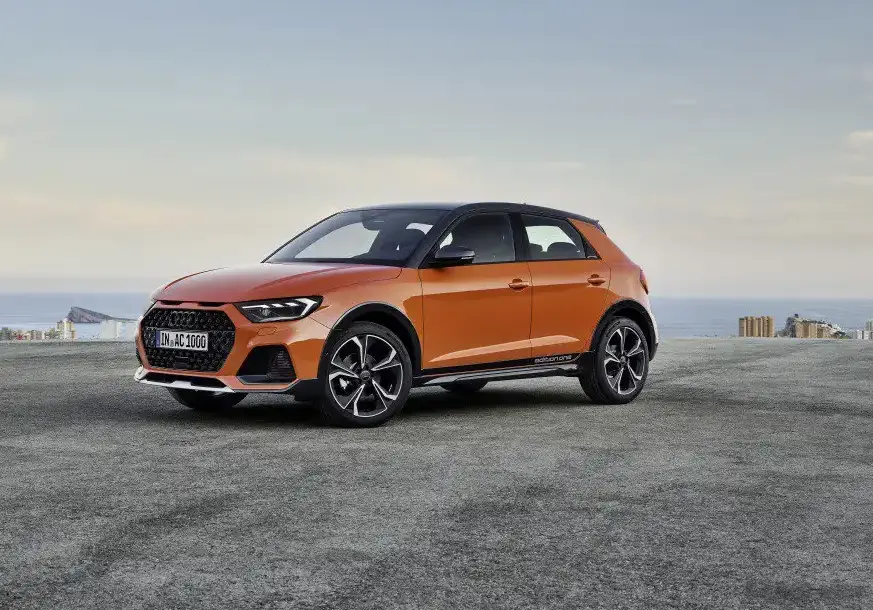
The Audi A1 citycarver 30 TFSI S tronic is a subcompact crossover automobile produced by the German manufacturer Audi from September 2020 to May 2022. Positioned as a more rugged and versatile variant of the standard A1 hatchback, the citycarver aimed to appeal to buyers seeking a stylish and practical vehicle with a slightly elevated ride height. This specific 30 TFSI configuration, powered by a 1.0-liter turbocharged three-cylinder engine paired with a seven-speed S tronic dual-clutch transmission, represented an entry-level offering within the citycarver lineup, prioritizing fuel efficiency and ease of driving over outright performance.
Technical Specifications
| Brand | Audi |
| Model | A1 |
| Generation | A1 citycarver (GB) |
| Type (Engine) | 30 TFSI (110 Hp) S tronic |
| Start of production | September, 2020 |
| End of production | May, 2022 |
| Powertrain Architecture | Internal Combustion engine |
| Body type | Crossover |
| Seats | 5 |
| Doors | 5 |
| Fuel consumption (urban) | 5.6-5.7 l/100 km (42-41.3 US mpg, 50.4-49.6 UK mpg, 17.9-17.5 km/l) |
| Fuel consumption (extra urban) | 4.5-4.6 l/100 km (52.3-51.1 US mpg, 62.8-61.4 UK mpg, 22.2-21.7 km/l) |
| Fuel consumption (combined) | 4.9-5 l/100 km (48-47 US mpg, 57.6-56.5 UK mpg, 20.4-20 km/l) |
| CO2 emissions | 112-115 g/km |
| Fuel Type | Petrol (Gasoline) |
| Acceleration 0 – 100 km/h | 10.5 sec |
| Acceleration 0 – 62 mph | 10.5 sec |
| Acceleration 0 – 60 mph | 10 sec |
| Maximum speed | 191 km/h (118.68 mph) |
| Emission standard | Euro 6d-ISC-FCM |
| Weight-to-power ratio | 10.7 kg/Hp, 93.6 Hp/tonne |
| Weight-to-torque ratio | 5.9 kg/Nm, 170.2 Nm/tonne |
| Power | 110 Hp @ 5500 rpm |
| Power per litre | 110.1 Hp/l |
| Torque | 200 Nm @ 2000-3000 rpm (147.51 lb.-ft. @ 2000-3000 rpm) |
| Engine layout | Front, Transverse |
| Engine Model/Code | EA211evo / DLAA |
| Engine displacement | 999 cm3 (60.96 cu. in.) |
| Number of cylinders | 3 |
| Engine configuration | Inline |
| Number of valves per cylinder | 4 |
| Fuel injection system | Direct injection |
| Engine aspiration | Turbocharger, Intercooler |
| Engine oil capacity | 4 l (4.23 US qt | 3.52 UK qt) |
| Kerb Weight | 1175 kg (2590.43 lbs.) |
| Max. weight | 1695 kg (3736.84 lbs.) |
| Max load | 520 kg (1146.4 lbs.) |
| Trunk (boot) space (minimum) | 335 l (11.83 cu. ft.) |
| Trunk (boot) space (maximum) | 1090 l (38.49 cu. ft.) |
| Fuel tank capacity | 40 l (10.57 US gal | 8.8 UK gal) |
| Max. roof load | 75 kg (165.35 lbs.) |
| Length | 4046 mm (159.29 in.) |
| Width | 1756 mm (69.13 in.) |
| Width including mirrors | 1940 mm (76.38 in.) |
| Height | 1459 mm (57.44 in.) |
| Wheelbase | 2566 mm (101.02 in.) |
| Front track | 1523 mm (59.96 in.) |
| Rear track | 1505 mm (59.25 in.) |
| Front overhang | 793 mm (31.22 in.) |
| Rear overhang | 687 mm (27.05 in.) |
| Minimum turning circle | 10.6 m (34.78 ft.) |
| Drivetrain Architecture | Front wheel drive |
| Number of gears | 7 |
| Gearbox type | Automatic transmission S tronic |
| Front suspension | Independent type McPherson |
| Rear suspension | Torsion |
| Front brakes | Ventilated discs |
| Rear brakes | Disc |
| Assisting systems | ABS (Anti-lock braking system) |
| Steering type | Steering rack and pinion |
| Power steering | Electric Steering |
| Tires size | 205/60 R16; 205/55 R17; 215/45 R18 |
| Wheel rims size | 16; 17; 18 |
INTRODUCTION
The Audi A1 citycarver, launched in 2020, represented Audi’s attempt to capitalize on the growing popularity of the subcompact crossover segment. Built on the Volkswagen Group’s MQB A0 platform (specifically the A1/Ibiza/Polo architecture), the citycarver distinguishes itself from the standard A1 Sportback through its raised suspension, plastic body cladding, and a more adventurous aesthetic. The 30 TFSI S tronic variant, equipped with the 1.0-liter turbocharged engine and seven-speed dual-clutch transmission, served as the entry point to the citycarver range, targeting buyers who prioritized fuel economy and affordability. Production continued until May 2022, after which the model was discontinued.
Powertrain & Engine Architecture
At the heart of the A1 citycarver 30 TFSI lies the EA211evo family of three-cylinder gasoline engines. Specifically, the DLAA engine code designates this particular iteration. This 999cc engine utilizes direct fuel injection and a single turbocharger with an intercooler to deliver a balance of power and efficiency. The engine features four valves per cylinder and is constructed with an aluminum cylinder block and head. The S tronic seven-speed dual-clutch transmission (DCT) is a key component of this powertrain. This transmission offers quick and smooth gear changes, contributing to a more engaging driving experience compared to a traditional automatic. The S tronic utilizes two separate clutches – one for even-numbered gears and one for odd-numbered gears – allowing for pre-selection of the next gear, minimizing interruption in power delivery. The engine management system incorporates start/stop technology to further enhance fuel economy.
Driving Characteristics
The 110 horsepower and 200 Nm (147.51 lb-ft) of torque produced by the 1.0 TFSI engine provide adequate, though not exhilarating, performance. Acceleration from 0 to 100 km/h (0-62 mph) takes approximately 10.5 seconds. The S tronic transmission helps to maximize the available power, offering responsive shifts and keeping the engine within its optimal operating range. Compared to higher-output versions of the A1 citycarver, such as those equipped with the 1.5-liter TSI engine, the 30 TFSI feels noticeably less powerful, particularly during overtaking maneuvers or when carrying a full load. The gear ratios in the S tronic transmission are tuned for fuel efficiency, which can sometimes result in the engine feeling slightly strained at higher speeds. However, for typical urban and suburban driving, the 30 TFSI provides a comfortable and refined driving experience.
Equipment & Trim Levels
The A1 citycarver 30 TFSI typically came equipped with a respectable level of standard features. These included Audi’s MMI radio plus infotainment system with a 7-inch touchscreen display, Bluetooth connectivity, and a leather-wrapped multifunction steering wheel. Safety features such as ABS, electronic stability control, and multiple airbags were also standard. Interior upholstery was typically cloth, with options for leather upgrades. Common optional extras included larger alloy wheels, a panoramic sunroof, parking sensors, and Audi’s virtual cockpit digital instrument cluster. Trim levels varied slightly depending on the market, but generally offered progressive upgrades in terms of interior materials, exterior styling, and technology features.
Chassis & Braking
The A1 citycarver’s chassis is based on the MQB A0 platform, featuring a McPherson strut front suspension and a torsion beam rear suspension. The citycarver’s ride height is approximately 40mm higher than the standard A1 Sportback, providing increased ground clearance and a more commanding driving position. The braking system consists of ventilated front discs and solid rear discs. ABS (Anti-lock Braking System) is standard, providing enhanced braking performance and stability. The steering is an electric power-assisted rack and pinion system, offering precise and responsive steering feel.
Market Reception & Comparison
The Audi A1 citycarver 30 TFSI was generally well-received by automotive critics, who praised its stylish design, comfortable interior, and fuel-efficient powertrain. However, some reviewers noted that the 1.0-liter engine could feel underpowered in certain situations. Compared to other trims in the A1 citycarver lineup, the 30 TFSI offered the most affordable entry point, making it an attractive option for budget-conscious buyers. In terms of fuel economy, the 30 TFSI consistently outperformed the higher-output variants, achieving combined fuel consumption figures of around 4.9-5.0 l/100 km (48-47 US mpg). Reliability reports suggest that the EA211 engine is generally reliable, although regular maintenance is essential to prevent issues such as turbocharger failure or carbon buildup.
Legacy
The Audi A1 citycarver 30 TFSI, while a relatively short-lived model, has established a presence in the used car market. Its combination of Audi build quality, fuel efficiency, and practicality makes it a desirable option for buyers seeking a stylish and affordable subcompact crossover. The 1.0 TFSI engine, while not known for its blistering performance, has proven to be a durable and reliable unit when properly maintained. As with any used vehicle, prospective buyers should carefully inspect the car’s service history and consider a pre-purchase inspection by a qualified mechanic.