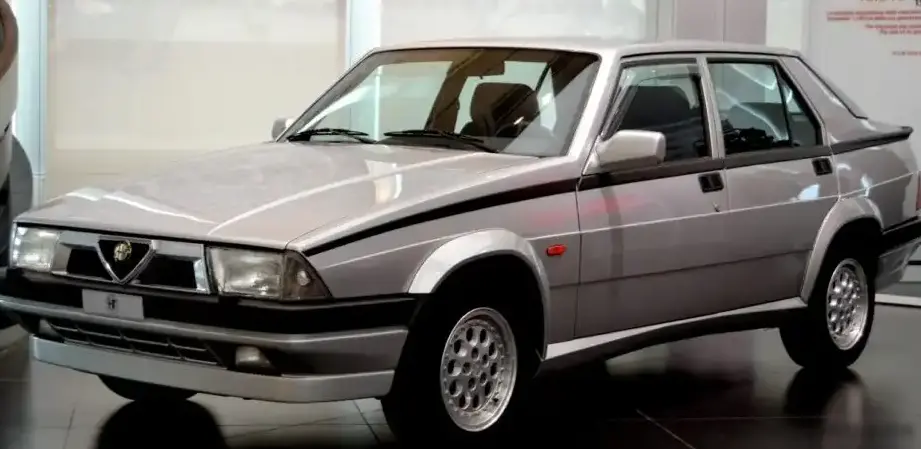
The Alfa Romeo 75, known as the Milano in some markets, was a compact executive car produced by the Italian manufacturer Alfa Romeo from 1985 to 1992. The Quadrifoglio Verde 2.5 V6 Automatic, introduced with the 162 B facelift in 1988, represented a luxurious and performance-oriented variant of the 75 series. Positioned as a premium offering, it combined a powerful V6 engine with the convenience of an automatic transmission, appealing to buyers seeking a blend of Italian style and effortless driving. Production spanned from 1985 to 1991, with the facelift models representing the later, more refined iterations of the design.
Technical Specifications
| Brand | Alfa Romeo |
| Model | 75 |
| Generation | 75 (162 B, facelift 1988) |
| Type (Engine) | Quadrifoglio Verde 2.5 V6 (156 Hp) Automatic |
| Start of production | 1985 |
| End of production | 1991 |
| Powertrain Architecture | Internal Combustion engine |
| Body type | Sedan |
| Seats | 5 |
| Doors | 4 |
| Fuel consumption (urban) | 13.5 l/100 km (17.4 US mpg, 20.9 UK mpg, 7.4 km/l) |
| Fuel consumption (extra urban) | 7.4 l/100 km (31.8 US mpg, 38.2 UK mpg, 13.5 km/l) |
| Fuel consumption (combined) | 10.2 l/100 km (23.1 US mpg, 27.7 UK mpg, 9.8 km/l) |
| Fuel Type | Petrol (Gasoline) |
| Acceleration 0 – 100 km/h | 10.3 sec |
| Acceleration 0 – 62 mph | 10.3 sec |
| Acceleration 0 – 60 mph | 9.8 sec |
| Maximum speed | 210 km/h (130.49 mph) |
| Weight-to-power ratio | 7.6 kg/Hp, 132.2 Hp/tonne |
| Weight-to-torque ratio | 5.6 kg/Nm, 178 Nm/tonne |
| Power | 156 Hp @ 5600 rpm |
| Power per litre | 62.6 Hp/l |
| Torque | 210 Nm @ 4000 rpm (154.89 lb.-ft. @ 4000 rpm) |
| Engine layout | Front, Longitudinal |
| Engine Model/Code | 019.11, 016.46 |
| Engine displacement | 2492 cm3 (152.07 cu. in.) |
| Number of cylinders | 6 |
| Engine configuration | V-engine |
| Cylinder Bore | 88 mm (3.46 in.) |
| Piston Stroke | 68.3 mm (2.69 in.) |
| Compression ratio | 9:1 |
| Number of valves per cylinder | 2 |
| Fuel injection system | Multi-port manifold injection |
| Engine aspiration | Naturally aspirated engine |
| Engine oil capacity | 6.1 l (6.45 US qt | 5.37 UK qt) |
| Coolant | 8 l (8.45 US qt | 7.04 UK qt) |
| Kerb Weight | 1180 kg (2601.45 lbs.) |
| Max. weight | 1585 kg (3494.33 lbs.) |
| Max load | 405 kg (892.87 lbs.) |
| Trunk (boot) space – minimum | 500 l (17.66 cu. ft.) |
| Fuel tank capacity | 49 l (12.94 US gal | 10.78 UK gal) |
| Max. roof load | 80 kg (176.37 lbs.) |
| Permitted towbar download | 60 kg (132.28 lbs.) |
| Length | 4330 mm (170.47 in.) |
| Width | 1630 mm (64.17 in.) |
| Height | 1400 mm (55.12 in.) |
| Wheelbase | 2510 mm (98.82 in.) |
| Front track | 1368 mm (53.86 in.) |
| Rear (Back) track | 1358 mm (53.46 in.) |
| Front overhang | 825 mm (32.48 in.) |
| Rear overhang | 995 mm (39.17 in.) |
| Drag coefficient (Cd) | 0.36 |
| Minimum turning circle (turning diameter) | 10.9 m (35.76 ft.) |
| Drivetrain Architecture | The Internal combustion engine (ICE) drives the rear wheels of the vehicle. |
| Drive wheel | Rear wheel drive |
| Number of gears and type of gearbox | 3 gears, automatic transmission |
| Front brakes | Ventilated discs |
| Rear brakes | Disc |
| Steering type | Steering rack and pinion |
| Tires size | 195/60 R14 |
| Wheel rims size | 6.5J x 14 |
INTRODUCTION
The Alfa Romeo 75 Quadrifoglio Verde 2.5 V6 Automatic was a flagship variant of the 75 series, introduced with the 1988 facelift (162 B). Building upon the success of the original 75 launched in 1985, the facelift brought subtle styling revisions and mechanical improvements. The Quadrifoglio Verde, meaning “Green Cloverleaf,” was Alfa Romeo’s high-performance designation, signifying a more powerful engine, upgraded suspension, and enhanced interior appointments. The addition of an automatic transmission to the 2.5 V6 model broadened its appeal, offering a more relaxed driving experience without sacrificing the inherent character of the Alfa Romeo marque. It was primarily sold in Europe, where the demand for sophisticated, driver-focused sedans was strong.
Powertrain & Engine Architecture
The heart of the Quadrifoglio Verde was the Alfa Romeo 019.11 (later 016.46) 2.5-liter V6 engine. This engine, a descendant of the legendary Busso V6, was known for its smooth power delivery and distinctive exhaust note. It featured a 60-degree V-angle, aluminum alloy cylinder heads and block, and a dual overhead camshaft design with two valves per cylinder. Fuel delivery was managed by a Bosch multi-port fuel injection system. The engine produced 156 horsepower at 5600 rpm and 210 Nm (155 lb-ft) of torque at 4000 rpm. The automatic transmission was a three-speed unit, designed to provide smooth and comfortable gear changes. While not as sporty as a manual transmission, it complemented the V6 engine’s torque curve, making it well-suited for relaxed cruising and city driving.
Driving Characteristics
The 75 Quadrifoglio Verde 2.5 V6 Automatic offered a unique driving experience. While the automatic transmission dulled the immediacy of gear changes compared to the manual versions, it didn’t entirely diminish the car’s engaging character. The V6 engine provided ample power for spirited driving, and the rear-wheel-drive layout contributed to balanced handling. Acceleration from 0 to 60 mph took around 9.8 seconds, and the car could reach a top speed of 210 km/h (130 mph). The three-speed automatic transmission had relatively long gear ratios, prioritizing comfort and fuel economy over outright performance. Compared to the manual transmission versions, the automatic felt slightly less responsive, but it offered a more refined and effortless driving experience.
Equipment & Trim Levels
The Quadrifoglio Verde trim level was generously equipped. Standard features included power windows, central locking, a sunroof, and upgraded interior upholstery, typically featuring leather seats. The dashboard featured wood trim and a comprehensive instrument cluster. Optional extras included air conditioning, a premium sound system, and alloy wheels. The interior was designed to provide a comfortable and luxurious environment, befitting the car’s premium positioning. The Quadrifoglio Verde also featured distinctive exterior details, such as green cloverleaf badges and a unique wheel design.
Chassis & Braking
The 75 Quadrifoglio Verde utilized a MacPherson strut front suspension and a De Dion axle rear suspension. This setup provided a good balance of ride comfort and handling precision. The car was equipped with ventilated disc brakes at the front and solid disc brakes at the rear, providing adequate stopping power. The steering was a rack-and-pinion system, offering precise and responsive control. The suspension was tuned to provide a comfortable ride without sacrificing handling performance. Stabilizer bars were fitted front and rear to reduce body roll during cornering.
Market Reception & Comparison
The Alfa Romeo 75 Quadrifoglio Verde 2.5 V6 Automatic was generally well-received by automotive critics. It was praised for its stylish design, powerful engine, and comfortable interior. However, some critics noted that the automatic transmission detracted slightly from the car’s sporty character. Compared to other trims in the 75 lineup, such as the 1.8-liter and 2.0-liter models, the Quadrifoglio Verde offered significantly more performance and luxury. Fuel economy was relatively poor, averaging around 23.1 US mpg in combined driving. Reliability was typical for an Italian car of the era – requiring diligent maintenance.
Legacy
The Alfa Romeo 75 Quadrifoglio Verde 2.5 V6 Automatic remains a sought-after classic car today. The Busso V6 engine is highly regarded by enthusiasts, and the car’s distinctive styling and engaging driving experience continue to appeal to collectors. While the automatic transmission isn’t as desirable as the manual version, it offers a more accessible entry point into the 75 Quadrifoglio Verde ownership experience. The powertrain, when properly maintained, is known for its durability, although age-related issues such as rubber component degradation and electrical faults are common. Values for well-maintained examples have been steadily increasing in recent years, reflecting the car’s growing popularity among classic car enthusiasts.