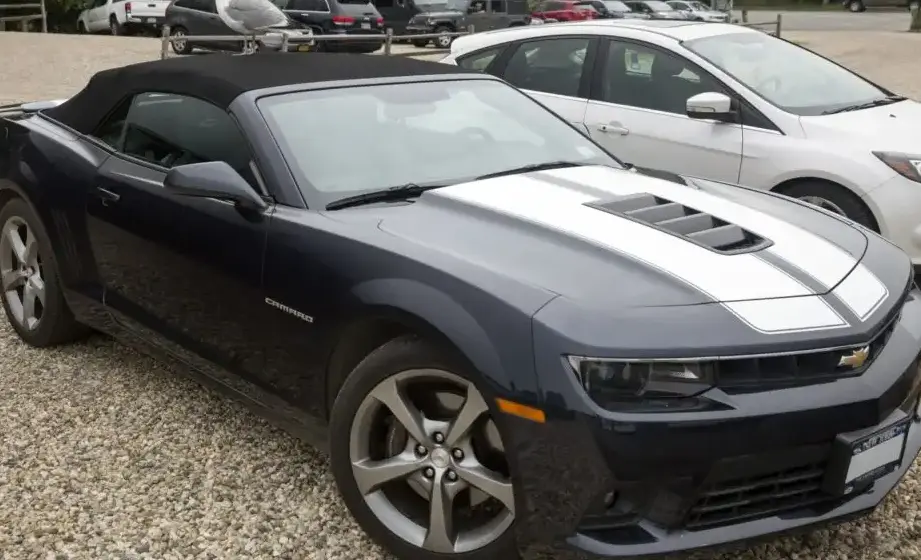
The Chevrolet Camaro V (facelift 2013) Convertible, equipped with the 6.2-liter V8 engine producing 426 horsepower and paired with a Hydra-Matic automatic transmission, represents a significant iteration of the fifth-generation Camaro. Produced from 2013 to 2016, this variant aimed to deliver the classic American muscle car experience with a degree of open-air enjoyment. It occupied a premium position within the Camaro lineup, offering a substantial performance upgrade over the base models while remaining accessible compared to the track-focused 1LE variant. This model was primarily targeted at the North American market, capitalizing on the enduring popularity of powerful, rear-wheel-drive convertibles.
Technical Specifications
| Brand | Chevrolet |
| Model | Camaro |
| Generation | Camaro V (facelift 2013) Convertible |
| Type (Engine) | 6.2 V8 (426 Hp) Hydra-Matic |
| Start of production | 2013 |
| End of production | 2016 |
| Powertrain Architecture | Internal Combustion engine |
| Body type | Cabriolet |
| Seats | 4 |
| Doors | 2 |
| Fuel consumption (urban) | 14.7 l/100 km (16 US mpg, 19.2 UK mpg, 6.8 km/l) |
| Fuel consumption (extra urban) | 9.4 l/100 km (25 US mpg, 30.1 UK mpg, 10.6 km/l) |
| Fuel consumption (combined) | 12.4 l/100 km (19 US mpg, 22.8 UK mpg, 8.1 km/l) |
| CO2 emissions | 286 g/km |
| Fuel Type | Petrol (Gasoline) |
| Weight-to-power ratio | 4.5 kg/Hp, 223.2 Hp/tonne |
| Weight-to-torque ratio | 3.4 kg/Nm, 298.1 Nm/tonne |
| Power | 426 Hp @ 5900 rpm |
| Power per litre | 69.1 Hp/l |
| Torque | 569 Nm @ 4600 rpm (419.67 lb.-ft. @ 4600 rpm) |
| Maximum engine speed | 6600 rpm |
| Engine layout | Front, Longitudinal |
| Engine Model/Code | LS3 |
| Engine displacement | 6162 cm3 (376.03 cu. in.) |
| Number of cylinders | 8 |
| Engine configuration | V-engine |
| Cylinder Bore | 103.25 mm (4.06 in.) |
| Piston Stroke | 92 mm (3.62 in.) |
| Compression ratio | 10.7:1 |
| Number of valves per cylinder | 2 |
| Fuel injection system | Multi-port manifold injection |
| Engine aspiration | Naturally aspirated engine |
| Valvetrain | OHV |
| Engine oil capacity | 8.5 l (8.98 US qt | 7.48 UK qt) |
| Coolant capacity | 10.9 l (11.52 US qt | 9.59 UK qt) |
| Kerb Weight | 1909 kg (4208.62 lbs.) |
| Trunk (boot) space (minimum) | 289 l (10.21 cu. ft.) |
| Fuel tank capacity | 71.9 l (18.99 US gal | 15.82 UK gal) |
| Length | 4841 mm (190.59 in.) |
| Width | 1918 mm (75.51 in.) |
| Height | 1389 mm (54.69 in.) |
| Wheelbase | 2852 mm (112.28 in.) |
| Front track | 1618 mm (63.7 in.) |
| Rear track | 1618 mm (63.7 in.) |
| Minimum turning circle | 10.5 m (34.45 ft.) |
| Drivetrain Architecture | Rear wheel drive |
| Number of gears and type of gearbox | 6 gears, automatic transmission Hydra-Matic |
| Front suspension | Independent multi-link suspension |
| Rear suspension | Independent multi-link suspension |
| Front brakes | Ventilated discs, 355×32 mm |
| Rear brakes | Ventilated discs, 365×28 mm |
| Assisting systems | ABS (Anti-lock braking system) |
| Steering type | Steering rack and pinion |
| Power steering | Electric Steering |
| Front tire size | 245/45 ZR20 |
| Rear tire size | 275/40 ZR20 |
| Front wheel rim size | 8J x 20 |
| Rear wheel rim size | 9J x 20 |
Introduction
The 2013-2016 Chevrolet Camaro V Convertible, powered by the 6.2L LS3 V8 and equipped with the Hydra-Matic 6L80 automatic transmission, represented a compelling blend of performance and open-air driving. This facelifted fifth-generation Camaro (introduced in 2010) benefited from revised styling, an upgraded interior, and enhanced technology. The LS3 engine, a cornerstone of GM’s performance lineup, provided a significant power boost compared to the earlier 3.6L V6 models. The Hydra-Matic transmission, a six-speed automatic, offered smooth shifts and contributed to a more refined driving experience than the available manual transmission for some drivers. This particular configuration positioned itself as a mid-to-high range offering, appealing to buyers seeking substantial power without the engagement of a manual gearbox.
Powertrain & Engine Architecture
At the heart of the Camaro V Convertible lies the 6.2-liter LS3 V8 engine. This naturally aspirated powerplant utilizes an aluminum cylinder block and cast iron cylinder liners. The engine employs a robust overhead valve (OHV) valvetrain with two valves per cylinder, a configuration favored for its simplicity and reliability. Fuel delivery is managed by a multi-port fuel injection system, ensuring precise fuel metering for optimal performance and efficiency. The LS3 boasts a compression ratio of 10.7:1, contributing to its impressive power output. The Hydra-Matic 6L80 automatic transmission is a six-speed unit known for its smooth and responsive shifts. It features electronically controlled shift points and a torque converter lock-up clutch to improve fuel economy at cruising speeds. The transmission’s gear ratios are tuned to balance acceleration and highway cruising, providing a comfortable and engaging driving experience.
Driving Characteristics
The 426 horsepower and 419.67 lb-ft of torque delivered by the LS3 engine, coupled with the six-speed automatic transmission, resulted in brisk acceleration. While not as aggressively geared as the manual transmission variants, the automatic provided a more relaxed driving experience, particularly in urban environments. The Hydra-Matic transmission’s shift points were generally well-calibrated, offering smooth transitions between gears. However, some enthusiasts noted that the automatic lacked the direct engagement and control offered by the manual gearbox. The convertible top added weight compared to the coupe, slightly impacting handling, but the independent multi-link suspension on both axles helped to mitigate body roll and maintain a reasonably composed ride. The power delivery was linear and predictable, making the car accessible to drivers of varying skill levels.
Equipment & Trim Levels
The Camaro V Convertible came standard with a respectable array of features, including leather upholstery, power-adjustable front seats, a Boston Acoustics premium sound system, and automatic climate control. Additional standard equipment included keyless entry, a rearview camera, and Bluetooth connectivity. Optional extras included a head-up display, a navigation system, and heated front seats. The convertible also featured a power-operated soft top, which could be raised or lowered at speeds up to 30 mph. Interior trim options included various color combinations and accent materials, allowing buyers to personalize their vehicle. The overall interior design aimed for a sporty aesthetic, with a driver-focused cockpit and prominent analog gauges.
Chassis & Braking
The Camaro V Convertible utilized a robust chassis with independent multi-link suspension at both the front and rear. This suspension setup provided a good balance of ride comfort and handling performance. The front suspension featured coil springs and stabilizer bar, while the rear suspension employed coil springs, a multi-link design, and a stabilizer bar. Braking duties were handled by ventilated disc brakes on all four wheels. The front brakes measured 355×32 mm, while the rear brakes were slightly smaller at 365×28 mm. An anti-lock braking system (ABS) was standard, enhancing safety and control during hard braking maneuvers. The electric power steering provided responsive and precise steering feel.
Market Reception & Comparison
The 2013-2016 Camaro V Convertible with the 6.2L V8 and automatic transmission received generally positive reviews from automotive critics. It was praised for its powerful engine, comfortable ride, and well-equipped interior. However, some critics noted the car’s relatively poor visibility and limited rear seat space. Compared to the Camaro SS with a manual transmission, the automatic version offered a more relaxed driving experience but sacrificed some performance and driver engagement. Fuel economy was typical for a V8-powered muscle car, with combined fuel consumption around 19 US mpg. Reliability was generally good, although some owners reported minor issues with the infotainment system and convertible top mechanism.
Legacy
The LS3 engine and 6L80 transmission pairing in the Camaro V Convertible have proven to be remarkably durable and reliable. These powertrains are known for their longevity and relatively low maintenance costs. On the used car market, these Camaros hold their value reasonably well, particularly well-maintained examples with low mileage. The combination of a powerful V8 engine, comfortable interior, and open-air driving experience continues to appeal to enthusiasts today. The 2013-2016 Camaro V Convertible represents a modern interpretation of the classic American muscle car, offering a compelling blend of performance, style, and practicality.