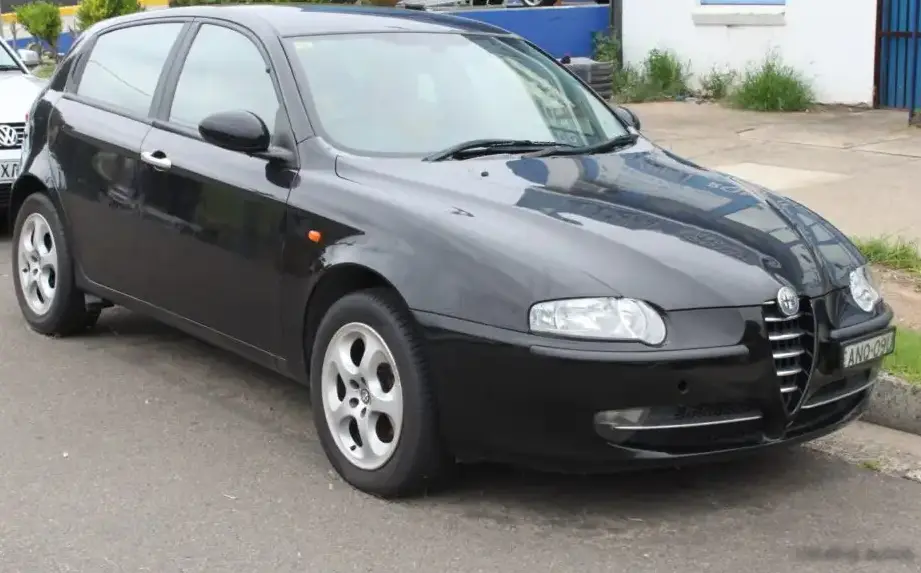
The Alfa Romeo 147 5-doors 1.6 Twin Spark (120 Hp) represents a significant model in the Italian automaker’s modern history, encapsulating the brand’s core tenets of passionate design, driver-focused engineering, and charismatic performance within the competitive premium C-segment hatchback market. Produced from 2000 to 2004 in its initial guise, this particular variant offered a harmonious blend of everyday practicality, courtesy of its five-door layout, and the spirited driving experience for which Alfa Romeo is renowned. It stood as a testament to the idea that a family car need not be devoid of soul, powered by the innovative and characterful Twin Spark engine that became a hallmark of the brand during this era.
History and Development
Launched at the Turin Motor Show in 2000, the Alfa Romeo 147 was introduced as the successor to the angular and distinctive Alfa Romeo 145 and 146 models. The 147 signalled a new design direction, embracing more fluid, organic lines while retaining the brand’s aggressive and unmistakable identity. Designed under the leadership of Walter de’Silva and Wolfgang Egger, the car was an immediate critical success. Its combination of striking aesthetics, advanced chassis technology, and engaging powertrains earned it the prestigious European Car of the Year award in 2001, triumphing over formidable rivals like the Ford Mondeo and Toyota Prius. This accolade significantly bolstered Alfa Romeo’s reputation and positioned the 147 as a highly desirable alternative to its German counterparts.
The platform for the 147 was heavily derived from the acclaimed Alfa Romeo 156 saloon, which had been praised for its exceptional handling. By shortening the 156’s chassis, Alfa Romeo’s engineers were able to imbue the smaller hatchback with a similar level of dynamic prowess, setting a new benchmark for ride and handling in its class. The 5-door version, introduced shortly after the initial 3-door model, broadened the car’s appeal, attracting buyers who required greater accessibility and practicality without wanting to sacrifice the sporty, coupe-like profile that defined the 147’s design.
Design and Styling
The aesthetic of the Alfa Romeo 147 is one of its most celebrated attributes. The front end is dominated by the traditional Scudetto (shield) grille, which plunges deep into the front bumper, forcing the license plate to be offset to the side—a quirky and iconic Alfa Romeo design trait. The triple-lamp headlights are recessed into the bodywork, giving the car an aggressive, focused expression.
The car’s profile is clean and muscular, with a high waistline and taut surfaces that convey a sense of forward motion even at a standstill. A key design feature of the five-door model is the placement of the rear door handles, which are cleverly concealed in the C-pillar. This design sleight-of-hand preserves the sleek, uninterrupted lines of a three-door coupe while offering the convenience of two extra doors, a solution that won praise for its ingenuity and style.
Inside, the cabin is distinctly driver-centric. The dashboard is angled towards the driver, and the main instruments—a large speedometer and tachometer—are housed in deep cowls, a nod to Alfa Romeo’s sporting heritage. The ergonomics are well-considered, with controls falling easily to hand. The use of high-quality materials, stylish circular air vents, and classic Italian design flair created an interior ambiance that felt more special and upmarket than many of its contemporaries. Despite its compact external dimensions, the five-door layout provided reasonable space for passengers in the rear, making it a viable option for small families.
Engine and Performance: The Alfa Romeo 147 5-doors 1.6 Twin Spark (120 Hp)
At the heart of this model is the 1.6-litre Twin Spark engine. The Twin Spark name refers to the use of two spark plugs per cylinder, a technology Alfa Romeo had long utilised in its racing and road car engines. Paired with a Double Overhead Camshaft (DOHC) valvetrain and 16 valves, this system promotes more complete and efficient combustion of the air-fuel mixture. The result is improved thermal efficiency, leading to a smoother power delivery, better responsiveness, and a more distinctive engine note compared to conventional single-spark designs.
In this higher-output configuration, the 1.6-litre, 1598 cc inline-four engine produces a healthy 120 horsepower (Hp) at a relatively high 6200 rpm and a peak torque of 146 Nm (107.7 lb-ft) at 4200 rpm. This power plant, designated with the engine code AR 32104, encourages an enthusiastic driving style, rewarding drivers who are willing to explore the upper reaches of the rev range. The engine is naturally aspirated, providing linear and predictable throttle response.
Mated to a 5-speed manual transmission driving the front wheels, this powertrain enabled the Alfa Romeo 147 5-doors 1.6 Twin Spark (120 Hp) to deliver spirited performance for its class. It could accelerate from 0 to 100 km/h (62 mph) in 10.6 seconds and reach a maximum speed of 195 km/h (121 mph). While not exceptionally fast by modern standards, its performance was competitive at the time and felt lively on the road, thanks in large part to the engine’s free-revving character and engaging soundtrack.
In terms of fuel efficiency, the vehicle registered a combined consumption of 8.2 l/100 km (34.4 UK mpg). In urban environments, this figure rose to 11.2 l/100 km (25.2 UK mpg), while on extra-urban routes, it could achieve a more frugal 6.4 l/100 km (44.1 UK mpg). The CO2 emissions were rated at 194 g/km.
Chassis, Drivetrain, and Handling
The exceptional handling of the Alfa Romeo 147 was a direct result of its sophisticated suspension setup, which was far more advanced than the torsion beam or simple MacPherson strut systems used by most of its rivals. At the front, the car employed a double wishbone suspension layout. This design allows for better control of wheel camber during cornering and suspension travel, ensuring the tyre’s contact patch with the road is maximised. This results in superior grip, more precise steering, and enhanced driver feedback.
The rear suspension consisted of a MacPherson strut system with transverse stabilizer bars. While more conventional than the front setup, it was expertly tuned to work in harmony with the front axle, providing a nimble and adjustable chassis that was both stable at high speeds and agile on twisty roads. The steering, a rack and pinion system with hydraulic assistance, was known for being quick and communicative, further contributing to the car’s reputation as a true driver’s car.
The drivetrain architecture sends power from the transversely mounted internal combustion engine to the front wheels via a five-speed manual gearbox. Braking was handled by 284 mm ventilated discs at the front and 251 mm solid discs at the rear, with an Anti-lock Braking System (ABS) included as standard to ensure controlled stops under all conditions.
Full Technical Specifications
| Category | Specification |
| ————————— | ————————————————————————————————————————- |
| General Information | |
| Brand | Alfa Romeo |
| Model | 147 |
| Generation | 147 5-doors |
| Engine Type | 1.6 Twin Spark (120 Hp) |
| Production Start | 2000 |
| Production End | 2004 |
| Body Type | Hatchback |
| Seats | 5 |
| Doors | 5 |
| Performance | |
| Fuel Consumption (Combined) | 8.2 l/100 km (28.7 US mpg / 34.4 UK mpg) |
| Fuel Consumption (Urban) | 11.2 l/100 km (21 US mpg / 25.2 UK mpg) |
| Fuel Consumption (Extra-Urban) | 6.4 l/