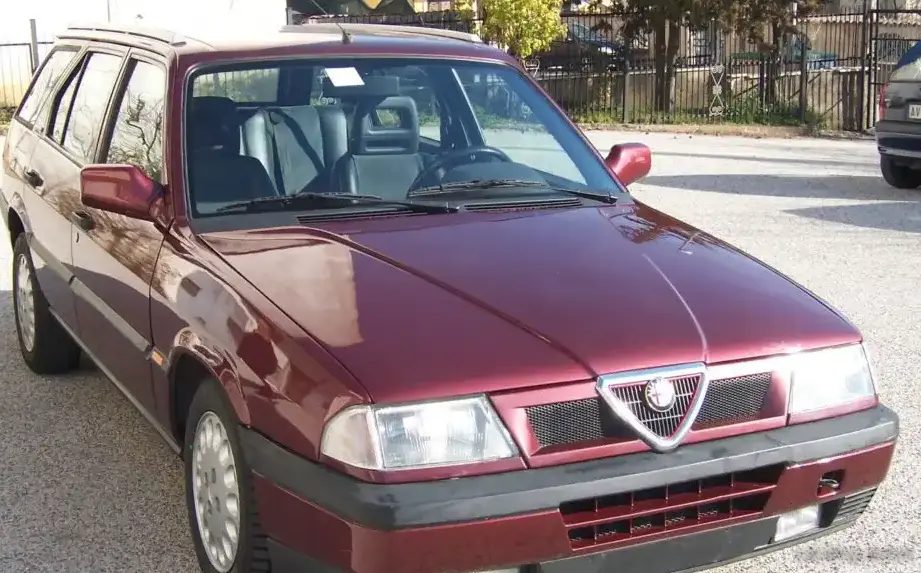
The Alfa Romeo 33 Sport Wagon (907B) 1.7 16V 4×4, produced between 1990 and 1992, represents a unique and relatively rare iteration of Alfa Romeo’s compact family car. Positioned as a premium offering within the 33 Sport Wagon range, this variant combined a high-performance 16-valve engine with all-wheel drive, offering a blend of practicality and engaging driving dynamics. It was part of the second series (907B) of the 33, which brought significant updates to the original 33 launched in 1983, particularly in terms of styling and mechanical refinement. The 907B series was built on the Alfa Romeo Type Four platform, shared with the Lancia Delta and Fiat Tipo.
Technical Specifications
| Brand | Alfa Romeo |
| Model | 33 |
| Generation | 33 Sport Wagon (907B) |
| Type (Engine) | 1.7 16V (132 Hp) 4×4 |
| Start of production | 1990 |
| End of production | 1992 |
| Powertrain Architecture | Internal Combustion engine |
| Body type | Station wagon (estate) |
| Seats | 5 |
| Doors | 5 |
| Fuel consumption (urban) | 10 l/100 km (23.5 US mpg) |
| Fuel Type | Petrol (Gasoline) |
| Acceleration 0 – 100 km/h | 9 sec |
| Acceleration 0 – 62 mph | 9 sec |
| Acceleration 0 – 60 mph | 8.6 sec |
| Weight-to-power ratio | 8.1 kg/Hp |
| Weight-to-torque ratio | 6.9 kg/Nm |
| Power | 132 Hp @ 6500 rpm |
| Power per litre | 77.1 Hp/l |
| Torque | 155 Nm @ 4600 rpm (114.32 lb.-ft. @ 4600 rpm) |
| Engine layout | Front, Transverse |
| Engine Model/Code | 307.46, 307.47 |
| Engine displacement | 1712 cm3 (104.47 cu. in.) |
| Number of cylinders | 4 |
| Engine configuration | Boxer |
| Cylinder Bore | 87 mm (3.43 in.) |
| Piston Stroke | 72 mm (2.83 in.) |
| Compression ratio | 10:1 |
| Number of valves per cylinder | 4 |
| Fuel injection system | Multi-port manifold injection |
| Engine aspiration | Naturally aspirated engine |
| Valvetrain | OHC |
| Engine oil capacity | 4 l (4.23 US qt | 3.52 UK qt) |
| Coolant capacity | 7.3 l (7.71 US qt | 6.42 UK qt) |
| Kerb Weight | 1065 kg (2347.92 lbs.) |
| Max. weight | 1490 kg (3284.89 lbs.) |
| Max load | 425 kg (936.96 lbs.) |
| Trunk (boot) space – minimum | 350 l (12.36 cu. ft.) |
| Trunk (boot) space – maximum | 1200 l (42.38 cu. ft.) |
| Fuel tank capacity | 50 l (13.21 US gal | 11 UK gal) |
| Length | 4200 mm (165.35 in.) |
| Width | 1615 mm (63.58 in.) |
| Height | 1375 mm (54.13 in.) |
| Wheelbase | 2475 mm (97.44 in.) |
| Front track | 1365 mm (53.74 in.) |
| Rear track | 1365 mm (53.74 in.) |
| Drive wheel | All wheel drive (4×4) |
| Number of gears | 5 |
| Gearbox type | Manual transmission |
| Front suspension | Coil spring |
| Rear suspension | Coil spring |
| Front brakes | Ventilated discs |
| Rear brakes | Disc |
| Assisting systems | ABS (Anti-lock braking system) |
| Steering type | Steering rack and pinion |
| Power steering | Hydraulic |
| Tires size | 185/60 R14 |
Powertrain & Engine Architecture
The heart of the 33 Sport Wagon 1.7 16V 4×4 is the Alfa Romeo 307 series engine. Specifically, the 307.46 and 307.47 codes denote slight variations within the 1.7-liter, 16-valve, boxer engine. This engine was a significant departure from Alfa Romeo’s traditional inline engines, offering a lower center of gravity and improved balance. The boxer configuration, with its horizontally opposed pistons, contributed to a smoother power delivery and reduced engine vibrations. The engine featured multi-port fuel injection, managed by an early electronic control unit (ECU), optimizing fuel delivery for performance and efficiency. The 16-valve cylinder head, with two valves per cylinder, maximized airflow, contributing to the engine’s 132 horsepower output. The five-speed manual transmission was specifically chosen to handle the engine’s torque and complement the all-wheel-drive system.
Driving Characteristics
The 1.7 16V 4×4 Sport Wagon offered a noticeably more engaging driving experience than its lower-powered siblings. While not a sports car in the purest sense, the combination of the responsive 16-valve engine and the surefootedness of all-wheel drive provided confident handling and traction, particularly in adverse weather conditions. Acceleration to 60 mph was achieved in around 8.6 seconds, respectable for a family wagon of the early 1990s. The all-wheel-drive system, a viscous coupling type, distributed power between the front and rear axles as needed, enhancing stability and grip. The five-speed manual transmission allowed drivers to fully exploit the engine’s powerband, with well-spaced gear ratios. Compared to the 1.4-liter versions, the 1.7 16V offered a significant performance boost, while the all-wheel drive provided superior handling compared to front-wheel-drive models.
Equipment & Trim Levels
The 33 Sport Wagon 1.7 16V 4×4 was generally well-equipped for its time, reflecting its position as a premium variant. Standard features typically included power steering, ABS anti-lock brakes, and a relatively comfortable interior with cloth upholstery. The dashboard layout was typical of early 1990s Italian design, with a functional and straightforward arrangement of gauges and controls. Optional extras could include electric windows, central locking, and a sunroof. The interior trim was generally focused on practicality and durability, with a focus on providing a comfortable and functional space for passengers and cargo.
Chassis & Braking
The 33 Sport Wagon utilized a relatively simple but effective chassis design. Front suspension consisted of coil springs and independent wishbones, while the rear employed a torsion beam axle with coil springs. The braking system featured ventilated discs on the front wheels and solid discs on the rear, providing adequate stopping power for the vehicle’s weight and performance. The ABS system further enhanced braking safety, preventing wheel lockup during hard braking. The all-wheel-drive system added to the vehicle’s overall weight, but also contributed to improved stability and handling.
Market Reception & Comparison
The Alfa Romeo 33 Sport Wagon 1.7 16V 4×4 was generally well-received by automotive critics, who praised its engaging driving dynamics and practical wagon body style. However, its relatively high price compared to other compact wagons limited its sales volume. Fuel economy was reasonable for the time, averaging around 23.5 mpg in urban driving. Reliability was a mixed bag, as with many Italian cars of the era. While the engine itself was generally robust, the electrical systems and some components were prone to issues. Compared to the more common 1.4-liter versions, the 1.7 16V 4×4 offered a significant performance upgrade, but at a higher cost of ownership.
Legacy
Today, the Alfa Romeo 33 Sport Wagon 1.7 16V 4×4 is a relatively rare and sought-after classic car. Its unique combination of performance, practicality, and Italian styling has earned it a dedicated following among Alfa Romeo enthusiasts. The boxer engine, while requiring specialized maintenance, is known for its durability and distinctive sound. Finding well-maintained examples can be challenging, and parts availability can be limited. However, for those willing to invest the time and effort, the 33 Sport Wagon 1.7 16V 4×4 offers a rewarding and engaging driving experience, representing a unique chapter in Alfa Romeo’s history.