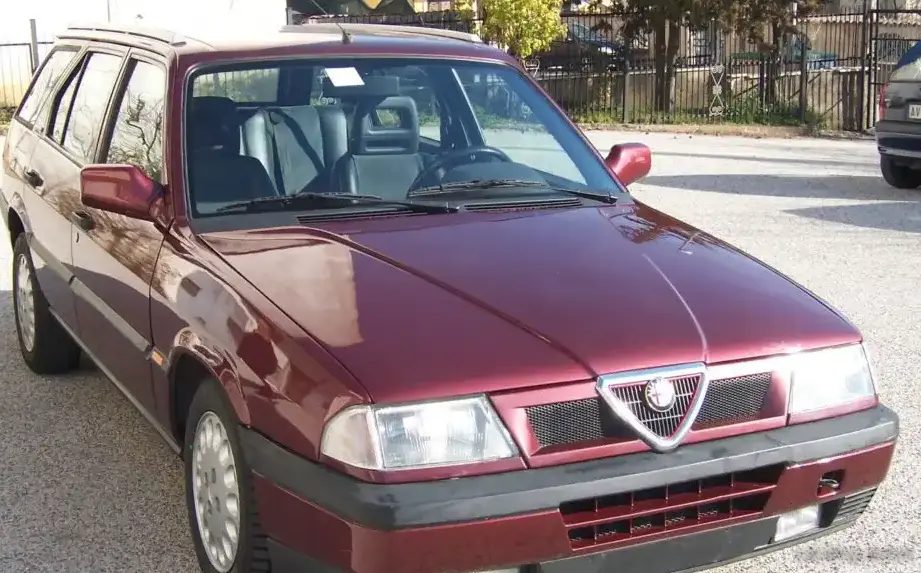
The Alfa Romeo 33 Sport Wagon, specifically the 1.7 i.e. 4×4 variant produced between 1990 and 1992, represents a unique offering within the 907B generation of the 33 series. Positioned as a more practical and all-weather capable version of the stylish 33, the Sport Wagon combined Alfa Romeo’s sporting heritage with the versatility of a station wagon body style. This particular model, equipped with a 1.7-liter inline-four engine producing 107 horsepower and a five-speed manual transmission, aimed to provide a balance between performance, fuel efficiency, and all-wheel drive security for the European market. It was a relatively niche model, appealing to buyers seeking a distinctive and capable family vehicle.
Technical Specifications
| Brand | Alfa Romeo |
| Model | 33 |
| Generation | 33 Sport Wagon (907B) |
| Type (Engine) | 1.7 i.e. (107 Hp) 4×4 |
| Start of production | 1990 |
| End of production | 1992 |
| Powertrain Architecture | Internal Combustion engine |
| Body type | Station wagon (estate) |
| Seats | 5 |
| Doors | 5 |
| Fuel consumption (urban) | 10.9 l/100 km (21.6 US mpg, 25.9 UK mpg, 9.2 km/l) |
| Fuel consumption (extra urban) | 5.7 l/100 km (41.3 US mpg, 49.6 UK mpg, 17.5 km/l) |
| Fuel consumption (combined) | 7.6 l/100 km (30.9 US mpg, 37.2 UK mpg, 13.2 km/l) |
| Fuel Type | Petrol (Gasoline) |
| Acceleration 0 – 100 km/h | 11.1 sec |
| Acceleration 0 – 62 mph | 11.1 sec |
| Acceleration 0 – 60 mph | 10.5 sec |
| Maximum speed | 185 km/h (114.95 mph) |
| Weight-to-power ratio | 9.7 kg/Hp, 103.4 Hp/tonne |
| Weight-to-torque ratio | 6.9 kg/Nm, 144 Nm/tonne |
| Power | 107 Hp @ 5800 rpm |
| Power per litre | 62.5 Hp/l |
| Torque | 149 Nm @ 4500 rpm (109.9 lb.-ft. @ 4500 rpm) |
| Engine layout | Front, Transverse |
| Engine Model/Code | 307.36 |
| Engine displacement | 1712 cm3 (104.47 cu. in.) |
| Number of cylinders | 4 |
| Engine configuration | Boxer |
| Cylinder Bore | 87 mm (3.43 in.) |
| Piston Stroke | 72 mm (2.83 in.) |
| Compression ratio | 9.5:1 |
| Number of valves per cylinder | 2 |
| Fuel injection system | Multi-port manifold injection |
| Engine aspiration | Naturally aspirated engine |
| Valvetrain | OHC |
| Engine oil capacity | 4 l (4.23 US qt | 3.52 UK qt) |
| Coolant | 7.8 l (8.24 US qt | 6.86 UK qt) |
| Kerb Weight | 1035 kg (2281.78 lbs.) |
| Max. weight | 1455 kg (3207.73 lbs.) |
| Max load | 420 kg (925.94 lbs.) |
| Trunk (boot) space – minimum | 350 l (12.36 cu. ft.) |
| Trunk (boot) space – maximum | 1200 l (42.38 cu. ft.) |
| Fuel tank capacity | 50 l (13.21 US gal | 11 UK gal) |
| Length | 4200 mm (165.35 in.) |
| Width | 1615 mm (63.58 in.) |
| Height | 1350 mm (53.15 in.) |
| Wheelbase | 2475 mm (97.44 in.) |
| Front track | 1365 mm (53.74 in.) |
| Rear (Back) track | 1365 mm (53.74 in.) |
| Drive wheel | All wheel drive (4×4) |
| Number of gears and type of gearbox | 5 gears, manual transmission |
| Front suspension | Coil spring |
| Rear suspension | Coil spring |
| Front brakes | Ventilated discs |
| Rear brakes | Disc |
| Assisting systems | ABS (Anti-lock braking system) |
| Steering type | Steering rack and pinion |
| Power steering | Hydraulic Steering |
| Tires size | 185/60 R14 |
Powertrain & Engine Architecture
The heart of the 33 Sport Wagon 1.7 i.e. 4×4 is the Alfa Romeo 307.36 engine, a 1712cc, naturally aspirated, inline-four cylinder unit. Unusually for Alfa Romeo, this engine employed a boxer configuration, meaning the pistons oppose each other horizontally. This design contributes to a lower center of gravity, improving handling characteristics. The engine features a single overhead camshaft (OHC) operating two valves per cylinder. Fuel delivery is managed by a multi-port fuel injection system, providing precise fuel metering for improved efficiency and performance. The 4×4 system utilizes a viscous coupling to distribute power between the front and rear axles, providing all-weather traction without the complexity of a more sophisticated system. The five-speed manual transmission was the only gearbox option for this variant, offering a direct connection between the engine and the wheels.
Driving Characteristics
The 107 horsepower and 149 Nm (109.9 lb-ft) of torque produced by the 1.7-liter engine provided adequate, but not overwhelming, performance. Acceleration from 0-60 mph took around 10.5 seconds, and the top speed was approximately 115 mph. Compared to the more powerful 1.8-liter or V6 versions of the 33, this variant felt noticeably less spirited. However, the manual transmission allowed drivers to make the most of the available power, and the all-wheel drive system provided enhanced grip in slippery conditions. The gear ratios were tuned for a balance between acceleration and fuel economy, making it a reasonably comfortable cruiser on the highway. The boxer engine provided a unique engine note and smooth power delivery.
Equipment & Trim Levels
The 1.7 i.e. 4×4 Sport Wagon typically came equipped with a reasonable level of standard features for its time. This included power steering, ABS brakes, and a relatively well-appointed interior with cloth upholstery. Optional extras included electric windows, central locking, and a sunroof. The dashboard layout was typical of early 1990s Alfa Romeos, with a focus on functionality and a sporty aesthetic. The interior space was generous for a compact station wagon, offering ample room for passengers and luggage. The trim level was generally considered mid-range within the 33 Sport Wagon lineup, sitting below the more luxurious and powerful versions.
Chassis & Braking
The 33 Sport Wagon utilized a relatively simple but effective chassis design. Front suspension consisted of coil springs and independent wishbones, while the rear featured a coil-sprung torsion beam axle. This setup provided a good balance between ride comfort and handling. Braking duties were handled by ventilated discs at the front and solid discs at the rear, providing adequate stopping power for the vehicle’s weight and performance. The hydraulic power steering offered a responsive and precise steering feel.
Market Reception & Comparison
The Alfa Romeo 33 Sport Wagon 1.7 i.e. 4×4 was generally well-received by automotive critics, who praised its stylish design, practical interior, and all-weather capability. However, some critics noted that the 1.7-liter engine felt underpowered compared to the larger-displacement options. Fuel economy was considered reasonable for the time, but not exceptional. Compared to other station wagons in its class, the 33 Sport Wagon offered a more distinctive and sporty driving experience. The 1.8-liter versions offered more power, but at the expense of fuel economy. The V6 models provided significantly more performance, but were considerably more expensive.
Legacy
The Alfa Romeo 33 Sport Wagon 1.7 i.e. 4×4, while not a high-volume seller, has gained a following among Alfa Romeo enthusiasts. The boxer engine, while requiring careful maintenance, is known for its durability and unique character. Today, these cars are relatively rare and sought after by collectors. The all-wheel drive system and practical station wagon body style make it a unique and appealing classic car. Finding parts can be challenging, but a dedicated community of Alfa Romeo owners and specialists exists to provide support and assistance. The 33 Sport Wagon represents a charming and distinctive example of Italian automotive design and engineering from the early 1990s.