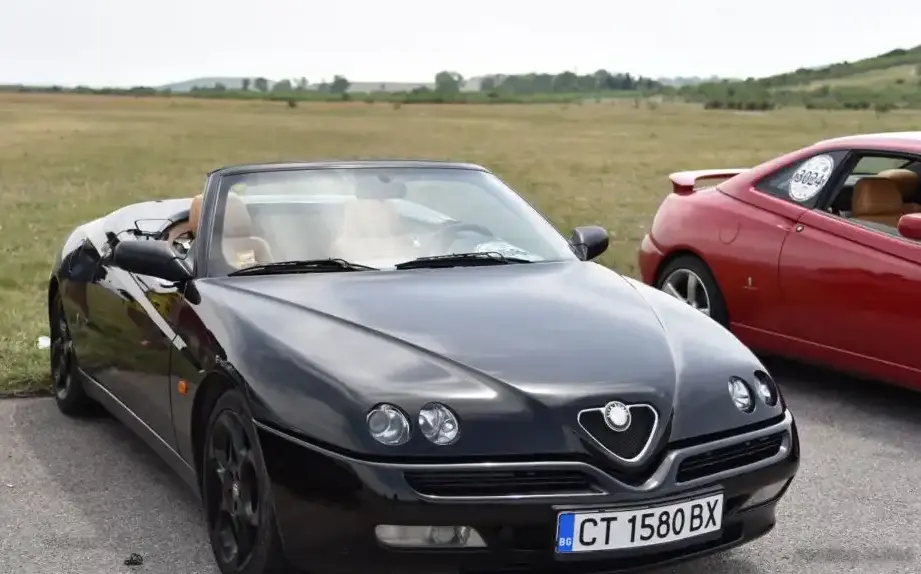
The Alfa Romeo Spider (916) 1.8 Twin Spark, produced from 1998 to 2002, represents a compelling entry point into the iconic Italian roadster lineage. Positioned as a more accessible variant within the 916 series – which also included more potent 2.0 Twin Spark and 3.0 V6 models – the 1.8 offered a blend of classic Alfa Romeo styling, engaging handling, and a relatively economical engine. It was a key model for attracting a broader customer base to the Spider, particularly those prioritizing style and driving pleasure over outright performance. The 916 generation Spider, designed by Pininfarina, aimed to recapture the spirit of the original Duetto while incorporating modern engineering and safety features. This variant played a significant role in maintaining the Spider’s presence in the European market during its production run.
Technical Specifications
| Brand | Alfa Romeo |
| Model | Spider |
| Generation | Spider (916) |
| Type (Engine) | 1.8 Twin Spark (144 Hp) |
| Start of production | 1998 |
| End of production | 2002 |
| Powertrain Architecture | Internal Combustion engine |
| Body type | Cabriolet |
| Seats | 2 |
| Doors | 2 |
| Fuel consumption (urban) | 12.9 l/100 km (18.2 US mpg, 21.9 UK mpg) |
| Fuel consumption (extra urban) | 6.5 l/100 km (36.2 US mpg, 43.5 UK mpg) |
| Fuel Type | Petrol (Gasoline) |
| Acceleration 0 – 100 km/h | 9 sec |
| Acceleration 0 – 62 mph | 9 sec |
| Acceleration 0 – 60 mph | 8.6 sec |
| Maximum speed | 205 km/h (127.38 mph) |
| Weight-to-power ratio | 9.4 kg/Hp |
| Weight-to-torque ratio | 8 kg/Nm |
| Power | 144 Hp @ 6500 rpm |
| Power per litre | 82.4 Hp/l |
| Torque | 169 Nm @ 3500 rpm (124.65 lb.-ft. @ 3500 rpm) |
| Engine layout | Front, Transverse |
| Engine Model/Code | AR 32201 |
| Engine displacement | 1747 cm3 (106.61 cu. in.) |
| Number of cylinders | 4 |
| Engine configuration | Inline |
| Cylinder Bore | 82 mm (3.23 in.) |
| Piston Stroke | 82.7 mm (3.26 in.) |
| Compression ratio | 10.3:1 |
| Number of valves per cylinder | 4 |
| Fuel injection system | Multi-port manifold injection |
| Engine aspiration | Naturally aspirated engine |
| Valvetrain | DOHC |
| Engine oil capacity | 4.4 l (4.65 US qt | 3.87 UK qt) |
| Coolant capacity | 8.4 l (8.88 US qt | 7.39 UK qt) |
| Kerb Weight | 1350 kg (2976.24 lbs.) |
| Max. weight | 1600 kg (3527.4 lbs.) |
| Max load | 250 kg (551.16 lbs.) |
| Trunk (boot) space – minimum | 110 l (3.88 cu. ft.) |
| Fuel tank capacity | 70 l (18.49 US gal | 15.4 UK gal) |
| Length | 4285 mm (168.7 in.) |
| Width | 1780 mm (70.08 in.) |
| Height | 1320 mm (51.97 in.) |
| Wheelbase | 2540 mm (100 in.) |
| Front track | 1500 mm (59.06 in.) |
| Rear track | 1505 mm (59.25 in.) |
| Drivetrain Architecture | Front wheel drive |
| Number of gears | 5 |
| Gearbox type | Manual transmission |
| Front suspension | Spring Strut |
| Rear suspension | Coil spring |
| Front brakes | Ventilated discs |
| Rear brakes | Disc |
| Assisting systems | ABS (Anti-lock braking system) |
| Steering type | Steering rack and pinion |
| Power steering | Hydraulic Steering |
| Tires size | 195/60 R15 |
Powertrain & Engine Architecture
The heart of the 1.8 Twin Spark Spider is the AR 32201 engine, a 1747cc inline-four cylinder powerplant. This engine is a descendant of Alfa Romeo’s long-standing Twin Spark philosophy, featuring two spark plugs per cylinder for improved combustion efficiency and reduced emissions. The engine utilizes a multi-port fuel injection system and a double overhead camshaft (DOHC) valvetrain, contributing to its responsive nature. The 1.8 Twin Spark produced 144 horsepower at 6500 rpm and 169 Nm (124.65 lb-ft) of torque at 3500 rpm. The engine’s relatively high-revving character is typical of Alfa Romeo designs. The standard transmission for this variant was a five-speed manual, although a Selespeed automated manual transmission was also offered as an option. The Selespeed, while offering convenience, was often criticized for its somewhat jerky shifts compared to the traditional manual.
Driving Characteristics
The 1.8 Twin Spark Spider offered a distinctly different driving experience compared to its more powerful siblings. While lacking the outright acceleration of the 2.0 or 3.0 models, the 1.8 provided a more balanced and accessible driving experience. The engine’s power delivery was smooth and linear, making it easy to modulate in everyday driving situations. The five-speed manual transmission featured relatively short gear ratios, encouraging drivers to keep the engine in its sweet spot. The Spider’s front-wheel-drive layout contributed to predictable handling, although it didn’t offer the same level of dynamic precision as rear-wheel-drive alternatives. The 1.8 Twin Spark was well-suited for spirited driving on winding roads, offering a good balance of performance and control. It wasn’t a track weapon, but it was a genuinely enjoyable car to drive.
Equipment & Trim Levels
The 1.8 Twin Spark Spider typically came equipped with a respectable level of standard features. Interior appointments included cloth upholstery, power windows, central locking, and an AM/FM radio. Optional extras included leather upholstery, air conditioning, a sunroof, and upgraded audio systems. The dashboard layout was typically Italian in its simplicity, focusing on functionality rather than excessive ornamentation. Trim levels were relatively limited, with most variations stemming from the addition of optional packages. The focus was on providing a stylish and well-equipped roadster at a competitive price point.
Chassis & Braking
The Spider 916 utilized a MacPherson strut front suspension and a coil spring rear suspension. The suspension setup was tuned to provide a comfortable ride while maintaining good handling characteristics. Braking duties were handled by ventilated discs at the front and solid discs at the rear. Anti-lock braking system (ABS) was standard equipment, enhancing safety and control. The steering was a hydraulic power-assisted rack and pinion system, providing precise and responsive steering feel. The relatively lightweight nature of the 1.8 Twin Spark variant, compared to the V6 models, contributed to its nimble handling.
Market Reception & Comparison
The 1.8 Twin Spark Spider was generally well-received by automotive critics as an affordable and stylish entry into the Alfa Romeo range. It was praised for its engaging driving dynamics, attractive design, and relatively economical fuel consumption. However, some critics noted that the engine lacked the outright punch of the larger-displacement models. Compared to the 2.0 Twin Spark, the 1.8 offered a more accessible price point but sacrificed some performance. Compared to the 3.0 V6, the 1.8 was significantly less powerful but offered better fuel economy and a lighter overall feel. Reliability was generally considered to be average for an Italian car of the era, with some owners reporting issues with electrical components and cooling systems.
Legacy
Today, the Alfa Romeo Spider (916) 1.8 Twin Spark is gaining recognition as a desirable classic roadster. Its relatively affordable price point and engaging driving experience make it an attractive option for enthusiasts. While not as sought-after as the V6 models, the 1.8 Twin Spark offers a unique blend of style, performance, and Italian flair. The engine, while not known for its bulletproof reliability, is generally considered to be relatively straightforward to maintain. Well-maintained examples are becoming increasingly rare, and values are slowly appreciating. The 1.8 Twin Spark Spider represents a compelling reminder of Alfa Romeo’s commitment to building passionate and engaging automobiles.