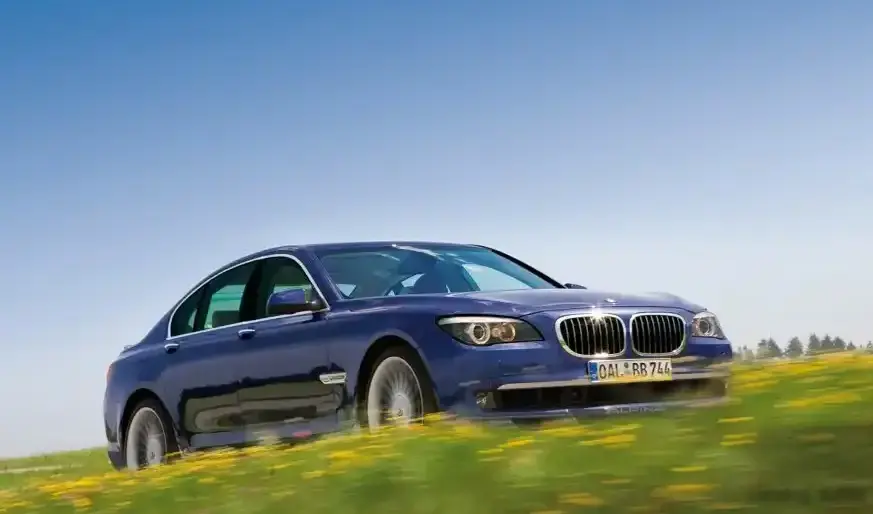
The Alpina B7 (E65/E66L) 4.4 V8, produced between 2005 and 2008, represents a high-performance iteration of the BMW 7 Series (E65/E66) luxury sedan. Alpina, a renowned German automotive engineering company, independently refined the 7 Series, focusing on enhanced performance, handling, and exclusivity. This model occupied the top echelon of the 7 Series lineup, positioned as a more driver-focused alternative to the standard BMW offerings, and competed with vehicles like the Porsche Panamera and high-performance versions of the Mercedes-Benz S-Class. The B7 was exclusively available as a long-wheelbase (L) model, further emphasizing its luxury orientation.
Technical Specifications
| Brand | Alpina |
| Model | B7 |
| Generation | B7 (E65/E66L) |
| Type (Engine) | 4.4 V8 (500 Hp) |
| Start of production | 2005 |
| End of production | 2008 |
| Powertrain Architecture | Internal Combustion engine |
| Body type | Sedan |
| Seats | 5 |
| Doors | 4 |
| Fuel consumption (economy) – urban | 20 l/100 km (11.8 US mpg, 14.1 UK mpg, 5 km/l) |
| Fuel consumption (economy) – extra urban | 10 l/100 km (23.5 US mpg, 28.2 UK mpg, 10 km/l) |
| Fuel Type | Petrol (Gasoline) |
| Acceleration 0 – 100 km/h | 5.5 sec |
| Acceleration 0 – 62 mph | 5.5 sec |
| Acceleration 0 – 60 mph | 5.2 sec |
| Maximum speed | 300 km/h (186.41 mph) |
| Emission standard | Euro 3 |
| Weight-to-power ratio | 3.9 kg/Hp, 253.8 Hp/tonne |
| Weight-to-torque ratio | 2.8 kg/Nm, 355.3 Nm/tonne |
| Power | 500 Hp @ 5500 rpm |
| Power per litre | 113.7 Hp/l |
| Torque | 700 Nm @ 4250 rpm (516.29 lb.-ft. @ 4250 rpm) |
| Engine layout | Front, Longitudinal |
| Engine displacement | 4398 cm3 (268.38 cu. in.) |
| Number of cylinders | 8 |
| Engine configuration | V-engine |
| Cylinder Bore | 92 mm (3.62 in.) |
| Piston Stroke | 82.7 mm (3.26 in.) |
| Compression ratio | 9:1 |
| Number of valves per cylinder | 4 |
| Fuel injection system | Multi-port manifold injection |
| Engine aspiration | Supercharger, Intercooler |
| Valvetrain | DOHC |
| Kerb Weight | 1970 kg (4343.11 lbs.) |
| Max. weight | 2510 kg (5533.6 lbs.) |
| Max load | 540 kg (1190.5 lbs.) |
| Trunk (boot) space – minimum | 500 l (17.66 cu. ft.) |
| Fuel tank capacity | 88 l (23.25 US gal, 19.36 UK gal) |
| Length | 5030 mm (198.03 in.) |
| Width | 1900 mm (74.8 in.) |
| Height | 1480 mm (58.27 in.) |
| Wheelbase | 2990 mm (117.72 in.) |
| Front track | 1580 mm (62.2 in.) |
| Rear (Back) track | 1580 mm (62.2 in.) |
| Drivetrain Architecture | The Internal combustion engine (ICE) drives the rear wheels of the vehicle. |
| Drive wheel | Rear wheel drive |
| Number of gears and type of gearbox | 6 gears, automatic transmission |
| Front suspension | Spring Strut, Transverse stabilizer |
| Rear suspension | Independent multi-link suspension, Air suspension |
| Front brakes | Ventilated discs |
| Rear brakes | Ventilated discs |
| Assisting systems | ABS (Anti-lock braking system) |
| Steering type | Steering rack and pinion |
| Power steering | Hydraulic Steering |
| Tires size | Front wheel tires: 245/35 R21 Rear wheel tires: 285/30 R21 |
| Wheel rims size | Front wheel rims: 9J x 21 Rear wheel rims: 10J x 21 |
Powertrain & Engine Architecture
At the heart of the Alpina B7 lies a modified version of BMW’s N62 4.4-liter V8 engine. Alpina significantly enhanced this engine with a mechanically driven supercharger, an intercooler, and revised engine management software. The engine code remained largely consistent with BMW’s internal designations, but Alpina’s modifications were extensive. The supercharger, unlike a turbocharger, provides instant boost across the rev range, contributing to the B7’s characteristic linear power delivery. The engine utilized multi-port fuel injection and a double overhead camshaft (DOHC) valvetrain. The 6-speed automatic transmission was also sourced from BMW but recalibrated by Alpina for quicker shifts and improved responsiveness. This transmission was crucial in managing the engine’s substantial 700 Nm (516 lb-ft) of torque.
Driving Characteristics
The B7’s driving experience was markedly different from the standard 7 Series. The supercharged V8 delivered effortless acceleration, with a 0-60 mph time of around 5.2 seconds and a governed top speed of 300 km/h (186 mph). The automatic transmission, while smooth, was tuned for performance, holding gears longer and downshifting more readily than the standard BMW transmission. The suspension, featuring Alpina-tuned dampers and air suspension on the rear axle, provided a comfortable ride while minimizing body roll during cornering. Compared to the naturally aspirated 745i or the diesel-powered 730d, the B7 offered a significantly more engaging and powerful driving experience. The supercharger eliminated the turbo lag present in some turbocharged BMW models, providing immediate throttle response.
Equipment & Trim Levels
The Alpina B7 came exceptionally well-equipped, building upon the already luxurious BMW 7 Series. Standard features included premium leather upholstery, wood trim, a high-end audio system, and a comprehensive suite of safety features. The long wheelbase provided ample rear legroom, enhancing the passenger experience. Alpina offered a range of bespoke options, allowing customers to personalize their vehicles with unique interior and exterior finishes. These options included custom leather colors, individual wood veneers, and Alpina-specific aerodynamic enhancements. The interior featured Alpina-branded gauges, steering wheel, and switchgear, further differentiating it from the standard BMW.
Chassis & Braking
The B7’s chassis benefited from Alpina’s expertise in handling and dynamics. The suspension was specifically tuned to complement the increased power output, with stiffer springs and dampers. The rear air suspension allowed for adjustable ride height and automatic leveling. Braking duties were handled by ventilated disc brakes on all four wheels, providing ample stopping power. The anti-lock braking system (ABS) was standard, ensuring safe and controlled braking in various conditions. The B7 retained the BMW 7 Series’ robust chassis structure, providing a solid foundation for the enhanced performance.
Market Reception & Comparison
The Alpina B7 was generally well-received by automotive critics, who praised its blend of luxury, performance, and exclusivity. It was often lauded as a more engaging alternative to the standard 7 Series, offering a unique driving experience. Fuel economy, however, was a concern, with the B7 consuming a significant amount of fuel, particularly in urban driving. Compared to the BMW 750i, the B7 offered a more refined and responsive engine, thanks to the supercharger. The B7’s higher price tag reflected its exclusivity and the extensive modifications performed by Alpina.
Legacy
The Alpina B7 (E65/E66L) remains a sought-after vehicle among enthusiasts and collectors. The supercharged V8 engine is known for its reliability, provided it receives regular maintenance. The B7’s unique character and limited production numbers have contributed to its increasing value in the used car market. While maintenance costs can be higher than those of a standard BMW 7 Series, the B7’s performance and exclusivity make it a compelling choice for those seeking a high-performance luxury sedan. The E65/E66 generation B7 solidified Alpina’s reputation as a builder of exceptional, hand-refined automobiles.