Technical Specifications
| Brand | Alpina |
| Model | D3 |
| Generation | D3 Touring (E91) |
| Type (Engine) | 2.0 Bi-Turbo Diesel (214 Hp) Switch-Tronic |
| Start of production | 2008 |
| End of production | 2013 |
| Powertrain Architecture | Internal Combustion engine |
| Body type | Station wagon (estate) |
| Seats | 5 |
| Doors | 5 |
| Fuel consumption (economy) – urban (NEDC) | 8.3 l/100 km (28.3 US mpg, 34 UK mpg, 12 km/l) |
| Fuel consumption (economy) – extra urban (NEDC) | 4.9 l/100 km (48 US mpg, 57.6 UK mpg, 20.4 km/l) |
| Fuel consumption (economy) – combined (NEDC) | 6.1 l/100 km (38.6 US mpg, 46.3 UK mpg, 16.4 km/l) |
| CO2 emissions (NEDC) | 162 g/km |
| Fuel Type | Diesel |
| Acceleration 0 – 100 km/h | 7.2 sec |
| Acceleration 0 – 62 mph | 7.2 sec |
| Acceleration 0 – 60 mph | 6.8 sec |
| Maximum speed | 241 km/h (149.75 mph) |
| Emission standard | Euro 5 |
| Weight-to-power ratio | 7.3 kg/Hp, 137.2 Hp/tonne |
| Weight-to-torque ratio | 3.5 kg/Nm, 288.5 Nm/tonne |
| Power | 214 Hp @ 4100 rpm |
| Power per litre | 107.3 Hp/l |
| Torque | 450 Nm @ 2000 rpm (331.9 lb.-ft. @ 2000 rpm) |
| Engine layout | Front, Longitudinal |
| Engine Model/Code | Alpina N1 |
| Engine displacement | 1995 cm3 (121.74 cu. in.) |
| Number of cylinders | 4 |
| Engine configuration | Inline |
| Cylinder Bore | 84 mm (3.31 in.) |
| Piston Stroke | 90 mm (3.54 in.) |
| Compression ratio | 17:1 |
| Number of valves per cylinder | 4 |
| Fuel injection system | Diesel Commonrail |
| Engine aspiration | BiTurbo, Intercooler |
| Valvetrain | DOHC |
| Engine systems | Particulate filter |
| Kerb Weight | 1560 kg (3439.21 lbs.) |
| Max. weight | 2100 kg (4629.71 lbs.) |
| Max load | 540 kg (1190.5 lbs.) |
| Trunk (boot) space – minimum | 460 l (16.24 cu. ft.) |
| Trunk (boot) space – maximum | 1385 l (48.91 cu. ft.) |
| Fuel tank capacity | 61 l (16.11 US gal, 13.42 UK gal) |
| Permitted trailer load with brakes (12%) | 1600 kg (3527.4 lbs.) |
| Permitted trailer load without brakes | 745 kg (1642.44 lbs.) |
| Length | 4541 mm (178.78 in.) |
| Width | 1817 mm (71.54 in.) |
| Height | 1450 mm (57.09 in.) |
| Wheelbase | 2760 mm (108.66 in.) |
| Front track | 1500 mm (59.06 in.) |
| Rear (Back) track | 1513 mm (59.57 in.) |
| Drivetrain Architecture | The Internal combustion engine (ICE) drives the rear wheels of the vehicle. |
| Drive wheel | Rear wheel drive |
| Number of gears and type of gearbox | 6 gears, automatic transmission |
| Front suspension | Spring Strut |
| Rear suspension | Coil spring |
| Front brakes | Ventilated discs, 375 mm |
| Rear brakes | Ventilated discs, 300 mm |
| Assisting systems | ABS (Anti-lock braking system) |
| Steering type | Steering rack and pinion |
| Power steering | Hydraulic Steering |
| Tires size | Front wheel tires: 245/40 R18 Rear wheel tires: 265/40 R18 |
| Wheel rims size | Front wheel rims: 8J x 18 Rear wheel rims: 9J x 18 |
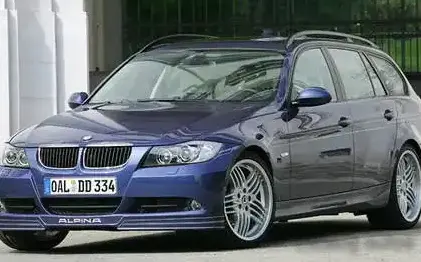
The Alpina D3 Touring (E91) 2.0 Bi-Turbo Diesel, produced between 2008 and 2013, represents a unique blend of performance and practicality within the BMW E91 3 Series Touring range. Alpina, a renowned German automotive engineering company, took the standard 3 Series and elevated it with significant mechanical and aesthetic enhancements. This particular variant, powered by a 2.0-liter turbocharged diesel engine producing 214 horsepower, occupied a middle ground in the D3 lineup, offering a compelling alternative to the more common petrol-powered models and the higher-output diesel versions. It was primarily marketed in Europe, where diesel engines held a substantial market share and were favored for their fuel efficiency and torque.
Powertrain & Engine Architecture
At the heart of the D3 Touring lies the Alpina N1 engine, a 2.0-liter inline-four cylinder diesel. This engine isn’t a direct derivative of BMW’s standard diesel units; Alpina extensively modified it with twin turbochargers, a larger intercooler, and a revised engine management system. The engine utilizes a common rail direct injection system, delivering fuel at extremely high pressure for optimized combustion. The twin-turbo setup, with one smaller and one larger turbocharger, provides both immediate response and sustained power delivery. The valvetrain features a double overhead camshaft (DOHC) design with four valves per cylinder. A particulate filter was standard to meet Euro 5 emission standards. The engine is longitudinally mounted in the front of the vehicle. The “Switch-Tronic” transmission is a six-speed automatic gearbox developed in collaboration with ZF, offering both fully automatic operation and manual gear selection via steering wheel-mounted paddles or the gear selector.
Driving Characteristics
The 214 horsepower and 450 Nm (331.9 lb-ft) of torque delivered by the N1 engine provide brisk acceleration. The 0-60 mph sprint takes approximately 6.8 seconds, and the car reaches a top speed of 149.75 mph. While not as overtly sporty as the petrol-powered D3 variants, the 2.0 Bi-Turbo Diesel offers ample power for everyday driving and long-distance cruising. The automatic transmission is well-tuned, providing smooth and responsive gear changes. The gear ratios are optimized for both acceleration and fuel efficiency. Compared to the manual transmission versions, the automatic offers greater convenience, but some enthusiasts might find it slightly less engaging. The torque curve is remarkably flat, providing strong pull throughout the rev range, making overtaking effortless.
Equipment & Trim Levels
The Alpina D3 Touring came generously equipped as standard. Interior features typically included leather upholstery, Alpina-specific interior trim (wood or aluminum), sports seats, and a premium sound system. Standard exterior features included Alpina’s signature front spoiler, rear spoiler, and unique alloy wheels (typically 18-inch). Optional extras included a panoramic sunroof, navigation system, adaptive headlights, and upgraded leather options. The D3 Touring aimed for a luxurious and refined experience, with a focus on comfort and quality materials.
Chassis & Braking
Alpina made significant revisions to the chassis to complement the increased power. The suspension was retuned with stiffer springs and dampers, and larger stabilizer bars were fitted to reduce body roll. The D3 Touring featured ventilated disc brakes on all four wheels, with larger front discs (375mm) compared to the standard 3 Series. ABS (Anti-lock Braking System) was standard. The steering system utilized a hydraulic power steering setup, providing precise and communicative feedback. The suspension setup aimed to strike a balance between sporty handling and comfortable ride quality.
Market Reception & Comparison
The Alpina D3 Touring (E91) was generally well-received by automotive critics. It was praised for its blend of performance, practicality, and refinement. The 2.0 Bi-Turbo Diesel variant was seen as a sensible option for those prioritizing fuel economy and low-end torque. Compared to the more powerful D3 variants (such as the 3.0-liter six-cylinder diesel), the 2.0 offered a lower price point and slightly better fuel economy. However, it lacked the outright performance and aural excitement of its larger-engined siblings. Against competitors like the Audi S4 Avant and the BMW 335d Touring, the D3 offered a unique combination of Alpina’s bespoke engineering and a luxurious driving experience.
Legacy
The Alpina D3 Touring (E91) 2.0 Bi-Turbo Diesel has proven to be a relatively reliable vehicle. The N1 engine, while complex, is generally robust when properly maintained. Common issues include turbocharger wear and potential problems with the diesel particulate filter. The Switch-Tronic transmission is also generally reliable, but regular fluid changes are essential. Today, the D3 Touring is a sought-after vehicle among enthusiasts who appreciate its unique character and blend of performance and practicality. Values for well-maintained examples have been steadily increasing, reflecting its status as a niche and desirable performance wagon.