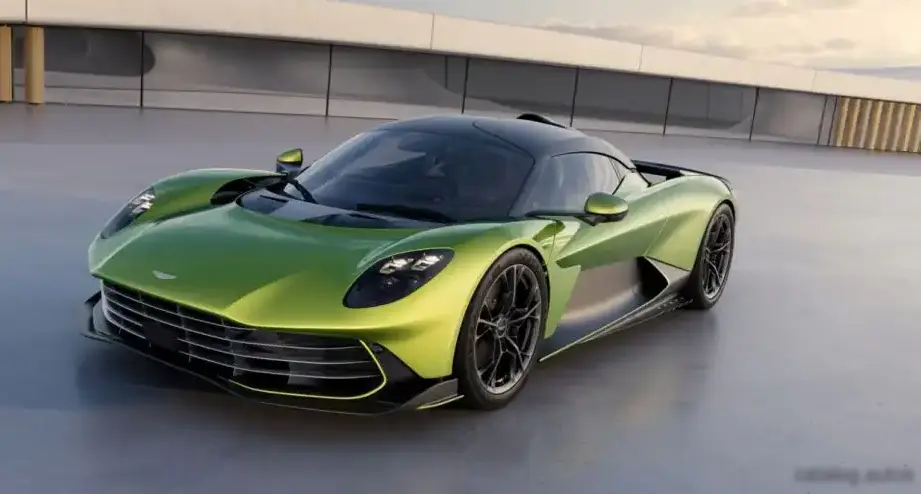
The Aston Martin Valhalla 4.0 V8 (1079 Hp) Plug-in Hybrid E-AWDD DCT represents a significant departure for the British marque, blending the performance expectations of an Aston Martin with cutting-edge hybrid technology. Production commenced in 2025, positioning the Valhalla as a mid-engined, two-seater coupe designed to compete with the likes of the Ferrari 296 GTB and McLaren Artura. It’s a crucial model for Aston Martin, embodying their commitment to electrification and advanced powertrain development. The Valhalla utilizes a sophisticated plug-in hybrid system centered around a 4.0-liter twin-turbocharged V8 engine, delivering a combined output of over 1000 horsepower.
Technical Specifications
| Brand | Aston Martin |
| Model | Valhalla |
| Generation | Valhalla |
| Type (Engine) | 4.0 V8 (1079 Hp) Plug-in Hybrid E-AWDD DCT |
| Start of production | 2025 |
| Powertrain Architecture | PHEV (Plug-in Hybrid Electric Vehicle) |
| Body type | Coupe |
| Seats | 2 |
| Doors | 2 |
| Fuel Type | Petrol / electricity |
| Acceleration 0 – 100 km/h | 2.5 sec |
| Acceleration 0 – 62 mph | 2.5 sec |
| Acceleration 0 – 60 mph | 2.4 sec |
| Maximum speed | 350 km/h (217.48 mph) |
| Weight-to-power ratio | 1.5 kg/Hp, 652 Hp/tonne |
| Weight-to-torque ratio | 1.5 kg/Nm, 664.7 Nm/tonne |
| Gross battery capacity | 6.1 kWh |
| Battery voltage | 400 V |
| Battery location | Behind the back wall of the passenger cabin |
| All-electric range | 14 km (8.7 mi) |
| Max speed (electric) | 140 km/h (86.99 mph) |
| System power | 1079 Hp @ 6700 rpm |
| System torque | 1100 Nm (811.32 lb.-ft.) |
| Power | 828 Hp |
| Torque | 857 Nm (632.09 lb.-ft.) @ 6700 rpm |
| Maximum engine speed | 7000 rpm |
| Engine layout | Middle, Longitudinal |
| Number of cylinders | 8 |
| Engine configuration | V-engine |
| Number of valves per cylinder | 4 |
| Engine aspiration | 2 x Twin-scroll turbo, Intercooler |
| Valvetrain | DOHC |
| Kerb Weight | 1655 kg (3648.65 lbs.) |
| Fuel tank capacity | 65 l (17.17 US gal | 14.3 UK gal) |
| Length | 4727 mm (186.1 in.) |
| Width | 2014 mm (79.29 in.) |
| Width including mirrors | 2208 mm (86.93 in.) |
| Height | 1161 mm (45.71 in.) |
| Wheelbase | 2760 mm (108.66 in.) |
| Front overhang | 1038 mm (40.87 in.) |
| Rear overhang | 927 mm (36.5 in.) |
| Ride height (ground clearance) | 109 mm (4.29 in.) |
| Minimum turning circle | 12.5 m (41.01 ft.) |
| Front tires | 285/30 ZR20 |
| Rear tires | 335/30 ZR21 |
| Front rims | 20 |
| Rear rims | 21 |
| Number of gears | 8 |
| Gearbox type | automatic transmission DCT |
Powertrain & Engine Architecture
At the heart of the Valhalla lies a hand-built 4.0-liter twin-turbocharged V8 engine, derived from the unit found in the DBX707 and Vantage. However, the Valhalla’s engine is specifically tuned to produce 828 horsepower. This internal combustion engine is paired with a sophisticated plug-in hybrid system. Three electric motors – one integrated into the rear axle and two driving the front wheels – contribute an additional 251 horsepower, bringing the total system output to 1079 horsepower and 811 lb-ft of torque. The electric motors are synchronous units, capable of spinning up to 18,800 rpm. The 6.1 kWh battery pack, located behind the passenger compartment, allows for an all-electric range of approximately 8.7 miles. The powertrain utilizes an 8-speed dual-clutch transmission (DCT), optimized for rapid shifts and efficient power delivery. The E-AWDD (Electric All-Wheel Drive) system allows for fully electric front-wheel drive, rear-wheel drive via the ICE and rear electric motor, or a combination of all four wheels for maximum traction.
Driving Characteristics
The Valhalla’s powertrain delivers astonishing performance. The combined output and all-wheel-drive system enable a 0-60 mph sprint in just 2.4 seconds and a top speed of 217 mph. The DCT transmission provides incredibly quick gear changes, enhancing the car’s responsiveness. The electric motors provide instant torque, filling in any gaps in the V8’s power delivery. The E-AWDD system allows for precise torque vectoring, improving cornering agility. While the Valhalla is designed for track performance, the hybrid system also allows for quiet and efficient electric-only driving in urban environments. The suspension is tuned for a balance between comfort and control, providing a surprisingly compliant ride for such a high-performance vehicle.
Equipment & Trim Levels
The Valhalla is positioned as a high-performance, technologically advanced offering within Aston Martin’s lineup. Standard equipment includes a lightweight carbon fiber chassis, advanced aerodynamics, and a luxurious interior. The interior features a minimalist design with a focus on driver engagement. Seats are sculpted for optimal support and comfort, and are trimmed in high-quality leather and Alcantara. A digital instrument cluster and a central infotainment screen provide essential information and control over vehicle functions. Optional extras include bespoke paint finishes, personalized interior trim options, and advanced driver assistance systems. The Valhalla is not offered with traditional trim levels; instead, customers can personalize their vehicles through Aston Martin’s ‘Q by Aston Martin’ customization service.
Chassis & Braking
The Valhalla utilizes a bonded aluminum chassis with carbon fiber structural elements, resulting in a lightweight and exceptionally rigid platform. The suspension features coil springs, double wishbones, and transverse stabilizers at the front, and an independent multi-link setup with a stabilizer at the rear. This configuration provides excellent handling and stability. The braking system consists of ventilated discs – 410mm at the front and 390mm at the rear – providing ample stopping power. ABS (Anti-lock Braking System) is standard, along with electric power steering for precise and responsive control.
Market Reception & Comparison
The Valhalla has been met with considerable anticipation and positive reviews. Critics praise its innovative hybrid powertrain, exceptional performance, and advanced technology. Compared to its rivals, such as the Ferrari 296 GTB and McLaren Artura, the Valhalla offers a unique combination of power, efficiency, and driver engagement. While the Ferrari emphasizes emotional connection and the McLaren focuses on lightweight agility, the Valhalla aims to deliver a more balanced experience. Fuel economy figures are still being finalized, but the hybrid system is expected to provide significantly better efficiency than traditional high-performance supercars. Reliability data is currently unavailable, as the Valhalla is a new model, but Aston Martin has invested heavily in quality control and engineering to ensure long-term durability.
Legacy
The Aston Martin Valhalla represents a pivotal moment for the brand, signaling its commitment to a future of electrified performance. The powertrain technology developed for the Valhalla is expected to influence future Aston Martin models. The car’s innovative hybrid system and advanced chassis design are likely to set new standards in the supercar segment. As a limited-production, high-performance vehicle, the Valhalla is expected to become a highly sought-after collectible in the future. Its long-term reliability will depend on the robustness of its complex hybrid system, but Aston Martin’s dedication to engineering and quality suggests that the Valhalla will be a durable and rewarding machine for years to come.