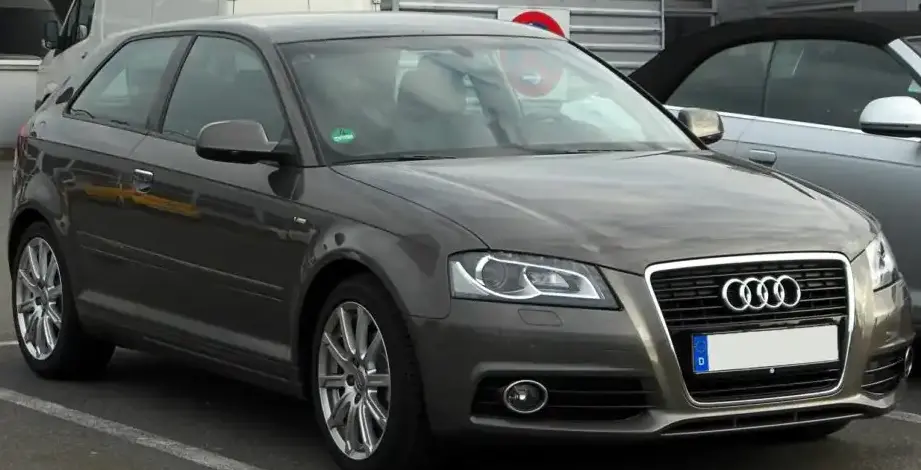
The Audi A3 (8P) facelift, produced from 2008 to 2013, represented a significant refresh of Audi’s popular compact hatchback. Within this generation, the 2.0 TDI variant with 140 horsepower and the S tronic dual-clutch transmission (DPF equipped) occupied a crucial middle ground in the lineup. This model aimed to balance fuel efficiency, performance, and refinement, appealing to buyers seeking a premium driving experience without the higher costs associated with the range-topping engines. It was a key offering in the European market, where diesel engines and compact hatchbacks were – and continue to be – highly favored.
Technical Specifications
| Brand | Audi |
| Model | A3 |
| Generation | A3 (8P, facelift 2008) |
| Type (Engine) | 2.0 TDI (140 Hp) S tronic DPF |
| Start of production | 2008 |
| End of production | 2013 |
| Powertrain Architecture | Internal Combustion engine |
| Body type | Hatchback |
| Seats | 5 |
| Doors | 3 |
| Fuel consumption (urban) | 7.2 l/100 km (32.7 US mpg, 39.2 UK mpg, 13.9 km/l) |
| Fuel consumption (extra urban) | 4.4 l/100 km (53.5 US mpg, 64.2 UK mpg, 22.7 km/l) |
| Fuel consumption (combined) | 5.4 l/100 km (43.6 US mpg, 52.3 UK mpg, 18.5 km/l) |
| Fuel Type | Diesel |
| Acceleration 0 – 100 km/h | 9.4 sec |
| Acceleration 0 – 62 mph | 9.4 sec |
| Acceleration 0 – 60 mph | 8.9 sec |
| Maximum speed | 207 km/h (128.62 mph) |
| Emission standard | Euro 4 |
| Weight-to-power ratio | 10.3 kg/Hp, 96.9 Hp/tonne |
| Weight-to-torque ratio | 4.5 kg/Nm, 221.5 Nm/tonne |
| Power | 140 Hp @ 4000 rpm |
| Power per litre | 71.1 Hp/l |
| Torque | 320 Nm @ 1750 rpm (236.02 lb.-ft. @ 1750 rpm) |
| Engine layout | Front, Transverse |
| Engine Model/Code | CBAB, CFFB, CLJA |
| Engine displacement | 1968 cm3 (120.09 cu. in.) |
| Number of cylinders | 4 |
| Engine configuration | Inline |
| Cylinder Bore | 81 mm (3.19 in.) |
| Piston Stroke | 95.5 mm (3.76 in.) |
| Compression ratio | 18:1 |
| Number of valves per cylinder | 4 |
| Fuel injection system | Diesel Commonrail |
| Engine aspiration | Turbocharger, Intercooler |
| Valvetrain | DOHC |
| Engine oil capacity | 4 l (4.23 US qt | 3.52 UK qt) |
| Kerb Weight | 1445 kg (3185.68 lbs.) |
| Max. weight | 1930 kg (4254.92 lbs.) |
| Max load | 485 kg (1069.24 lbs.) |
| Trunk (boot) space – minimum | 350 l (12.36 cu. ft.) |
| Trunk (boot) space – maximum | 1100 l (38.85 cu. ft.) |
| Fuel tank capacity | 55 l (14.53 US gal | 12.1 UK gal) |
| Length | 4238 mm (166.85 in.) |
| Width | 1765 mm (69.49 in.) |
| Height | 1421 mm (55.94 in.) |
| Wheelbase | 2578 mm (101.5 in.) |
| Front track | 1536 mm (60.47 in.) |
| Rear (Back) track | 1517 mm (59.72 in.) |
| Minimum turning circle | 10.7 m (35.1 ft.) |
| Drivetrain Architecture | The Internal combustion engine (ICE) drives the front wheels of the vehicle. |
| Drive wheel | Front wheel drive |
| Number of gears and type of gearbox | 6 gears, automatic transmission S-Tronic |
| Front suspension | Spring Strut |
| Rear suspension | Coil spring |
| Front brakes | Ventilated discs |
| Rear brakes | Disc |
| Assisting systems | ABS (Anti-lock braking system) |
| Steering type | Steering rack and pinion |
| Power steering | Hydraulic Steering |
| Tires size | 205/55 R16; 225/45 R17 |
| Wheel rims size | 7.5J x 17; 6.5J x 16 |
INTRODUCTION
The Audi A3 (8P) facelift, launched in 2008, built upon the success of the original 8P model, introducing revised styling, improved interior materials, and updated technology. The 2.0 TDI 140 hp S tronic variant was a popular choice, particularly in Europe, where diesel engines were favored for their fuel efficiency and torque. This version slotted into the A3 range between the lower-powered 1.6 TDI and the more potent 2.0 TDI 170 hp models. It offered a compelling blend of performance and economy, making it suitable for both daily commuting and longer journeys. The S tronic transmission, Audi’s dual-clutch gearbox, further enhanced the driving experience with its quick and smooth gear changes.
Powertrain & Engine Architecture
The heart of this A3 variant is the 2.0-liter inline-four cylinder diesel engine, identified by engine codes CBAB, CFFB, or CLJA depending on the specific production year and market. This engine utilizes a common rail direct injection system, delivering fuel directly into the combustion chamber at extremely high pressure. This technology, combined with a turbocharger and intercooler, optimizes combustion efficiency and boosts power output. The engine features a double overhead camshaft (DOHC) valvetrain with four valves per cylinder, further enhancing breathing and performance. The S tronic transmission is a six-speed dual-clutch gearbox. It operates similarly to two manual gearboxes in one, with one clutch controlling the odd gears and the other controlling the even gears. This allows for incredibly fast and seamless gear changes, improving both acceleration and fuel economy. A diesel particulate filter (DPF) was standard equipment to meet increasingly stringent emissions regulations.
Driving Characteristics
The 2.0 TDI 140 hp S tronic A3 offered a refined and capable driving experience. While not as overtly sporty as the higher-powered versions, it provided ample torque – 320 Nm (236 lb-ft) – from as low as 1750 rpm. This made it feel responsive in everyday driving situations, with strong acceleration for overtaking and merging. The S tronic transmission contributed significantly to the driving experience, providing quick and smooth gear changes, especially in automatic mode. The gear ratios were tuned to prioritize fuel efficiency, but also allowed for brisk acceleration. Compared to the manual transmission versions, the S tronic offered greater convenience and ease of use, particularly in urban traffic. However, some enthusiasts preferred the more engaging feel of a manual gearbox.
Equipment & Trim Levels
The 2.0 TDI 140 hp S tronic typically came equipped with a generous level of standard features. These included air conditioning, a multi-function steering wheel, electric windows, and an audio system with CD player. Higher trim levels, such as Sport or SE, added features like alloy wheels, sports seats, parking sensors, and upgraded infotainment systems. Optional extras included a sunroof, leather upholstery, and a navigation system. Interior upholstery was typically cloth, but leather options were available. The dashboard layout was clean and functional, with a focus on ergonomics and ease of use.
Chassis & Braking
The A3 8P utilized a MacPherson strut front suspension and a multi-link rear suspension, providing a good balance between ride comfort and handling. The suspension was tuned to be slightly softer than the more performance-oriented S3 model, prioritizing comfort for everyday driving. The braking system consisted of ventilated discs at the front and solid discs at the rear. Anti-lock braking system (ABS) was standard, providing enhanced stopping power and stability. Stabilizer bars were fitted to both the front and rear axles to reduce body roll during cornering.
Market Reception & Comparison
The 2.0 TDI 140 hp S tronic A3 was generally well-received by automotive critics. It was praised for its fuel efficiency, refined engine, and smooth-shifting transmission. Compared to the 1.6 TDI, it offered a noticeable performance upgrade, while remaining more affordable than the 2.0 TDI 170 hp. Fuel economy was a key selling point, with combined figures around 5.4 l/100 km (43.6 US mpg). Reliability was generally good, although, like all modern diesel engines, the DPF could be prone to clogging if the vehicle was primarily used for short journeys.
Legacy
The Audi A3 8P 2.0 TDI 140 hp S tronic remains a popular choice in the used car market. Its combination of fuel efficiency, practicality, and refinement continues to appeal to buyers. The 2.0 TDI engine, while requiring regular maintenance, is generally considered to be durable and reliable. The S tronic transmission, if properly maintained, can provide years of smooth and reliable operation. However, potential buyers should be aware of the potential for DPF issues and ensure that the vehicle has been regularly serviced. Overall, this A3 variant represents a well-rounded and capable compact hatchback that continues to offer a compelling ownership experience.