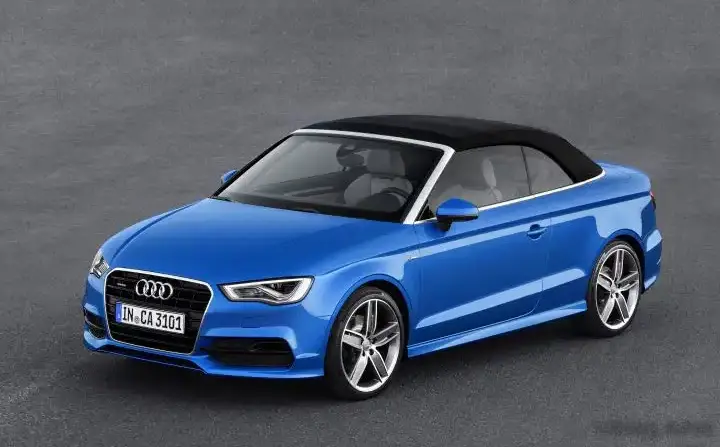
The Audi A3 Cabriolet (8V) 1.8 TFSI quattro S tronic represents a compelling blend of open-air motoring, performance, and sophisticated technology within the premium compact segment. Produced between 2014 and 2016, this variant occupied a mid-range position in the 8V A3 Cabriolet lineup, offering a step up in power and all-wheel drive capability compared to the base models, while remaining more accessible than the higher-performance S3 Cabriolet. It was primarily marketed in Europe and other global markets where compact convertibles with a premium badge held significant appeal.
Technical Specifications
| Brand | Audi |
| Model | A3 |
| Generation | A3 Cabriolet (8V) |
| Type (Engine) | 1.8 TFSI (180 Hp) quattro S tronic |
| Start of production | 2014 |
| End of production | 2016 |
| Powertrain Architecture | Internal Combustion engine |
| Body type | Cabriolet |
| Seats | 4 |
| Doors | 2 |
| Fuel consumption (urban) | 8.4 l/100 km (28 US mpg, 33.6 UK mpg, 11.9 km/l) |
| Fuel consumption (extra urban) | 5.6 l/100 km (42 US mpg, 50.4 UK mpg, 17.9 km/l) |
| Fuel consumption (combined) | 6.6 l/100 km (35.6 US mpg, 42.8 UK mpg, 15.2 km/l) |
| CO2 emissions | 154 g/km |
| Fuel Type | Petrol (Gasoline) |
| Acceleration 0 – 100 km/h | 7.6 sec |
| Acceleration 0 – 62 mph | 7.6 sec |
| Acceleration 0 – 60 mph | 7.2 sec |
| Maximum speed | 234 km/h (145.4 mph) |
| Emission standard | Euro 6 |
| Weight-to-power ratio | 8.6 kg/Hp, 116.9 Hp/tonne |
| Weight-to-torque ratio | 5.5 kg/Nm, 181.8 Nm/tonne |
| Power | 180 Hp @ 4500-6200 rpm |
| Power per litre | 100.1 Hp/l |
| Torque | 280 Nm @ 1350-4500 rpm (206.52 lb.-ft. @ 1350-4500 rpm) |
| Engine layout | Front, Transverse |
| Engine Model/Code | EA888 / CJSB |
| Engine displacement | 1798 cm3 (109.72 cu. in.) |
| Number of cylinders | 4 |
| Engine configuration | Inline |
| Cylinder Bore | 82.5 mm (3.25 in.) |
| Piston Stroke | 84.1 mm (3.31 in.) |
| Compression ratio | 9.6:1 |
| Number of valves per cylinder | 4 |
| Fuel injection system | Direct injection |
| Engine aspiration | Turbocharger, Intercooler |
| Valvetrain | DOHC |
| Engine oil capacity | 5.2 l (5.49 US qt | 4.58 UK qt) |
| Kerb Weight | 1540 kg (3395.12 lbs.) |
| Max. weight | 2040 kg (4497.43 lbs.) |
| Max load | 500 kg (1102.31 lbs.) |
| Trunk (boot) space – minimum | 245 l (8.65 cu. ft.) |
| Trunk (boot) space – maximum | 645 l (22.78 cu. ft.) |
| Fuel tank capacity | 55 l (14.53 US gal | 12.1 UK gal) |
| Permitted trailer load with brakes (8%) | 1800 kg (3968.32 lbs.) |
| Permitted trailer load with brakes (12%) | 1600 kg (3527.4 lbs.) |
| Permitted trailer load without brakes | 750 kg (1653.47 lbs.) |
| Permitted towbar download | 75 kg (165.35 lbs.) |
| Length | 4421 mm (174.06 in.) |
| Width | 1793 mm (70.59 in.) |
| Width including mirrors | 1960 mm (77.17 in.) |
| Height | 1409 mm (55.47 in.) |
| Wheelbase | 2595 mm (102.17 in.) |
| Front track | 1555 mm (61.22 in.) |
| Rear (Back) track | 1526 mm (60.08 in.) |
| Front overhang | 869 mm (34.21 in.) |
| Rear overhang | 957 mm (37.68 in.) |
| Drag coefficient (Cd) | 0.31 |
| Minimum turning circle (turning diameter) | 10.9 m (35.76 ft.) |
| Drivetrain Architecture | All wheel drive (4×4). Internal Combustion engine. The Internal combustion engine (ICE) drives the front wheels permanently, and the rear wheels are driven through an electrically or mechanically operated clutch if necessary. |
| Number of gears and type of gearbox | 6 gears, automatic transmission S tronic |
| Front suspension | Independent, type McPherson with coil spring and anti-roll bar |
| Rear suspension | Independent multi-link spring suspension with stabilizer |
| Front brakes | Ventilated discs |
| Rear brakes | Disc |
INTRODUCTION
The Audi A3 Cabriolet (8V) 1.8 TFSI quattro S tronic, launched in 2014 and continuing through 2016, is a front-engine, all-wheel drive convertible based on the Volkswagen Group’s MQB platform (specifically the A3/Golf 8V generation). This model aimed to provide a more engaging driving experience than the entry-level A3 Cabriolets, while offering the convenience of an automatic transmission and the added security of Audi’s quattro all-wheel drive system. It slotted between the 1.4 TFSI variants and the performance-oriented S3 Cabriolet in Audi’s lineup.
Powertrain & Engine Architecture
At the heart of this A3 Cabriolet lies the EA888 1.8-liter turbocharged four-cylinder engine, specifically the CJSB engine code. This engine utilizes direct fuel injection (FSI) and an intercooled turbocharger to deliver a balance of power and efficiency. The engine features a dual overhead camshaft (DOHC) valvetrain with four valves per cylinder. The 1.8 TFSI engine is known for its relatively smooth power delivery and responsiveness. Paired with this engine is Audi’s 7-speed S tronic dual-clutch transmission. This transmission offers quick and seamless gear changes, contributing to both performance and fuel economy. The quattro all-wheel drive system employs a multi-plate clutch to distribute torque between the front and rear axles as needed, enhancing traction and stability, particularly in adverse weather conditions.
Driving Characteristics
The 1.8 TFSI quattro S tronic A3 Cabriolet delivers a respectable driving experience. With 180 horsepower and 280 Nm (206 lb-ft) of torque, acceleration from 0 to 60 mph takes approximately 7.2 seconds. While not a sports car, the engine provides sufficient power for comfortable cruising and spirited driving. The S tronic transmission contributes to a responsive feel, and the quattro system provides excellent grip. Compared to the manual transmission versions, the S tronic offers greater convenience, especially in urban environments. However, some enthusiasts might find the manual transmission more engaging. Compared to the higher-output engines (like those found in the S3), this variant offers a more relaxed and fuel-efficient driving experience, prioritizing comfort and everyday usability.
Equipment & Trim Levels
The 1.8 TFSI quattro S tronic A3 Cabriolet typically came well-equipped, reflecting Audi’s premium positioning. Standard features often included leather upholstery, automatic climate control, a multi-function steering wheel, and Audi’s MMI infotainment system with a central display screen. Optional extras could include navigation, a premium sound system (Bang & Olufsen), parking sensors, and various driver-assistance systems. Trim levels varied by market, but generally offered options for upgraded interior finishes, exterior styling enhancements, and additional convenience features.
Chassis & Braking
The A3 Cabriolet’s chassis features independent suspension all around – a McPherson strut setup at the front and a multi-link setup at the rear. This configuration provides a good balance of ride comfort and handling. Stabilizer bars are fitted to both axles to reduce body roll during cornering. The braking system consists of ventilated discs at the front and solid discs at the rear. Anti-lock braking system (ABS) and electronic stability control (ESC) are standard features, enhancing safety and control.
Market Reception & Comparison
The Audi A3 Cabriolet 1.8 TFSI quattro S tronic was generally well-received by automotive critics. It was praised for its stylish design, comfortable interior, and refined driving experience. The combination of the turbocharged engine, S tronic transmission, and quattro all-wheel drive was seen as a strong selling point. Fuel economy was considered reasonable for a premium convertible. Compared to other trims, the 1.8 TFSI offered a sweet spot between performance and efficiency, appealing to buyers who wanted a more engaging driving experience than the base models but didn’t need the outright performance of the S3. Reliability reports generally indicate good dependability, although regular maintenance is crucial for the turbocharger and direct injection system.
Legacy
The 8V A3 Cabriolet 1.8 TFSI quattro S tronic has proven to be a relatively reliable vehicle in the used car market. The EA888 engine, while requiring regular maintenance (particularly oil changes), is generally considered durable. The S tronic transmission, if properly maintained, can provide years of smooth operation. Today, these models represent a good value for buyers seeking a stylish and well-equipped premium convertible. However, potential buyers should be aware of the potential for carbon buildup on the intake valves, a common issue with direct injection engines, and ensure that the vehicle has been properly serviced.