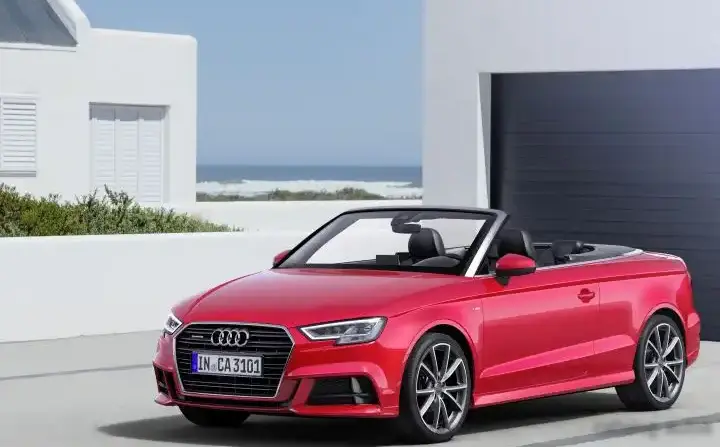
The Audi A3 Cabriolet 8V, facelifted in 2016, represented Audi’s entry into the premium compact convertible market. Introduced for the 2017 model year and continuing through 2018, the 1.5 TFSI (150 hp) variant occupied a key position in the lineup, offering a balance between fuel efficiency, reasonable performance, and affordability. This model aimed to attract buyers seeking a stylish open-top experience without the higher costs associated with more powerful engine options. It was built on the Volkswagen Group’s MQB platform (A3 platform – 1HX0/A3), shared with models like the Volkswagen Golf and SEAT Leon.
Technical Specifications
| Brand | Audi |
| Model | A3 |
| Generation | A3 Cabriolet (8V, facelift 2016) |
| Type (Engine) | 1.5 TFSI (150 Hp) |
| Start of production | 2017 |
| End of production | 2018 |
| Powertrain Architecture | Internal Combustion engine |
| Body type | Cabriolet |
| Seats | 4 |
| Doors | 2 |
| Fuel consumption (urban) | 6.4-6.6 l/100 km (36.8 – 35.6 US mpg, 44.1 – 42.8 UK mpg, 15.6 – 15.2 km/l) |
| Fuel consumption (extra urban) | 4.4-4.7 l/100 km (53.5 – 50 US mpg, 64.2 – 60.1 UK mpg, 22.7 – 21.3 km/l) |
| Fuel consumption (combined) | 5.2-5.4 l/100 km (45.2 – 43.6 US mpg, 54.3 – 52.3 UK mpg, 19.2 – 18.5 km/l) |
| CO2 emissions | 118-124 g/km |
| Fuel Type | Petrol (Gasoline) |
| Acceleration 0 – 100 km/h | 8.9 sec |
| Acceleration 0 – 62 mph | 8.9 sec |
| Acceleration 0 – 60 mph | 8.5 sec |
| Maximum speed | 222 km/h (137.94 mph) |
| Emission standard | Euro 6 |
| Weight-to-power ratio | 9.2 kg/Hp, 108.7 Hp/tonne |
| Weight-to-torque ratio | 5.5 kg/Nm, 181.2 Nm/tonne |
| Power | 150 Hp @ 5000-6000 rpm |
| Power per litre | 100.1 Hp/l |
| Torque | 250 Nm @ 1500-3500 rpm (184.39 lb.-ft. @ 1500-3500 rpm) |
| Engine layout | Front, Transverse |
| Engine Model/Code | EA211evo / DADA |
| Engine displacement | 1498 cm3 (91.41 cu. in.) |
| Number of cylinders | 4 |
| Engine configuration | Inline |
| Number of valves per cylinder | 4 |
| Fuel injection system | Direct injection |
| Engine aspiration | Turbocharger, Intercooler |
| Valvetrain | DOHC |
| Engine oil capacity | 4.3 l (4.54 US qt | 3.78 UK qt) |
| Kerb Weight | 1380 kg (3042.38 lbs.) |
| Max. weight | 1880 kg (4144.69 lbs.) |
| Max load | 500 kg (1102.31 lbs.) |
| Trunk (boot) space – minimum | 320 l (11.3 cu. ft.) |
| Fuel tank capacity | 50 l (13.21 US gal | 11 UK gal) |
| Permitted trailer load with brakes (8%) | 1700 kg (3747.86 lbs.) |
| Permitted trailer load with brakes (12%) | 1500 kg (3306.93 lbs.) |
| Permitted trailer load without brakes | 720 kg (1587.33 lbs.) |
| Permitted towbar download | 75 kg (165.35 lbs.) |
| Length | 4423 mm (174.13 in.) |
| Width | 1793 mm (70.59 in.) |
| Width including mirrors | 1960 mm (77.17 in.) |
| Height | 1409 mm (55.47 in.) |
| Wheelbase | 2595 mm (102.17 in.) |
| Front track | 1555 mm (61.22 in.) |
| Rear (Back) track | 1526 mm (60.08 in.) |
| Front overhang | 870 mm (34.25 in.) |
| Rear overhang | 958 mm (37.72 in.) |
| Drag coefficient (Cd) | 0.30 |
| Minimum turning circle (turning diameter) | 10.9 m (35.76 ft.) |
| Drivetrain Architecture | The Internal combustion engine (ICE) drives the front wheels of the vehicle. |
| Drive wheel | Front wheel drive |
| Number of gears and type of gearbox | 6 gears, manual transmission |
| Front suspension | Independent, type McPherson with coil spring and anti-roll bar |
| Rear suspension | Semi-independent, coil spring |
| Front brakes | Ventilated discs |
| Rear brakes | Disc |
| Assisting systems | ABS (Anti-lock braking system) |
| Steering type | Steering rack and pinion |
| Power steering | Electric Steering |
INTRODUCTION
The Audi A3 Cabriolet 8V facelift, specifically the 1.5 TFSI 150 hp variant, was launched in 2017 as part of a mid-cycle refresh for the A3 family. This model aimed to broaden the A3 Cabriolet’s appeal by offering a more accessible entry point into the premium convertible segment. Positioned as a mid-range offering, it sat below the more powerful 2.0 TFSI versions and above any potential base-level engine options (which were less common in the US market). The facelift brought styling updates, improved technology, and refinements to the engine lineup, including the introduction of the new 1.5-liter turbocharged engine.
Powertrain & Engine Architecture
The heart of this A3 Cabriolet is the EA211evo 1.5 TFSI engine, designated with the code DADA. This is a four-cylinder, inline engine displacing 1498 cc. A key feature of this engine is its ability to operate on a Miller cycle at lower loads, improving efficiency. This is achieved through late intake valve closure. The engine utilizes direct fuel injection and is equipped with a single turbocharger and intercooler. The 1.5 TFSI produces 150 horsepower at 5000-6000 rpm and 250 Nm (184 lb-ft) of torque between 1500-3500 rpm. The engine is paired with a 6-speed manual transmission, delivering power to the front wheels. While a 7-speed S tronic dual-clutch transmission was available as an option, the 6-speed manual was a common configuration for this trim level.
Driving Characteristics
The 1.5 TFSI engine, while not delivering blistering performance, provides adequate power for comfortable cruising and everyday driving. Acceleration from 0-60 mph takes around 8.5 seconds. The turbocharger provides a noticeable boost in power, but the engine can feel somewhat strained at higher speeds or when fully loaded. The 6-speed manual transmission offers a reasonably engaging driving experience, although the gear ratios are tuned more for fuel economy than outright performance. Compared to the more powerful 2.0 TFSI variants, the 1.5 TFSI feels less responsive and requires more downshifting for overtaking maneuvers. However, the lighter engine weight contributes to a slightly more balanced feel in corners.
Equipment & Trim Levels
The 1.5 TFSI A3 Cabriolet typically came with a respectable level of standard equipment. This included features like automatic climate control, a 7-inch infotainment screen with Audi’s MMI interface, Bluetooth connectivity, and alloy wheels. Interior upholstery was typically cloth, with leather options available as an upgrade. Common optional extras included a larger infotainment screen, navigation system, parking sensors, and a premium sound system. The trim level often dictated the availability of certain features, with higher trims offering more luxurious appointments and advanced technology.
Chassis & Braking
The A3 Cabriolet utilizes a McPherson strut front suspension and a semi-independent coil spring rear suspension. This setup provides a comfortable ride quality, although it’s not as sporty as some of its competitors. The front brakes are ventilated discs, while the rear brakes are solid discs. ABS (Anti-lock Braking System) is standard. The steering is electric power-assisted, offering a light and precise feel. Stabilizer bars are fitted to both the front and rear axles to reduce body roll during cornering.
Market Reception & Comparison
The 1.5 TFSI A3 Cabriolet was generally well-received by critics as a sensible and stylish option in the premium compact convertible segment. It was praised for its fuel efficiency, comfortable ride, and attractive design. However, some reviewers noted that the engine lacked the punch of its rivals and that the interior, while well-built, could feel a bit basic compared to other premium offerings. Compared to the 2.0 TFSI versions, the 1.5 TFSI offered significantly better fuel economy but at the expense of performance. The 1.5 TFSI also represented a more affordable entry point into the A3 Cabriolet range, making it an attractive option for buyers on a budget.
Legacy
The EA211evo engine family, including the 1.5 TFSI, has proven to be relatively reliable, although some owners have reported issues with the turbocharger and fuel injectors. Regular maintenance, including oil changes and timely replacement of wear items, is crucial for ensuring long-term reliability. On the used car market, the 1.5 TFSI A3 Cabriolet represents a good value proposition, offering a stylish and well-equipped convertible at a reasonable price. Its fuel efficiency and relatively low running costs make it an appealing option for buyers seeking a practical and enjoyable open-top experience.