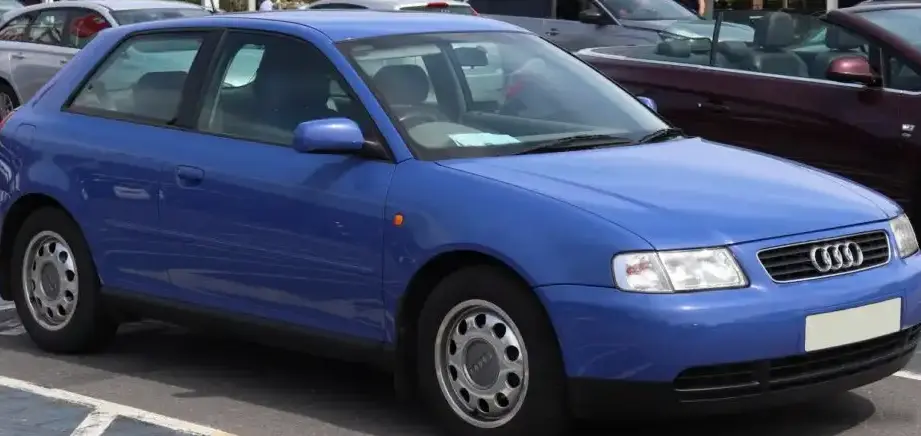
The Audi A3 Sportback (8PA) 1.8 TFSI, produced from 2007 to 2008, represented a significant step forward for the compact luxury hatchback segment. Positioned as a mid-range offering within the 8PA A3 Sportback lineup, it bridged the gap between the entry-level 1.6-liter models and the performance-oriented 2.0 TFSI variants. This model was primarily aimed at European markets, where the Sportback body style – a five-door hatchback – was particularly popular. It utilized Audi’s then-new direct-injection turbocharged engine technology to deliver a balance of performance, fuel efficiency, and refinement. The 8PA generation A3 Sportback was built on the Volkswagen Group’s A5 (PQ35) platform, shared with models like the Volkswagen Golf Mk5 and Škoda Octavia.
Technical Specifications
| Brand | Audi |
| Model | A3 |
| Generation | A3 Sportback (8PA) |
| Type (Engine) | 1.8 TFSI (160 Hp) |
| Start of production | 2007 |
| End of production | 2008 |
| Powertrain Architecture | Internal Combustion engine |
| Body type | Hatchback |
| Seats | 5 |
| Doors | 5 |
| Fuel consumption (economy) – urban | 10.1 l/100 km (23.3 US mpg, 28 UK mpg, 9.9 km/l) |
| Fuel consumption (economy) – extra urban | 5.8 l/100 km (40.6 US mpg, 48.7 UK mpg, 17.2 km/l) |
| Fuel consumption (economy) – combined | 7.4 l/100 km (31.8 US mpg, 38.2 UK mpg, 13.5 km/l) |
| Fuel Type | Petrol (Gasoline) |
| Acceleration 0 – 100 km/h | 7.9 sec |
| Acceleration 0 – 62 mph | 7.9 sec |
| Acceleration 0 – 60 mph | 7.5 sec |
| Maximum speed | 214 km/h (132.97 mph) |
| Emission standard | Euro 4 |
| Weight-to-power ratio | 8.4 kg/Hp, 119 Hp/tonne |
| Weight-to-torque ratio | 5.4 kg/Nm, 185.9 Nm/tonne |
| Power | 160 Hp @ 6000 rpm |
| Power per litre | 89 Hp/l |
| Torque | 250 Nm @ 1500-4200 rpm (184.39 lb.-ft. @ 1500-4200 rpm) |
| Engine layout | Front, Transverse |
| Engine Model/Code | BYT |
| Engine displacement | 1798 cm3 (109.72 cu. in.) |
| Number of cylinders | 4 |
| Engine configuration | Inline |
| Cylinder Bore | 82.5 mm (3.25 in.) |
| Piston Stroke | 84.1 mm (3.31 in.) |
| Compression ratio | 9.6:1 |
| Number of valves per cylinder | 4 |
| Fuel injection system | Direct injection |
| Engine aspiration | Turbocharger, Intercooler |
| Valvetrain | DOHC |
| Engine oil capacity | 4.6 l (4.86 US qt | 4.05 UK qt) |
| Kerb Weight | 1345 kg (2965.22 lbs.) |
| Max. weight | 1905 kg (4199.81 lbs.) |
| Max load | 560 kg (1234.59 lbs.) |
| Trunk (boot) space – minimum | 370 l (13.07 cu. ft.) |
| Trunk (boot) space – maximum | 1120 l (39.55 cu. ft.) |
| Fuel tank capacity | 55 l (14.53 US gal | 12.1 UK gal) |
| Length | 4286 mm (168.74 in.) |
| Width | 1765 mm (69.49 in.) |
| Height | 1423 mm (56.02 in.) |
| Wheelbase | 2578 mm (101.5 in.) |
| Front track | 1534 mm (60.39 in.) |
| Rear (Back) track | 1507 mm (59.33 in.) |
| Drag coefficient (Cd) | 0.33 |
| Minimum turning circle | 10.7 m (35.1 ft.) |
| Drivetrain Architecture | The Internal combustion engine (ICE) drives the front wheels of the vehicle. |
| Drive wheel | Front wheel drive |
| Number of gears and type of gearbox | 6 gears, manual transmission |
| Front suspension | Spring Strut |
| Rear suspension | Transverse stabilizer |
| Front brakes | Ventilated discs |
| Rear brakes | Disc |
| Assisting systems | ABS (Anti-lock braking system) |
| Steering type | Steering rack and pinion |
| Tires size | 205/55 R16 |
| Wheel rims size | 6.5J x 16 |
Powertrain & Engine Architecture
The heart of the A3 1.8 TFSI is the BYT engine code, a 1.8-liter inline-four cylinder engine. This engine was a key component of Volkswagen Group’s strategy to introduce direct-injection and turbocharging across its model range. Direct injection, in this case, allowed for more precise fuel delivery, resulting in improved combustion efficiency and increased power output. The engine featured a single scroll turbocharger with an intercooler to manage intake air temperature. The valvetrain employed a dual overhead camshaft (DOHC) design with four valves per cylinder, optimizing airflow for enhanced performance. The 1.8 TFSI produced 160 horsepower at 6000 rpm and 184 lb-ft of torque between 1500 and 4200 rpm. This broad torque curve was a significant advantage, providing strong acceleration in everyday driving situations. The engine was paired with a 6-speed manual transmission, delivering power to the front wheels.
Driving Characteristics
The 1.8 TFSI Sportback offered a noticeably more engaging driving experience than the base 1.6-liter models. While not as overtly sporty as the 2.0 TFSI, the 1.8 provided ample power for confident overtaking and highway cruising. The turbocharger provided a noticeable boost in acceleration, though some turbo lag was present, particularly at lower engine speeds. The 6-speed manual transmission was well-matched to the engine’s characteristics, offering precise shifts and allowing the driver to maintain optimal engine speed. Compared to the 2.0 TFSI, the 1.8 felt less urgent in its acceleration, but it also offered better fuel economy and a more relaxed driving experience. The suspension tuning prioritized comfort, providing a compliant ride over most road surfaces, although it wasn’t as sharp or responsive as the sport-tuned suspension options available on higher-spec A3 models.
Equipment & Trim Levels
The 1.8 TFSI Sportback typically came equipped with a respectable level of standard features. These included air conditioning, a CD stereo system, alloy wheels, and electric front windows. Safety features such as ABS, front airbags, and side airbags were also standard. Optional extras included a sunroof, leather upholstery, parking sensors, and a more advanced infotainment system. Trim levels varied slightly depending on the market, but generally, the 1.8 TFSI sat in the middle of the A3 Sportback range, offering a good balance of features and price. Interior upholstery was typically cloth, with the option of upgrading to leather. The dashboard layout was typical of early 2000s Audis, characterized by a clean, functional design with a focus on ergonomics.
Chassis & Braking
The A3 Sportback 1.8 TFSI utilized a MacPherson strut front suspension and a multi-link rear suspension. This setup provided a good balance of ride comfort and handling. The front brakes were ventilated discs, while the rear brakes were solid discs. ABS (Anti-lock Braking System) was standard, enhancing braking performance and stability. The steering was a rack-and-pinion system, providing precise and responsive steering feel. The chassis was relatively lightweight, contributing to the car’s agility and fuel efficiency. Stabilizer bars were fitted to both the front and rear axles to reduce body roll during cornering.
Market Reception & Comparison
The Audi A3 Sportback 1.8 TFSI was generally well-received by automotive critics. It was praised for its refined engine, comfortable ride, and practical hatchback body style. Critics noted that the 1.8 TFSI offered a compelling alternative to traditional compact hatchbacks, providing a more premium experience. Compared to the 1.6-liter A3, the 1.8 TFSI offered a significant performance upgrade, while the 2.0 TFSI provided even more power but at a higher price point. Fuel economy was considered good for its class, and reliability was generally above average. However, some critics noted that the turbo lag could be noticeable at low speeds.
Legacy
The 1.8 TFSI engine proved to be a durable and reliable powerplant when properly maintained. The BYT engine code is generally considered robust, although regular oil changes and adherence to the manufacturer’s maintenance schedule are crucial. In the used car market, the A3 1.8 TFSI Sportback remains a popular choice for buyers seeking a well-rounded and refined compact hatchback. Its combination of performance, fuel efficiency, and practicality has ensured its continued appeal. While not a particularly rare or collectible model, well-maintained examples command reasonable prices and offer a good value proposition for those seeking a premium European hatchback.