Technical Specifications
| Brand | Audi |
| Model | A3 |
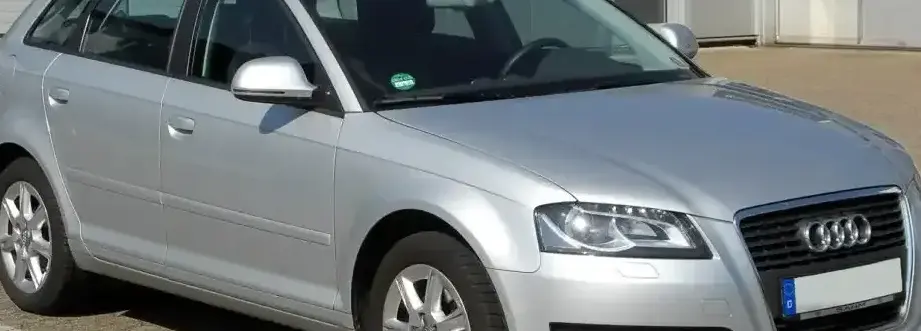
| Generation | A3 Sportback (8PA, facelift 2008) |
| Type (Engine) | 1.8 TFSI (160 Hp) |
| Start of production | 2008 |
| End of production | 2013 |
| Powertrain Architecture | Internal Combustion engine |
| Body type | Hatchback |
| Seats | 5 |
| Doors | 5 |
| Fuel consumption (urban) | 9 l/100 km (26.1 US mpg, 31.4 UK mpg, 11.1 km/l) |
| Fuel consumption (extra urban) | 5.3 l/100 km (44.4 US mpg, 53.3 UK mpg, 18.9 km/l) |
| Fuel consumption (combined) | 6.7 l/100 km (35.1 US mpg, 42.2 UK mpg, 14.9 km/l) |
| Fuel Type | Petrol (Gasoline) |
| Acceleration 0 – 100 km/h | 7.8 sec |
| Acceleration 0 – 62 mph | 7.8 sec |
| Acceleration 0 – 60 mph | 7.4 sec |
| Maximum speed | 222 km/h (137.94 mph) |
| Emission standard | Euro 4 |
| Weight-to-power ratio | 8.3 kg/Hp, 121.2 Hp/tonne |
| Weight-to-torque ratio | 5.3 kg/Nm, 189.4 Nm/tonne |
| Power | 160 Hp @ 4500-6200 rpm |
| Power per litre | 89 Hp/l |
| Torque | 250 Nm @ 1500-4500 rpm (184.39 lb.-ft. @ 1500-4500 rpm) |
| Engine layout | Front, Transverse |
| Engine Model/Code | BZB, CDAA |
| Engine displacement | 1798 cm3 (109.72 cu. in.) |
| Number of cylinders | 4 |
| Engine configuration | Inline |
| Cylinder Bore | 82.5 mm (3.25 in.) |
| Piston Stroke | 84.1 mm (3.31 in.) |
| Compression ratio | 9.6:1 |
| Number of valves per cylinder | 4 |
| Fuel injection system | Direct injection |
| Engine aspiration | Turbocharger, Intercooler |
| Valvetrain | DOHC |
| Engine oil capacity | 4.6 l (4.86 US qt | 4.05 UK qt) |
| Kerb Weight | 1320 kg (2910.1 lbs.) |
| Max. weight | 1880 kg (4144.69 lbs.) |
| Max load | 560 kg (1234.59 lbs.) |
| Trunk (boot) space – minimum | 552 l (19.49 cu. ft.) |
| Trunk (boot) space – maximum | 1104 l (38.99 cu. ft.) |
| Fuel tank capacity | 55 l (14.53 US gal | 12.1 UK gal) |
| Length | 4292 mm (168.98 in.) |
| Width | 1765 mm (69.49 in.) |
| Height | 1423 mm (56.02 in.) |
| Wheelbase | 2578 mm (101.5 in.) |
| Front track | 1534 mm (60.39 in.) |
| Rear (Back) track | 1507 mm (59.33 in.) |
| Ride height (ground clearance) | 110 mm (4.33 in.) |
| Drag coefficient (Cd) | 0.31 |
| Minimum turning circle (turning diameter) | 10.7 m (35.1 ft.) |
| Drivetrain Architecture | The Internal combustion engine (ICE) drives the front wheels of the vehicle. |
| Drive wheel | Front wheel drive |
| Number of gears and type of gearbox | 6 gears, manual transmission |
| Front suspension | Spring Strut |
| Rear suspension | Transverse stabilizer |
| Front brakes | Ventilated discs |
| Rear brakes | Disc |
| Assisting systems | ABS (Anti-lock braking system) |
| Steering type | Steering rack and pinion |
| Tires size | 205/55 R16; 225/45 R17 |
| Wheel rims size | 6.5J x 16; 7.5J x 17 |
The Audi A3 Sportback (8PA) facelift, launched in 2008, represented a significant evolution of Audi’s popular compact hatchback. The 1.8 TFSI variant, producing 160 horsepower, occupied a crucial mid-range position within the 8PA generation. This model aimed to strike a balance between performance, fuel efficiency, and affordability, appealing to a wider audience than the more potent S3 or the diesel-focused TDI models. The facelift brought with it revised styling cues, improved interior materials, and updated technology, solidifying the A3 Sportback’s position as a premium contender in the highly competitive European C-segment.
Powertrain & Engine Architecture
The 1.8 TFSI A3 Sportback is powered by an engine from the EA888 family, typically identified by the engine codes BZB or CDAA, depending on the production year and specific market. This 1.8-liter, inline-four cylinder engine utilizes direct fuel injection (FSI – Fuel Stratified Injection) coupled with a single turbocharger and intercooler. The direct injection system allows for precise fuel metering, resulting in improved power output and fuel economy. The engine features a dual overhead camshaft (DOHC) valvetrain with four valves per cylinder, optimizing airflow for enhanced performance. The turbocharger significantly boosts power compared to naturally aspirated engines of similar displacement. Audi offered the 1.8 TFSI with either a 6-speed manual transmission or an optional 7-speed S tronic dual-clutch transmission. The S tronic provided faster, smoother gear changes, enhancing the driving experience, but came at a higher price point.
Driving Characteristics
The 1.8 TFSI engine delivers 160 horsepower and 184 lb-ft of torque, providing the A3 Sportback with responsive acceleration. Acceleration from 0 to 60 mph was typically achieved in around 7.4 to 7.8 seconds, making it a competitive performer in its class. While not as aggressively quick as the 2.0 TFSI models, the 1.8 TFSI offered sufficient power for everyday driving and comfortable highway cruising. A degree of turbo lag was noticeable at lower engine speeds, but the torque curve flattened out nicely in the mid-range, providing strong pulling power for overtaking. The manual transmission offered precise and engaging shifts, while the optional S tronic provided seamless and rapid gear changes. The A3 Sportback’s front-wheel-drive configuration delivered predictable handling, although traction could be compromised in adverse weather conditions.
Equipment & Trim Levels
The A3 Sportback 1.8 TFSI came reasonably well-equipped as standard. Typical features included air conditioning, a CD stereo system, alloy wheels, and electric windows. Higher trim levels, such as SE and Sport, added features like climate control, upgraded interior upholstery, parking sensors, and a multi-function steering wheel. A range of optional extras were available, including a panoramic sunroof, a navigation system, and a premium sound system. Interior upholstery was generally cloth in the base models, with leather options available on higher trim levels. The dashboard layout was clean, modern, and focused on ergonomics and ease of use.
Chassis & Braking
The A3 Sportback 8PA employed a MacPherson strut front suspension and a multi-link rear suspension, providing a comfortable yet controlled ride quality. The suspension was tuned to balance handling and comfort, making it suitable for both urban driving and longer journeys. Braking was handled by ventilated discs at the front and solid discs at the rear. An anti-lock braking system (ABS) was standard, enhancing safety and stability during emergency braking maneuvers. Stabilizer bars were fitted to both the front and rear axles to minimize body roll during cornering.
Market Reception & Comparison
The Audi A3 Sportback 1.8 TFSI received generally positive reviews from automotive critics. It was praised for its refined engine, comfortable ride, and high-quality interior. Compared to the entry-level 1.6-liter models, the 1.8 TFSI offered a substantial performance improvement without significantly impacting fuel economy. In comparison to the 2.0 TFSI, it presented a more affordable option with slightly better fuel efficiency. The 1.8 TFSI also provided a more balanced driving experience than the diesel-powered TDI models, which prioritized fuel economy over outright performance. Fuel economy figures were competitive for the class, averaging around 35 mpg in combined driving cycles.
Legacy
The 1.8 TFSI engine proved to be a generally reliable and durable powerplant, although early iterations of the EA888 engine were sometimes prone to carbon buildup on the intake valves. Regular servicing, including the use of quality fuel and occasional intake valve cleaning, can help mitigate this issue. Today, the A3 Sportback 1.8 TFSI remains a popular choice in the used car market, offering a compelling combination of style, practicality, and affordability. Its relatively straightforward mechanical design and readily available parts contribute to relatively low maintenance costs. The 8PA A3 Sportback, and particularly the 1.8 TFSI variant, played a significant role in establishing Audi as a leading player in the premium compact hatchback segment, setting the stage for subsequent generations of the A3.