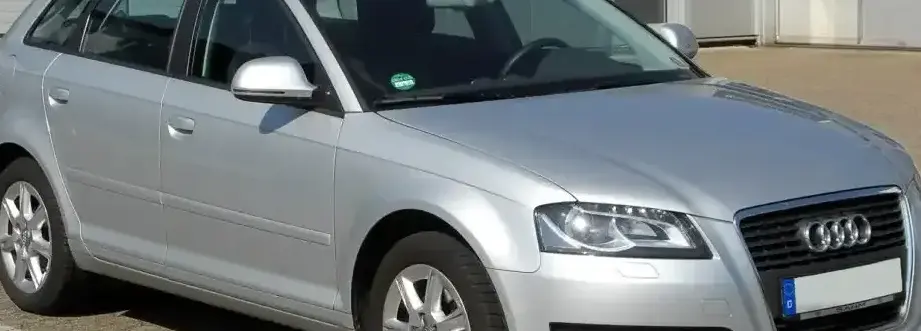
The Audi A3 Sportback (8PA) facelift, produced from 2008 to 2013, represented a significant update to Audi’s compact hatchback offering. Within the 8PA generation, the 2.0 TDI quattro variant, producing 140 horsepower, occupied a middle ground in the lineup, balancing performance, fuel efficiency, and all-weather capability. This model was primarily aimed at the European market, where demand for diesel engines and all-wheel drive systems remained strong. It offered a more refined and practical alternative to sportier, front-wheel-drive A3 models, and a more economical option than the higher-output TDI variants.
Technical Specifications
| Brand | Audi |
| Model | A3 |
| Generation | A3 Sportback (8PA, facelift 2008) |
| Type (Engine) | 2.0 TDI (140 Hp) quattro DPF |
| Start of production | 2008 |
| End of production | 2013 |
| Powertrain Architecture | Internal Combustion engine |
| Body type | Hatchback |
| Seats | 5 |
| Doors | 5 |
| Fuel consumption (economy) – urban (NEDC) | 6.3 l/100 km (37.3 US mpg, 44.8 UK mpg, 15.9 km/l) |
| Fuel consumption (economy) – extra urban (NEDC) | 4.2 l/100 km (56 US mpg, 67.3 UK mpg, 23.8 km/l) |
| Fuel consumption (economy) – combined (NEDC) | 5 l/100 km (47 US mpg, 56.5 UK mpg, 20 km/l) |
| CO2 emissions (NEDC) | 129 g/km |
| Fuel Type | Diesel |
| Acceleration 0 – 100 km/h | 9.4 sec |
| Acceleration 0 – 62 mph | 9.4 sec |
| Acceleration 0 – 60 mph | 8.9 sec |
| Maximum speed | 208 km/h (129.25 mph) |
| Emission standard | Euro 5 |
| Weight-to-power ratio | 10.4 kg/Hp, 95.9 Hp/tonne |
| Weight-to-torque ratio | 4.6 kg/Nm, 219.2 Nm/tonne |
| Power | 140 Hp @ 4200 rpm |
| Power per litre | 71.1 Hp/l |
| Torque | 320 Nm @ 1750-2500 rpm (236.02 lb.-ft. @ 1750-2500 rpm) |
| Engine layout | Front, Transverse |
| Engine Model/Code | CBAA, CFFA |
| Engine displacement | 1968 cm3 (120.09 cu. in.) |
| Number of cylinders | 4 |
| Engine configuration | Inline |
| Cylinder Bore | 81 mm (3.19 in.) |
| Piston Stroke | 95.5 mm (3.76 in.) |
| Compression ratio | 16.5:1 |
| Number of valves per cylinder | 4 |
| Fuel injection system | Diesel Commonrail |
| Engine aspiration | Turbocharger, Intercooler |
| Valvetrain | DOHC |
| Engine oil capacity | 4 l (4.23 US qt | 3.52 UK qt) |
| Coolant | 8.7 l (9.19 US qt | 7.65 UK qt) |
| Kerb Weight | 1460 kg (3218.75 lbs.) |
| Max. weight | 2020 kg (4453.34 lbs.) |
| Max load | 560 kg (1234.59 lbs.) |
| Trunk (boot) space – minimum | 302 l (10.67 cu. ft.) |
| Trunk (boot) space – maximum | 1032 l (36.44 cu. ft.) |
| Fuel tank capacity | 60 l (15.85 US gal | 13.2 UK gal) |
| Max. roof load | 75 kg (165.35 lbs.) |
| Permitted trailer load with brakes (8%) | 1800 kg (3968.32 lbs.) |
| Permitted trailer load with brakes (12%) | 1600 kg (3527.4 lbs.) |
| Permitted trailer load without brakes | 750 kg (1653.47 lbs.) |
| Permitted towbar download | 75 kg (165.35 lbs.) |
| Length | 4292 mm (168.98 in.) |
| Width | 1765 mm (69.49 in.) |
| Width including mirrors | 2023 mm (79.65 in.) |
| Height | 1423 mm (56.02 in.) |
| Wheelbase | 2578 mm (101.5 in.) |
| Front track | 1534 mm (60.39 in.) |
| Rear (Back) track | 1508 mm (59.37 in.) |
| Front overhang | 881 mm (34.69 in.) |
| Rear overhang | 833 mm (32.8 in.) |
| Drag coefficient (Cd) | 0.33 |
| Minimum turning circle (turning diameter) | 10.7 m (35.1 ft.) |
| Drivetrain Architecture | The Internal combustion engine (ICE) drives the front wheels permanently, and the rear wheels are driven through an electrically or mechanically operated clutch if necessary. |
| Drive wheel | All wheel drive (4×4) |
| Number of gears and type of gearbox | 6 gears, manual transmission |
| Front suspension | Independent type McPherson, Transverse stabilizer |
| Rear suspension | Independent multi-link suspension, Transverse stabilizer |
| Front brakes | Ventilated discs |
| Rear brakes | Disc |
| Assisting systems | ABS (Anti-lock braking system) |
| Steering type | Steering rack and pinion |
| Power steering | Electric Steering |
| Tires size | 205/55 R16; 225/45 R17 |
| Wheel rims size | 6.5J x 16; 7.5J x 17 |
INTRODUCTION
The Audi A3 Sportback (8PA) facelift, launched in 2008, built upon the success of the original 8P A3, offering a more refined and technologically advanced package. The 2.0 TDI quattro variant, equipped with a 140 horsepower diesel engine and Audi’s renowned quattro all-wheel-drive system, was a popular choice for drivers seeking a practical, efficient, and capable hatchback. This model sat comfortably in the middle of the A3 range, offering a step up in performance and all-weather grip compared to the entry-level 1.6 TDI, while remaining more accessible than the more powerful 2.0 TDI variants.
Powertrain & Engine Architecture
The heart of the A3 2.0 TDI quattro is the Volkswagen Group’s 1968cc inline-four cylinder diesel engine, typically identified by engine codes CBAA or CFFA. This engine utilizes a common rail direct injection system, delivering fuel at extremely high pressures for optimized combustion. A turbocharger with an intercooler further enhances performance, boosting power and torque. The engine features a double overhead camshaft (DOHC) valvetrain with four valves per cylinder, contributing to its efficient operation. The 140 horsepower output is achieved at 4200 rpm, while peak torque of 320 Nm (236 lb-ft) is available from 1750 to 2500 rpm, providing strong pulling power across a wide rev range. The engine is transversely mounted in the front of the vehicle. The quattro system employs a Haldex multi-plate clutch to distribute power between the front and rear axles as needed, providing enhanced traction and stability.
Driving Characteristics
The 2.0 TDI quattro offers a composed and refined driving experience. While not overtly sporty, the 140 horsepower engine provides adequate performance for everyday driving and occasional highway journeys. The quattro all-wheel-drive system significantly improves grip, particularly on slippery surfaces, inspiring confidence in challenging conditions. The six-speed manual transmission provides precise gear changes, although an S-tronic dual-clutch transmission was also available as an option. Compared to the lower-powered 1.6 TDI, the 2.0 TDI offers noticeably stronger acceleration and more relaxed cruising speeds. However, it lacks the outright punch of the higher-output 2.0 TDI variants. The gear ratios are tuned for a balance of fuel efficiency and usability, with a relatively long final drive contributing to good highway economy.
Equipment & Trim Levels
The A3 Sportback 2.0 TDI quattro typically came well-equipped, even in base trim. Standard features included air conditioning, alloy wheels, a multi-function steering wheel, and an audio system with CD player. Higher trim levels, such as Sport and S-line, added features like sport seats, upgraded interior trim, and exterior styling enhancements. Optional extras included a sunroof, navigation system, parking sensors, and leather upholstery. The interior design was typically understated and functional, with a focus on ergonomics and build quality. Upholstery options ranged from cloth to leather, and dashboard trim could be specified in a variety of materials and colors.
Chassis & Braking
The A3 Sportback 8PA utilizes a McPherson strut front suspension and a multi-link rear suspension, providing a comfortable and controlled ride. Stabilizer bars are fitted to both axles to reduce body roll during cornering. The quattro system adds to the vehicle’s stability by distributing torque to all four wheels. Braking duties are handled by ventilated discs at the front and solid discs at the rear. Anti-lock braking system (ABS) is standard, along with electronic brake-force distribution (EBD). The suspension setup is tuned to provide a balance between comfort and handling, making the A3 a pleasant car to drive on a variety of road surfaces.
Market Reception & Comparison
The Audi A3 Sportback 2.0 TDI quattro was generally well-received by automotive critics. It was praised for its refined engine, comfortable ride, and all-weather capability. Fuel economy was also a strong point, with combined fuel consumption figures around 5 liters per 100 kilometers (47 US mpg). Compared to the front-wheel-drive A3 2.0 TDI, the quattro version offered superior traction and handling, but at a slightly higher price and with a small penalty in fuel economy. The 1.6 TDI was a more affordable option, but lacked the performance and refinement of the 2.0 TDI. The higher-output 2.0 TDI variants offered more power, but were more expensive and less fuel-efficient.
Legacy
The 2.0 TDI engine, in its various iterations, proved to be a durable and reliable powerplant. However, like all modern diesel engines, it is susceptible to issues related to the diesel particulate filter (DPF), particularly if the vehicle is primarily used for short journeys. Regular servicing and the use of high-quality diesel fuel are essential for maintaining the engine’s longevity. Today, the A3 Sportback 2.0 TDI quattro remains a popular choice in the used car market, offering a compelling combination of practicality, efficiency, and all-weather capability. Its reputation for reliability and build quality ensures continued demand from discerning buyers.