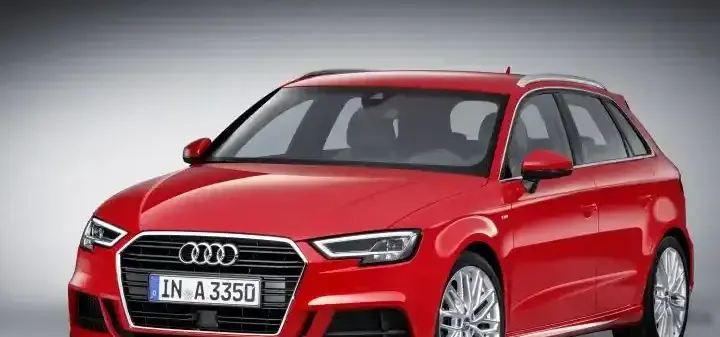
The Audi A3 Sportback (8V, facelift) 2.0 TFSI quattro S tronic, produced from 2016 to 2018, represents a significant iteration of Audi’s popular compact hatchback. This variant occupied a mid-to-upper position within the 8V A3 Sportback range, offering a blend of performance, sophisticated technology, and all-weather capability through its quattro all-wheel-drive system. It was primarily marketed in Europe and other global markets where compact premium hatchbacks are highly sought after, competing with vehicles like the BMW 1 Series, Mercedes-Benz A-Class, and Volkswagen Golf GTI. The facelift brought styling updates, improved interior materials, and enhanced technology compared to the pre-facelift 8V models.
Technical Specifications
| Brand | Audi |
| Model | A3 |
| Generation | A3 Sportback (8V, facelift 2016) |
| Type (Engine) | 2.0 TFSI (190 Hp) quattro S tronic |
| Start of production | 2016 |
| End of production | 2018 |
| Powertrain Architecture | Internal Combustion engine |
| Body type | Hatchback |
| Seats | 5 |
| Doors | 5 |
| Fuel consumption (urban) | 7.1-7.4 l/100 km (33.1 – 31.8 US mpg, 39.8 – 38.2 UK mpg, 14.1 – 13.5 km/l) |
| Fuel consumption (extra urban) | 4.8-5.1 l/100 km (49 – 46.1 US mpg, 58.9 – 55.4 UK mpg, 20.8 – 19.6 km/l) |
| Fuel consumption (combined) | 5.7-6 l/100 km (41.3 – 39.2 US mpg, 49.6 – 47.1 UK mpg, 17.5 – 16.7 km/l) |
| CO2 emissions | 130-137 g/km |
| Fuel Type | Petrol (Gasoline) |
| Acceleration 0 – 100 km/h | 6.2 sec |
| Acceleration 0 – 62 mph | 6.2 sec |
| Acceleration 0 – 60 mph | 5.9 sec |
| Maximum speed | 236 km/h (146.64 mph) |
| Emission standard | Euro 6 |
| Weight-to-power ratio | 7.3 kg/Hp, 137.2 Hp/tonne |
| Weight-to-torque ratio | 4.3 kg/Nm, 231 Nm/tonne |
| Power | 190 Hp @ 4200-6000 rpm |
| Torque | 320 Nm @ 1500-4200 rpm (236.02 lb.-ft. @ 1500-4200 rpm) |
| Engine layout | Front, Transverse |
| Engine Model/Code | EA888 / CZPB |
| Engine displacement | 1984 cm3 (121.07 cu. in.) |
| Number of cylinders | 4 |
| Engine configuration | Inline |
| Cylinder Bore | 82.5 mm (3.25 in.) |
| Piston Stroke | 92.8 mm (3.65 in.) |
| Compression ratio | 11.65:1 |
| Number of valves per cylinder | 4 |
| Fuel injection system | Direct injection and Multi-port manifold injection |
| Engine aspiration | Turbocharger, Intercooler |
| Valvetrain | DOHC |
| Engine oil capacity | 5.7 l (6.02 US qt | 5.02 UK qt) |
| Coolant | 9 l (9.51 US qt | 7.92 UK qt) |
| Kerb Weight | 1385 kg (3053.4 lbs.) |
| Max. weight | 1945 kg (4287.99 lbs.) |
| Max load | 560 kg (1234.59 lbs.) |
| Trunk (boot) space – minimum | 340 l (12.01 cu. ft.) |
| Trunk (boot) space – maximum | 1180 l (41.67 cu. ft.) |
| Fuel tank capacity | 55 l (14.53 US gal | 12.1 UK gal) |
| Max. roof load | 75 kg (165.35 lbs.) |
| Permitted trailer load with brakes (8%) | 1800 kg (3968.32 lbs.) |
| Permitted trailer load with brakes (12%) | 1600 kg (3527.4 lbs.) |
| Permitted trailer load without brakes | 730 kg (1609.37 lbs.) |
| Permitted towbar download | 75 kg (165.35 lbs.) |
| Length | 4313 mm (169.8 in.) |
| Width | 1785 mm (70.28 in.) |
| Width including mirrors | 1966 mm (77.4 in.) |
| Height | 1426 mm (56.14 in.) |
| Wheelbase | 2637 mm (103.82 in.) |
| Front track | 1543 mm (60.75 in.) |
| Rear (Back) track | 1514 mm (59.61 in.) |
| Front overhang | 870 mm (34.25 in.) |
| Rear overhang | 806 mm (31.73 in.) |
| Drag coefficient (Cd) | 0.32 |
| Minimum turning circle (turning diameter) | 10.9 m (35.76 ft.) |
| Drivetrain Architecture | The Internal combustion engine (ICE) drives the front wheels permanently, and the rear wheels are driven through an electrically or mechanically operated clutch if necessary. |
| Drive wheel | All wheel drive (4×4) |
| Number of gears and type of gearbox | 7 gears, automatic transmission S tronic |
| Front suspension | Independent, type McPherson with coil spring and anti-roll bar |
| Rear suspension | Independent multi-link spring suspension with stabilizer |
| Front brakes | Ventilated discs |
| Rear brakes | Disc |
| Assisting systems | ABS (Anti-lock braking system) |
| Steering type | Steering rack and pinion |
| Power steering | Electric Steering |
| Tires size | 205/55 R16; 225/45 R17; 225/40 R18; 235/35 R19 |
| Wheel rims size | 6.5J x 16; 7.5J x 17; 7.5J x 18; 8J x 19 |
INTRODUCTION
The Audi A3 Sportback (8V, facelift) 2.0 TFSI quattro S tronic, produced between 2016 and 2018, is a five-door hatchback that builds upon the success of the 8V A3 platform (introduced in 2012). The facelift brought revised front and rear styling, updated infotainment systems, and enhanced efficiency. This particular variant combines a 2.0-liter turbocharged four-cylinder engine producing 190 horsepower with Audi’s quattro all-wheel-drive system and a seven-speed S tronic dual-clutch transmission. It aimed to provide a sporty and refined driving experience with all-weather confidence, appealing to buyers seeking a premium compact hatchback.
Powertrain & Engine Architecture
At the heart of this A3 Sportback lies the EA888 2.0-liter turbocharged four-cylinder engine, specifically the CZPB code. This engine utilizes direct fuel injection combined with multi-point injection, optimizing combustion efficiency and reducing emissions. The engine features a single turbocharger with an intercooler, boosting power output to 190 hp and 320 Nm (236 lb-ft) of torque. The valvetrain employs a dual overhead camshaft (DOHC) configuration with four valves per cylinder. The S tronic seven-speed dual-clutch transmission provides rapid and smooth gear changes, contributing to the car’s sporty feel. This transmission allows for both fully automatic operation and manual gear selection via steering wheel-mounted paddles or the gear selector. The quattro all-wheel-drive system uses a multi-plate clutch to distribute torque between the front and rear axles as needed, enhancing traction and stability.
Driving Characteristics
The 2.0 TFSI quattro S tronic delivers a responsive and engaging driving experience. The 190 hp engine provides ample power for everyday driving and confident overtaking. The S tronic transmission’s quick shifts contribute to brisk acceleration, achieving 0-62 mph in 6.2 seconds. The quattro all-wheel-drive system provides excellent grip in various conditions, particularly on wet or slippery surfaces. Compared to the base 1.0 TFSI models, this variant offers significantly more performance. While not as raw or focused as the S3, it provides a good balance between performance and comfort. The gear ratios are tuned for a blend of acceleration and fuel efficiency, with the seventh gear providing a comfortable cruising speed on the highway. The steering is precise and well-weighted, offering good feedback to the driver.
Equipment & Trim Levels
The 2.0 TFSI quattro S tronic typically came equipped with a generous level of standard features. These included Audi’s MMI infotainment system with a 7-inch display (upgradable to a larger screen), automatic climate control, Bluetooth connectivity, and a leather-wrapped steering wheel. Standard safety features included ABS, electronic stability control, and multiple airbags. Higher trim levels offered options such as Audi Virtual Cockpit (a fully digital instrument cluster), a Bang & Olufsen sound system, leather upholstery, and advanced driver-assistance systems like adaptive cruise control and lane departure warning. Interior upholstery was typically cloth in the base trims, with leather options available as upgrades. Dashboard trim could be customized with various materials and finishes.
Chassis & Braking
The A3 Sportback’s chassis features an independent suspension setup. The front utilizes a McPherson strut design with coil springs and an anti-roll bar, while the rear employs a multi-link suspension system, also with a stabilizer bar. This configuration provides a comfortable ride while maintaining good handling characteristics. The braking system consists of ventilated discs at the front and solid discs at the rear. ABS (Anti-lock Braking System) is standard, ensuring effective braking performance in emergency situations. The chassis was tuned to complement the increased power output of the 2.0 TFSI engine and the all-wheel-drive system, providing a stable and predictable driving experience.
Market Reception & Comparison
The Audi A3 Sportback 2.0 TFSI quattro S tronic was generally well-received by automotive critics. It was praised for its refined driving experience, powerful engine, and sophisticated interior. The quattro all-wheel-drive system was highlighted as a significant advantage, particularly in regions with inclement weather. Compared to the front-wheel-drive A3 variants, the quattro model offered superior traction and handling. Fuel economy was considered respectable for a performance-oriented hatchback, averaging around 41.3-39.2 US mpg in combined driving. Reliability was generally good, although some owners reported minor issues with the infotainment system. The A3 Sportback competed directly with the BMW 1 Series and Mercedes-Benz A-Class, offering a similar blend of performance, luxury, and technology.
Legacy
The 2.0 TFSI quattro S tronic powertrain has proven to be relatively reliable over the long term. The EA888 engine is known for its durability, and the S tronic transmission, while requiring regular maintenance (fluid changes), is generally robust. In the used car market, these A3 Sportbacks hold their value reasonably well, particularly those with lower mileage and a full service history. They remain a popular choice for buyers seeking a premium compact hatchback with all-wheel-drive capability and a sporty driving experience. The combination of performance, practicality, and Audi’s reputation for quality ensures that this variant continues to be a desirable option for discerning drivers.