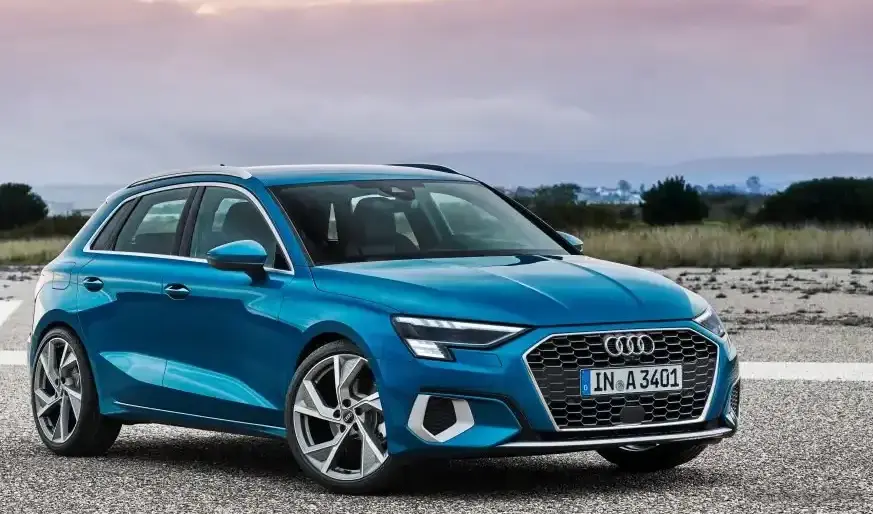
The Audi A3 Sportback (8Y) 30 TDI S tronic, produced from October 2020 through 2024, represents a key entry point into the fourth-generation A3 (8Y) lineup. Positioned as a fuel-efficient and practical hatchback, this variant catered to European markets prioritizing diesel economy and refined driving experience. It’s built on the Volkswagen Group’s MQB platform, shared with models like the Volkswagen Golf and SEAT Leon, and offered a balance between performance, technology, and affordability within the A3 range. The “30 TDI” designation signifies its engine output and fuel type, while “S tronic” denotes the dual-clutch transmission.
Technical Specifications
| Brand | Audi |
| Model | A3 |
| Generation | A3 Sportback (8Y) |
| Type (Engine) | 30 TDI (116 Hp) S tronic |
| Start of production | October, 2020 |
| End of production | 2024 |
| Powertrain Architecture | Internal Combustion engine |
| Body type | Hatchback |
| Seats | 5 |
| Doors | 5 |
| Combined fuel consumption (WLTP) | 4.6-5.0 l/100 km (51.1 – 47 US mpg, 61.4 – 56.5 UK mpg, 21.7 – 20 km/l) |
| CO2 emissions (WLTP) | 119-132 g/km |
| Fuel Type | Diesel |
| Acceleration 0 – 100 km/h | 10.1 sec |
| Acceleration 0 – 62 mph | 10.1 sec |
| Acceleration 0 – 60 mph | 9.6 sec |
| Maximum speed | 206 km/h (128 mph) |
| Emission standard | Euro 6d-ISC-FCM |
| Weight-to-power ratio | 11.9 kg/Hp, 84.4 Hp/tonne |
| Weight-to-torque ratio | 5.5 kg/Nm, 181.8 Nm/tonne |
| Power | 116 Hp @ 3250-4250 rpm |
| Power per litre | 58.9 Hp/l |
| Torque | 250 Nm @ 1500-3250 rpm (184.39 lb.-ft. @ 1500-3250 rpm) |
| Engine layout | Front, Transverse |
| Engine Model/Code | DSUD |
| Engine displacement | 1968 cm3 (120.09 cu. in.) |
| Number of cylinders | 4 |
| Engine configuration | Inline |
| Cylinder Bore | 81 mm (3.19 in.) |
| Piston Stroke | 95.5 mm (3.76 in.) |
| Compression ratio | 16:1 |
| Number of valves per cylinder | 4 |
| Fuel injection system | Diesel Commonrail |
| Engine aspiration | Turbocharger, Intercooler |
| Engine oil capacity | 5.5 l (5.81 US qt | 4.84 UK qt) |
| Coolant | 11.2 l (11.83 US qt | 9.85 UK qt) |
| Kerb Weight | 1375 kg (3031.36 lbs.) |
| Max. weight | 1920 kg (4232.88 lbs.) |
| Max load | 545 kg (1201.52 lbs.) |
| Trunk (boot) space – minimum | 380 l (13.42 cu. ft.) |
| Trunk (boot) space – maximum | 1200 l (42.38 cu. ft.) |
| Fuel tank capacity | 45 l (11.89 US gal | 9.9 UK gal) |
| AdBlue tank | 13 l (3.43 US gal | 2.86 UK gal) |
| Max. roof load | 75 kg (165.35 lbs.) |
| Permitted trailer load with brakes (8%) | 1800 kg (3968.32 lbs.) |
| Permitted trailer load with brakes (12%) | 1500 kg (3306.93 lbs.) |
| Permitted trailer load without brakes | 720 kg (1587.33 lbs.) |
| Permitted towbar download | 80 kg (176.37 lbs.) |
| Length | 4343 mm (170.98 in.) |
| Width | 1816 mm (71.5 in.) |
| Width including mirrors | 1984 mm (78.11 in.) |
| Height | 1449 mm (57.05 in.) |
| Wheelbase | 2636 mm (103.78 in.) |
| Front track | 1554 mm (61.18 in.) |
| Rear (Back) track | 1525 mm (60.04 in.) |
| Front overhang | 905 mm (35.63 in.) |
| Rear overhang | 802 mm (31.57 in.) |
| Drag coefficient (Cd) | 0.29 |
| Minimum turning circle (turning diameter) | 11.1 m (36.42 ft.) |
| Approach angle | 14.1° |
| Departure angle | 23.9° |
| Drivetrain Architecture | The Internal combustion engine (ICE) drives the front wheels of the vehicle. |
| Drive wheel | Front wheel drive |
| Number of gears and type of gearbox | 7 gears, automatic transmission S tronic |
| Front suspension | Independent, type McPherson with coil spring and anti-roll bar |
| Rear suspension | Semi-independent, coil spring, Trailing arm, Torsion |
| Front brakes | Ventilated discs |
| Rear brakes | Disc |
INTRODUCTION
The Audi A3 Sportback (8Y) 30 TDI S tronic, launched in late 2020, quickly became a popular choice for buyers seeking a premium compact hatchback with excellent fuel economy. It slots into the A3 Sportback range as the entry-level diesel option, positioned below the more powerful 35 TDI and petrol-powered variants. This model is particularly significant in Europe, where diesel engines continue to hold a substantial market share due to their efficiency and lower running costs. The 8Y generation A3 represented a significant step forward in terms of technology, interior quality, and driving dynamics compared to its predecessor.
Powertrain & Engine Architecture
At the heart of the A3 30 TDI S tronic lies the Volkswagen Group’s DSUD engine, a 1.968-liter inline-four cylinder diesel engine. This engine utilizes a common-rail direct injection system, delivering fuel at extremely high pressure for optimized combustion. A turbocharger with an intercooler is employed to boost power and torque, providing a relatively responsive driving experience. The engine produces 116 horsepower at 3250-4250 rpm and 250 Nm (184 lb-ft) of torque between 1500-3250 rpm. The S tronic transmission is a seven-speed dual-clutch gearbox, known for its quick and smooth shifts. This transmission allows for both fully automatic operation and manual gear changes via steering wheel-mounted paddles or the gear selector. The engine meets Euro 6d-ISC-FCM emissions standards, incorporating a diesel particulate filter (DPF) and selective catalytic reduction (SCR) system utilizing AdBlue to reduce NOx emissions.
Driving Characteristics
The A3 30 TDI S tronic offers a comfortable and refined driving experience. While not overtly sporty, the engine provides adequate power for everyday driving and highway cruising. Acceleration from 0-60 mph takes around 9.6 seconds, and the top speed is 128 mph. The S tronic transmission contributes to smooth and seamless gear changes, enhancing the overall driving experience. The gear ratios are tuned for fuel efficiency, with higher gears prioritizing economy at cruising speeds. Compared to the more powerful 35 TDI, the 30 TDI feels less urgent in acceleration, but the difference is often negligible in typical driving scenarios. The automatic transmission, while convenient, can sometimes feel slightly hesitant in certain situations, particularly during quick overtaking maneuvers. The front-wheel-drive configuration provides good traction in most conditions, but can exhibit some torque steer under hard acceleration.
Equipment & Trim Levels
The A3 30 TDI S tronic typically came equipped with a generous amount of standard features. These included Audi’s MMI infotainment system with a 10.1-inch touchscreen display, digital instrument cluster, automatic climate control, and a suite of driver-assistance systems such as lane departure warning and forward collision warning. Interior upholstery was typically cloth, with leather options available as an upgrade. Common optional extras included a panoramic sunroof, upgraded sound system, and various styling packages. Trim levels varied slightly depending on the market, but generally followed a progression from ‘Technik’ to ‘Sport’ and ‘S line’, with each step adding more features and a more aggressive aesthetic.
Chassis & Braking
The A3 30 TDI S tronic utilizes a McPherson strut front suspension and a semi-independent torsion beam rear suspension. This setup provides a good balance between ride comfort and handling. The suspension is tuned to prioritize comfort, resulting in a relatively smooth ride over uneven surfaces. The front brakes are ventilated discs, while the rear brakes are solid discs. ABS (Anti-lock Braking System) is standard, along with electronic stability control. The steering is electric power-assisted, providing a light and precise feel.
Market Reception & Comparison
The A3 30 TDI S tronic was generally well-received by automotive critics. It was praised for its fuel efficiency, comfortable ride, and refined interior. However, some reviewers noted that the engine could feel a little underpowered, particularly when fully loaded. Compared to the petrol-powered A3 variants, the 30 TDI offered significantly better fuel economy, making it an attractive option for drivers covering long distances. Against competitors like the BMW 1 Series and Mercedes-Benz A-Class, the A3 30 TDI S tronic held its own in terms of quality, technology, and overall driving experience.
Legacy
The Audi A3 30 TDI S tronic has proven to be a reliable and durable vehicle. The DSUD engine, while complex, is generally considered to be robust and long-lasting, provided it receives regular maintenance. The S tronic transmission is also known for its reliability, although it’s important to ensure that the transmission fluid is changed at the recommended intervals. On the used car market, these models continue to be popular due to their fuel efficiency, practicality, and premium brand appeal. However, potential buyers should be aware of the potential costs associated with maintaining a diesel vehicle, including DPF regeneration and AdBlue refills.