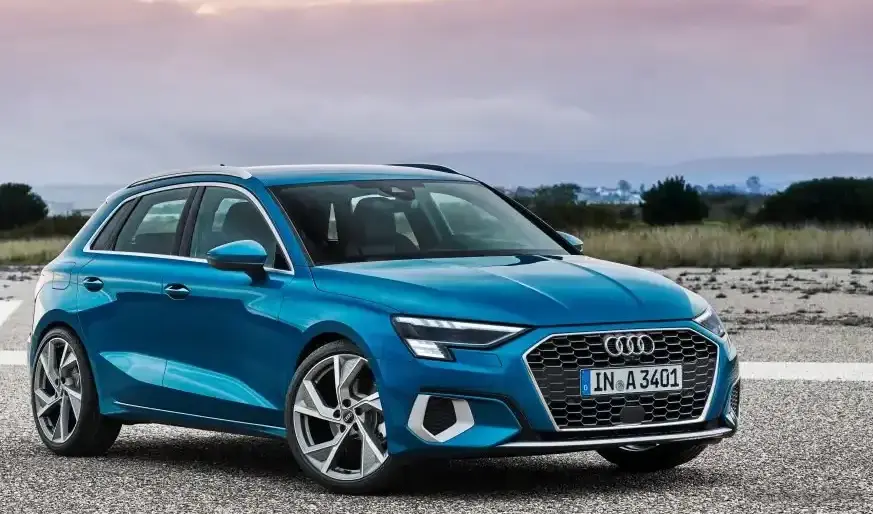
The Audi A3 Sportback (8Y) 30 TFSI, produced from 2020 to 2024, represents an entry point into the fourth generation (8Y) of Audi’s popular compact hatchback. Positioned as a fuel-efficient and accessible option within the A3 Sportback range, the 30 TFSI utilizes a 1.0-liter turbocharged three-cylinder engine paired with a six-speed manual transmission. This variant was primarily aimed at buyers prioritizing economy and everyday usability over outright performance, particularly in European markets where smaller displacement engines are favored due to tax incentives and fuel costs. It served as a direct alternative to higher-trim A3 models like the 40 TFSI and the diesel-powered 30 TDI.
Technical Specifications
| Brand | Audi |
| Model | A3 |
| Generation | A3 Sportback (8Y) |
| Type (Engine) | 30 TFSI (110 Hp) |
| Start of production | 2020 |
| End of production | 2024 |
| Powertrain Architecture | Internal Combustion engine |
| Body type | Hatchback |
| Seats | 5 |
| Doors | 5 |
| Combined fuel consumption (WLTP) | 5.5-6.0 l/100 km (42.8 – 39.2 US mpg, 51.4 – 47.1 UK mpg, 18.2 – 16.7 km/l) |
| CO2 emissions (WLTP) | 125-137 g/km |
| Fuel consumption (economy) – urban (NEDC) | 5.7-5.9 l/100 km (41.3 – 39.9 US mpg, 49.6 – 47.9 UK mpg, 17.5 – 16.9 km/l) |
| Fuel consumption (economy) – extra urban (NEDC) | 4.0-4.2 l/100 km (58.8 – 56 US mpg, 70.6 – 67.3 UK mpg, 25 – 23.8 km/l) |
| Fuel consumption (economy) – combined (NEDC) | 4.6-4.8 l/100 km (51.1 – 49 US mpg, 61.4 – 58.9 UK mpg, 21.7 – 20.8 km/l) |
| CO2 emissions (NEDC) | 106-111 g/km |
| Fuel Type | Petrol (Gasoline) |
| Acceleration 0 – 100 km/h | 10.6 sec |
| Acceleration 0 – 62 mph | 10.6 sec |
| Acceleration 0 – 60 mph | 10.1 sec |
| Maximum speed | 204 km/h (126.76 mph) |
| Emission standard | EURO 6d – ISC – FCM |
| Weight-to-power ratio | 11.1 kg/Hp, 90.2 Hp/tonne |
| Weight-to-torque ratio | 6.1 kg/Nm, 163.9 Nm/tonne |
| Power | 110 Hp @ 5500 rpm |
| Power per litre | 110.1 Hp/l |
| Torque | 200 Nm @ 2000-3000 rpm (147.51 lb.-ft. @ 2000-3000 rpm) |
| Engine layout | Front, Transverse |
| Engine Model/Code | DLAA |
| Engine displacement | 999 cm3 (60.96 cu. in.) |
| Number of cylinders | 3 |
| Engine configuration | Inline |
| Cylinder Bore | 74.5 mm (2.93 in.) |
| Piston Stroke | 76.4 mm (3.01 in.) |
| Compression ratio | 11.5:1 |
| Number of valves per cylinder | 4 |
| Fuel injection system | Direct injection |
| Engine aspiration | Turbocharger, Intercooler |
| Engine oil capacity | 4 l (4.23 US qt | 3.52 UK qt) |
| Coolant | 9 l (9.51 US qt | 7.92 UK qt) |
| Kerb Weight | 1220 kg (2689.64 lbs.) |
| Max. weight | 1770 kg (3902.18 lbs.) |
| Max load | 550 kg (1212.54 lbs.) |
| Trunk (boot) space – minimum | 380 l (13.42 cu. ft.) |
| Trunk (boot) space – maximum | 1200 l (42.38 cu. ft.) |
| Fuel tank capacity | 45 l (11.89 US gal | 9.9 UK gal) |
| Max. roof load | 75 kg (165.35 lbs.) |
| Permitted trailer load with brakes (8%) | 1500 kg (3306.93 lbs.) |
| Permitted trailer load with brakes (12%) | 1300 kg (2866.01 lbs.) |
| Permitted trailer load without brakes | 640 kg (1410.96 lbs.) |
| Permitted towbar download | 80 kg (176.37 lbs.) |
| Length | 4343 mm (170.98 in.) |
| Width | 1816 mm (71.5 in.) |
| Width including mirrors | 1984 mm (78.11 in.) |
| Height | 1449 mm (57.05 in.) |
| Wheelbase | 2636 mm (103.78 in.) |
| Front track | 1554 mm (61.18 in.) |
| Rear (Back) track | 1525 mm (60.04 in.) |
| Front overhang | 905 mm (35.63 in.) |
| Rear overhang | 802 mm (31.57 in.) |
| Drag coefficient (Cd) | 0.30 |
| Minimum turning circle (turning diameter) | 11.1 m (36.42 ft.) |
| Approach angle | 14.1° |
| Departure angle | 23.9° |
| Drivetrain Architecture | The Internal combustion engine (ICE) drives the front wheels of the vehicle. |
| Drive wheel | Front wheel drive |
| Number of gears and type of gearbox | 6 gears, manual transmission |
| Front suspension | Independent type McPherson |
| Rear suspension | Semi-independent, coil spring |
| Front brakes | Ventilated discs |
| Rear brakes | Disc |
| Assisting systems | ABS (Anti-lock braking system) |
| Steering type | Steering rack and pinion |
| Power steering | Electric Steering |
| Tires size | 205/55 R16 |
| Wheel rims size | 7J x 16 |
INTRODUCTION
The Audi A3 Sportback (8Y) 30 TFSI, launched in 2020, is a front-wheel-drive, five-door hatchback that forms part of the fourth generation of the A3 series. Built on the Volkswagen Group’s MQB platform (specifically the 8Y iteration), it shares its underpinnings with models like the Volkswagen Golf, SEAT Leon, and Skoda Octavia. The “30 TFSI” designation indicates the engine’s power output and fuel type – in this case, a 1.0-liter turbocharged gasoline engine producing 110 horsepower. This variant was designed to offer a balance of affordability, fuel efficiency, and practicality, making it a popular choice for urban commuters and those seeking a premium hatchback experience without the higher price tag of more powerful models.
Powertrain & Engine Architecture
At the heart of the 30 TFSI lies the Volkswagen Group’s DLAA engine code, a 999cc three-cylinder, turbocharged gasoline engine. This engine utilizes direct fuel injection and an intercooled turbocharger to deliver a respectable 110 horsepower at 5500 rpm and 200 Nm (147.51 lb-ft) of torque between 2000 and 3000 rpm. The engine features a relatively high compression ratio of 11.5:1, contributing to its efficiency. The engine’s compact size and lightweight construction help to reduce overall vehicle weight. The 30 TFSI is exclusively paired with a six-speed manual transmission, sending power to the front wheels. This transmission is known for its smooth shifting action and relatively short throw. The engine also incorporates a Start & Stop system to further enhance fuel economy.
Driving Characteristics
The 30 TFSI offers a comfortable and refined driving experience, prioritizing fuel efficiency over outright performance. Acceleration from 0 to 100 km/h (0-62 mph) takes approximately 10.6 seconds, and the top speed is limited to 204 km/h (126.76 mph). While not particularly quick, the engine provides sufficient power for everyday driving situations, including highway merging and overtaking. The turbocharger provides a noticeable boost in power at higher engine speeds, but the engine can feel slightly strained when pushed hard. The six-speed manual transmission allows for precise gear selection and enhances driver engagement. The gear ratios are well-matched to the engine’s power delivery, providing adequate acceleration in each gear. Compared to the more powerful 40 TFSI variant, the 30 TFSI feels noticeably slower, but it offers a more economical and relaxed driving experience.
Equipment & Trim Levels
The 30 TFSI typically came equipped with a generous amount of standard features, reflecting Audi’s commitment to providing a premium experience even in its entry-level models. Standard equipment often included Audi’s MMI infotainment system with a 7-inch touchscreen display, Bluetooth connectivity, and a USB interface. Safety features such as ABS, electronic stability control, and multiple airbags were also standard. Interior upholstery typically consisted of cloth seats, although leather options were available as upgrades. Higher trim levels offered additional features such as a larger touchscreen display, navigation system, automatic climate control, and a panoramic sunroof. Optional extras included LED headlights, a premium sound system, and various driver-assistance systems.
Chassis & Braking
The A3 Sportback 30 TFSI utilizes a McPherson strut front suspension and a semi-independent coil spring rear suspension. This setup provides a good balance of ride comfort and handling. The suspension is tuned to prioritize comfort, resulting in a smooth and controlled ride over most road surfaces. The front brakes consist of ventilated discs, while the rear brakes are solid discs. ABS (Anti-lock Braking System) is standard, providing enhanced braking performance and stability. The steering is an electric power steering system, offering light and precise steering feel. The car’s relatively low weight contributes to its agile handling characteristics.
Market Reception & Comparison
The Audi A3 Sportback 30 TFSI was generally well-received by automotive critics, who praised its fuel efficiency, comfortable ride, and refined interior. However, some critics noted that the engine could feel underpowered, particularly when fully loaded or driving uphill. Compared to other trims in the A3 lineup, the 30 TFSI offered the best fuel economy, making it an attractive option for budget-conscious buyers. The 40 TFSI, with its more powerful engine, offered significantly better performance but at the cost of increased fuel consumption. The diesel-powered 30 TDI provided similar fuel economy to the 30 TFSI but offered more torque and a different driving experience.
Legacy
The 1.0-liter TFSI engine, as used in the A3 30 TFSI, has proven to be a relatively reliable powertrain. While some early models experienced minor issues with the timing chain tensioner, these were generally addressed through software updates and revised components. The engine’s simple design and robust construction contribute to its long-term durability. On the used car market, the A3 30 TFSI represents a good value proposition, offering a premium hatchback experience at an affordable price. Its fuel efficiency and low running costs make it an attractive option for those seeking a practical and economical vehicle.