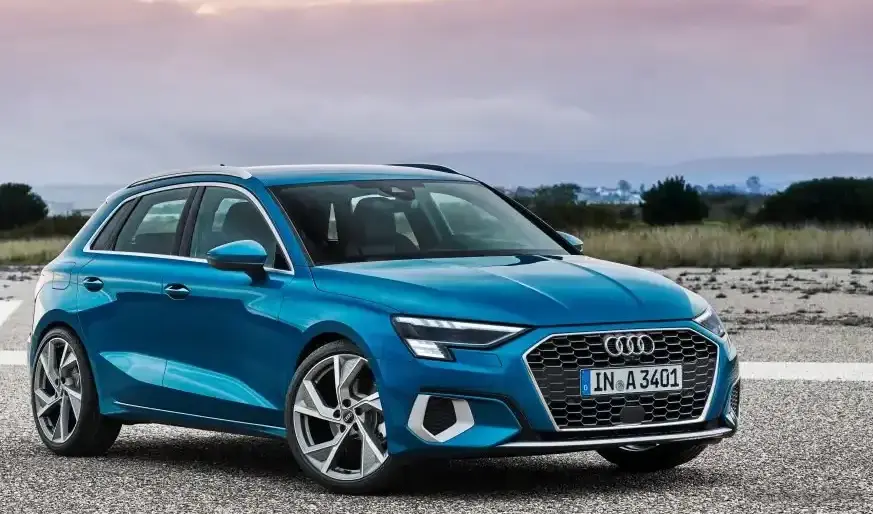
The Audi A3 Sportback (8Y) 30 TFSI, produced from 2020 to 2024, represents an entry point into the fourth generation (8Y) of Audi’s popular compact hatchback. This variant, powered by a 1.0-liter turbocharged three-cylinder engine paired with a mild-hybrid system and a seven-speed S tronic dual-clutch transmission, was designed to balance fuel efficiency with everyday usability. Positioned as the base model in many European markets, the 30 TFSI offered a more accessible price point compared to higher-powered A3 variants like the 40 TFSI. It played a significant role in Audi’s strategy to offer a diverse range of powertrain options, catering to varying customer preferences and increasingly stringent emissions regulations.
Technical Specifications
| Brand | Audi |
| Model | A3 |
| Generation | A3 Sportback (8Y) |
| Type (Engine) | 30 TFSI (110 Hp) Mild Hybrid S tronic |
| Start of production | 2020 |
| End of production | 2024 |
| Powertrain Architecture | MHEV (Mild Hybrid Electric Vehicle) |
| Body type | Hatchback |
| Seats | 5 |
| Doors | 5 |
| Combined fuel consumption (WLTP) | 5.1-5.7 l/100 km (46.1 – 41.3 US mpg) |
| CO2 emissions (WLTP) | 115-129 g/km |
| Fuel consumption (economy) – urban (NEDC) | 5.1-5.2 l/100 km (46.1 – 45.2 US mpg) |
| Fuel consumption (economy) – extra urban (NEDC) | 3.9-4.1 l/100 km (60.3 – 57.4 US mpg) |
| Fuel consumption (economy) – combined (NEDC) | 4.3-4.5 l/100 km (54.7 – 52.3 US mpg) |
| CO2 emissions (NEDC) | 99-104 g/km |
| Fuel Type | Petrol (Gasoline) |
| Acceleration 0 – 100 km/h | 10.6 sec |
| Acceleration 0 – 62 mph | 10.6 sec |
| Acceleration 0 – 60 mph | 10.1 sec |
| Maximum speed | 204 km/h (126.76 mph) |
| Emission standard | Euro 6d – ISC – FCM |
| Weight-to-power ratio | 11.6 kg/Hp |
| Weight-to-torque ratio | 6.4 kg/Nm |
| Power | 110 Hp @ 5500 rpm |
| Torque | 200 Nm @ 2000-3000 rpm (147.51 lb.-ft.) |
| Engine layout | Front, Transverse |
| Engine Model/Code | DLAA |
| Engine displacement | 999 cm3 (60.96 cu. in.) |
| Number of cylinders | 3 |
| Engine configuration | Inline |
| Cylinder Bore | 74.5 mm (2.93 in.) |
| Piston Stroke | 76.4 mm (3.01 in.) |
| Compression ratio | 11.5:1 |
| Number of valves per cylinder | 4 |
| Fuel injection system | Direct injection |
| Engine aspiration | Turbocharger, Intercooler |
| Engine oil capacity | 4 l (4.23 US qt | 3.52 UK qt) |
| Coolant | 9 l (9.51 US qt | 7.92 UK qt) |
| Kerb Weight | 1280 kg (2821.92 lbs.) |
| Max. weight | 1835 kg (4045.48 lbs.) |
| Max load | 555 kg (1223.57 lbs.) |
| Trunk (boot) space – minimum | 380 l (13.42 cu. ft.) |
| Trunk (boot) space – maximum | 1200 l (42.38 cu. ft.) |
| Fuel tank capacity | 45 l (11.89 US gal | 9.9 UK gal) |
| Max. roof load | 75 kg (165.35 lbs.) |
| Permitted trailer load with brakes (8%) | 1500 kg (3306.93 lbs.) |
| Permitted trailer load with brakes (12%) | 1300 kg (2866.01 lbs.) |
| Permitted trailer load without brakes | 670 kg (1477.1 lbs.) |
| Permitted towbar download | 80 kg (176.37 lbs.) |
| Length | 4343 mm (170.98 in.) |
| Width | 1816 mm (71.5 in.) |
| Width including mirrors | 1984 mm (78.11 in.) |
| Height | 1449 mm (57.05 in.) |
| Wheelbase | 2636 mm (103.78 in.) |
| Front track | 1554 mm (61.18 in.) |
| Rear (Back) track | 1525 mm (60.04 in.) |
| Front overhang | 905 mm (35.63 in.) |
| Rear overhang | 802 mm (31.57 in.) |
| Drag coefficient (Cd) | 0.29 |
| Minimum turning circle (turning diameter) | 11.1 m (36.42 ft.) |
| Drivetrain Architecture | Front wheel drive, MHEV |
| Number of gears and type of gearbox | 7 gears, automatic transmission S tronic |
| Front suspension | Independent, type McPherson with coil spring and anti-roll bar |
| Rear suspension | Independent multi-link suspension |
| Front brakes | Ventilated discs |
| Rear brakes | Disc |
INTRODUCTION
The Audi A3 Sportback (8Y) 30 TFSI, launched in 2020, is a front-wheel-drive hatchback that serves as the entry-level variant within the fourth-generation A3 range. Built on the Volkswagen Group’s MQB platform (specifically the 8Y iteration), it shares its underpinnings with other models like the Volkswagen Golf, SEAT Leon, and Skoda Octavia. The “30 TFSI” designation indicates the engine’s power output, while “Mild Hybrid” signifies the inclusion of a 48-volt electrical system designed to improve fuel economy and reduce emissions. The S tronic transmission, Audi’s name for its dual-clutch gearbox, is standard equipment. This model was primarily aimed at European markets where fuel efficiency and lower running costs are highly valued.
Powertrain & Engine Architecture
At the heart of the A3 30 TFSI lies the DLAA engine code, a 999cc three-cylinder turbocharged gasoline engine. This engine utilizes direct fuel injection and a single scroll turbocharger with an intercooler to deliver a respectable 110 horsepower at 5500 rpm and 200 Nm (147.51 lb-ft) of torque between 2000 and 3000 rpm. The mild-hybrid system incorporates a belt starter generator (BSG) and a small lithium-ion battery. The BSG allows for extended start-stop functionality, regenerative braking, and a limited amount of electric assistance during acceleration. The seven-speed S tronic dual-clutch transmission provides quick and smooth gear changes, contributing to both performance and efficiency. This transmission features a wet clutch design for improved durability and heat dissipation. The engine’s compact size and aluminum construction help to minimize weight, further enhancing fuel economy.
Driving Characteristics
The A3 30 TFSI offers a comfortable and refined driving experience, prioritizing efficiency over outright performance. Acceleration from 0 to 100 km/h (0-62 mph) takes approximately 10.6 seconds, which is noticeably slower than the more powerful 40 TFSI variants. The S tronic transmission is well-programmed, providing seamless shifts in both automatic and manual modes. The mild-hybrid system is largely unobtrusive, providing a subtle boost during acceleration. The steering is precise and well-weighted, and the suspension offers a good balance between comfort and handling. While not a sports car, the A3 30 TFSI is perfectly capable of handling everyday driving situations with ease. The gear ratios are tuned for fuel efficiency, meaning the engine can feel slightly strained when accelerating hard or climbing hills.
Equipment & Trim Levels
The standard equipment level for the A3 30 TFSI varied depending on the market, but generally included features such as Audi’s MMI infotainment system with a 10.1-inch touchscreen display, digital instrument cluster, automatic climate control, and a suite of safety features including lane departure warning and automatic emergency braking. Interior upholstery typically consisted of cloth seats, although leather options were available as upgrades. Common optional extras included a sunroof, upgraded sound system, and various driver assistance packages. Trim levels often included “Sport” and “S line” packages, which added cosmetic enhancements such as sport seats, unique alloy wheels, and exterior styling upgrades.
Chassis & Braking
The A3 30 TFSI utilizes a McPherson strut front suspension and a multi-link rear suspension, providing a comfortable and controlled ride. The front brakes are ventilated discs, while the rear brakes are solid discs. Anti-lock braking system (ABS) and electronic stability control (ESC) are standard features. The chassis is tuned to prioritize comfort and stability, rather than outright sportiness. The steering system is an electric power steering system, offering precise and responsive control. The relatively low weight of the 30 TFSI variant contributes to its agile handling characteristics.
Market Reception & Comparison
The A3 30 TFSI was generally well-received by automotive critics, who praised its fuel efficiency, comfortable ride, and refined interior. However, some reviewers noted that the engine lacked the punch of the more powerful 40 TFSI variants. Compared to the 40 TFSI, the 30 TFSI offered significantly better fuel economy but slower acceleration. The 30 TDI diesel variant provided similar fuel economy with more torque, but at a higher initial cost. The 30 TFSI appealed to buyers who prioritized fuel efficiency and affordability over outright performance.
Legacy
The Audi A3 30 TFSI (8Y) represents a key step in Audi’s transition towards more efficient and environmentally friendly powertrains. The combination of a small-displacement turbocharged engine, mild-hybrid technology, and a dual-clutch transmission proved to be a successful formula for balancing performance and fuel economy. On the used car market, these models are generally considered reliable, with the three-cylinder engine proving to be durable. However, potential buyers should be aware of the importance of regular maintenance, particularly oil changes, to ensure the longevity of the turbocharger and timing chain. The A3 30 TFSI remains a popular choice for buyers seeking a stylish, comfortable, and fuel-efficient compact hatchback.