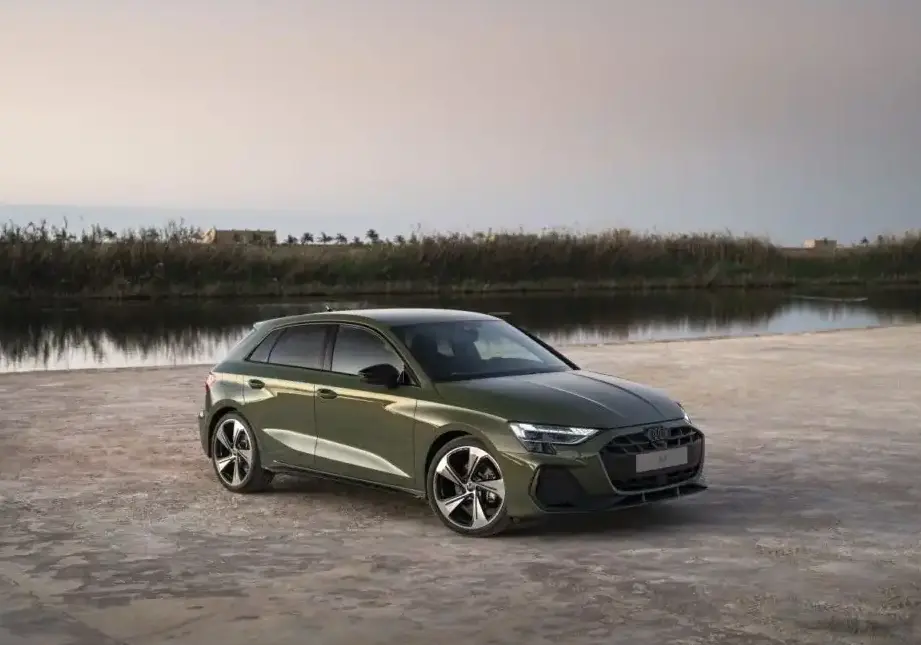
The Audi A3 Sportback 35 TFSI (150 hp) represents a key offering within the eighth-generation (8Y) A3 Sportback lineup, particularly following the 2024 facelift. Introduced in April 2024, this variant balances fuel efficiency with respectable performance, targeting buyers seeking a premium compact hatchback experience. It occupies a mid-range position within the A3 family, slotting between the entry-level 30 TFSI and the more potent 45 TFSI models. The 8Y generation A3 Sportback is built on the Volkswagen Group’s MQB Evo platform, shared with models like the Volkswagen Golf and SEAT Leon, and is primarily marketed towards European and Asian consumers, though limited imports are available in North America.
Technical Specifications
| Brand | Audi |
| Model | A3 |
| Generation | A3 Sportback (8Y, facelift 2024) |
| Type (Engine) | 35 TFSI (150 Hp) |
| Start of production | April, 2024 |
| Powertrain Architecture | Internal Combustion engine |
| Body type | Hatchback |
| Seats | 5 |
| Doors | 5 |
| Combined fuel consumption (WLTP) | 5.5-6.2 l/100 km (42.8 – 37.9 US mpg, 51.4 – 45.6 UK mpg, 18.2 – 16.1 km/l) |
| CO2 emissions (WLTP) | 126-141 g/km |
| Fuel Type | Petrol (Gasoline) |
| Acceleration 0 – 100 km/h | 8.4 sec |
| Acceleration 0 – 62 mph | 8.4 sec |
| Acceleration 0 – 60 mph | 8 sec |
| Maximum speed | 225 km/h (139.81 mph) |
| Emission standard | Euro 6e |
| Weight-to-power ratio | 8.6 kg/Hp, 116.3 Hp/tonne |
| Weight-to-torque ratio | 5.2 kg/Nm, 193.8 Nm/tonne |
| Power | 150 Hp @ 5000-6000 rpm |
| Power per litre | 100.1 Hp/l |
| Torque | 250 Nm @ 1500-3500 rpm (184.39 lb.-ft. @ 1500-3500 rpm) |
| Engine layout | Front, Transverse |
| Engine Model/Code | EA211 evo2 / DXD |
| Engine displacement | 1498 cm3 (91.41 cu. in.) |
| Number of cylinders | 4 |
| Engine configuration | Inline |
| Cylinder Bore | 74.5 mm (2.93 in.) |
| Piston Stroke | 85.9 mm (3.38 in.) |
| Compression ratio | 12:1 |
| Number of valves per cylinder | 4 |
| Fuel injection system | Direct injection |
| Engine aspiration | Turbocharger, Intercooler |
| Valvetrain | DOHC |
| Engine oil capacity | 4.3 l (4.54 US qt | 3.78 UK qt) |
| Coolant | 11.2 l (11.83 US qt | 9.85 UK qt) |
| Engine systems | Start & Stop System, Cylinder deactivation system, Particulate filter |
| Kerb Weight | 1290 kg (2843.96 lbs.) |
| Max. weight | 1845 kg (4067.53 lbs.) |
| Max load | 555 kg (1223.57 lbs.) |
| Trunk (boot) space – minimum | 380 l (13.42 cu. ft.) |
| Trunk (boot) space – maximum | 1200 l (42.38 cu. ft.) |
| Fuel tank capacity | 50 l (13.21 US gal | 11 UK gal) |
| Max. roof load | 75 kg (165.35 lbs.) |
| Permitted trailer load with brakes (8%) | 1700 kg (3747.86 lbs.) |
| Permitted trailer load with brakes (12%) | 1500 kg (3306.93 lbs.) |
| Permitted trailer load without brakes | 680 kg (1499.14 lbs.) |
| Permitted towbar download | 80 kg (176.37 lbs.) |
| Length | 4352 mm (171.34 in.) |
| Width | 1816 mm (71.5 in.) |
| Width including mirrors | 1984 mm (78.11 in.) |
| Height | 1441 mm (56.73 in.) |
| Wheelbase | 2635 mm (103.74 in.) |
| Front track | 1554 mm (61.18 in.) |
| Rear (Back) track | 1526 mm (60.08 in.) |
| Front overhang | 906 mm (35.67 in.) |
| Rear overhang | 811 mm (31.93 in.) |
| Drag coefficient (Cd) | 0.29 |
| Minimum turning circle (turning diameter) | 11.1 m (36.42 ft.) |
| Approach angle | 14.2° |
| Departure angle | 24.3° |
| Drivetrain Architecture | The Internal combustion engine (ICE) drives the front wheels of the vehicle. |
| Drive wheel | Front wheel drive |
| Number of gears and type of gearbox | 6 gears, manual transmission |
| Front suspension | Independent, type McPherson with coil spring and anti-roll bar |
| Rear suspension | Independent multi-link spring suspension with stabilizer |
| Front brakes | Ventilated discs, 288 mm |
| Rear brakes | Disc, 272 mm |
| Assisting systems | ABS (Anti-lock braking system) |
| Steering type | Steering rack and pinion |
| Power steering | Electric Steering |
| Tires size | 205/55 R16; 225/45 R17; 225/40 R18; 235/35 R19 |
| Wheel rims size | 7J x 16; 8J x 17; 8J x 18; 8J x 19 |
Powertrain & Engine Architecture
The 35 TFSI variant is powered by Audi’s EA211 evo2 1.5-liter turbocharged four-cylinder gasoline engine, internally designated DXD. This engine is a key component of the Volkswagen Group’s modular engine family. It features direct fuel injection, a single scroll turbocharger, and variable valve timing on both the intake and exhaust sides (DOHC). A notable feature is its cylinder deactivation system, which shuts down two cylinders under light load conditions to improve fuel economy. The engine produces 150 horsepower at 5000-6000 rpm and 250 Nm (184 lb-ft) of torque between 1500-3500 rpm. The engine is transversely mounted at the front of the vehicle. The 6-speed manual transmission is standard, offering precise shifts and a relatively engaging driving experience.
Driving Characteristics
The A3 35 TFSI with the manual transmission delivers a balanced driving experience. Acceleration from 0-100 km/h (0-62 mph) takes approximately 8.4 seconds. While not overtly sporty, the engine provides sufficient power for everyday driving and overtaking maneuvers. The turbocharger provides a noticeable boost in torque at lower engine speeds, making it feel responsive in urban environments. The manual gearbox is well-matched to the engine’s powerband, and the gear ratios are optimized for both fuel efficiency and performance. Compared to the more powerful 45 TFSI, the 35 TFSI feels less urgent, but it offers a more economical and relaxed driving experience.
Equipment & Trim Levels
The 35 TFSI typically comes standard with features such as Audi’s MMI infotainment system with a 10.1-inch touchscreen display, digital instrument cluster, automatic climate control, and a suite of driver-assistance systems including lane departure warning and forward collision warning. Interior upholstery is typically cloth, with options for leather available as upgrades. Trim levels often include ‘Advanced’ and ‘S line’ packages, adding features like larger alloy wheels, sport suspension, and more premium interior materials. Optional extras include a panoramic sunroof, adaptive cruise control, and a premium sound system.
Chassis & Braking
The A3 Sportback 35 TFSI utilizes an independent suspension setup, with a McPherson strut front suspension and a multi-link rear suspension. This configuration provides a comfortable ride quality while maintaining good handling characteristics. Front brakes are ventilated discs measuring 288mm, while rear brakes are solid discs measuring 272mm. The car is equipped with ABS (Anti-lock Braking System) and electronic stability control as standard safety features. Steering is via a rack-and-pinion system with electric power assistance.
Market Reception & Comparison
The A3 35 TFSI has been generally well-received by automotive critics as a practical and well-rounded compact hatchback. It’s praised for its fuel efficiency, comfortable ride, and refined interior. Compared to the higher-output 45 TFSI, the 35 TFSI offers a more affordable entry point into the A3 range, making it attractive to budget-conscious buyers. Fuel economy is a strong point, with combined WLTP figures ranging from 5.5 to 6.2 l/100 km. Reliability has been generally good, although some owners have reported minor issues with the infotainment system.
Legacy
The EA211 evo2 engine family, including the 1.5-liter unit found in the A3 35 TFSI, has proven to be a reliable and durable powertrain. While long-term reliability data is still emerging for the 2024 facelifted model, the engine’s predecessors have demonstrated good longevity. On the used car market, the A3 35 TFSI is expected to hold its value reasonably well, particularly examples with a full service history and low mileage. Its balance of fuel efficiency, practicality, and premium features makes it a desirable option for buyers seeking a well-rounded compact hatchback.