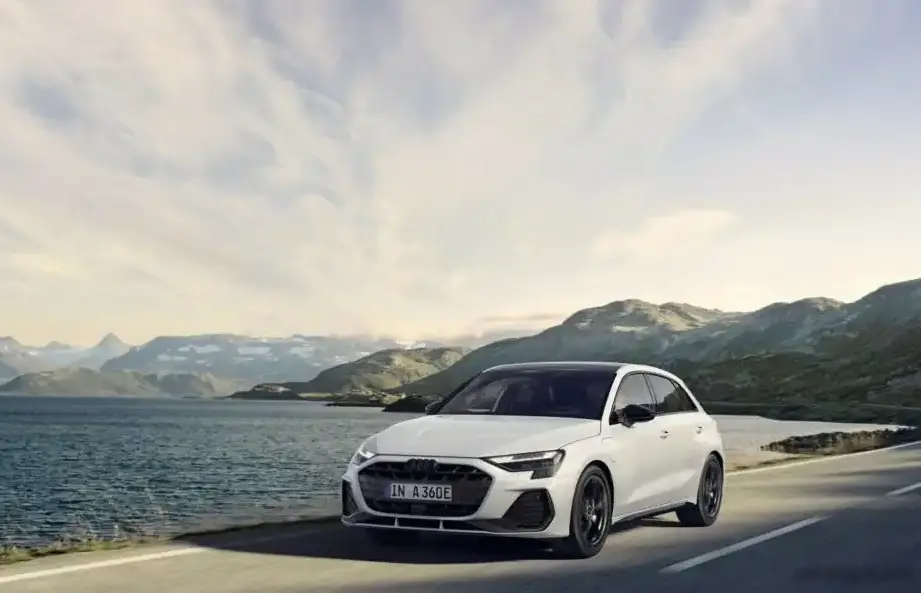
The Audi A3 Sportback 40 TFSI e, introduced in October 2024 as part of the 8Y facelift, represents Audi’s entry into the plug-in hybrid hatchback market. This variant combines a 1.5-liter turbocharged gasoline engine with an electric motor, delivering a combined output of 204 horsepower. Positioned as a mid-range offering within the A3 Sportback lineup, it aims to provide a balance between performance, efficiency, and electric driving range. The 40 TFSI e is primarily targeted towards environmentally conscious consumers seeking a premium compact hatchback with the flexibility of both electric and gasoline power.
Technical Specifications
| Brand | Audi |
| Model | A3 |
| Generation | A3 Sportback (8Y, facelift 2024) |
| Type (Engine) | 40 TFSI e (204 Hp) Plug-in Hybrid S tronic |
| Start of production | October, 2024 |
| Powertrain Architecture | PHEV (Plug-in Hybrid Electric Vehicle) |
| Body type | Hatchback |
| Seats | 5 |
| Doors | 5 |
| Combined fuel consumption (WLTP) | 0.3-0.4 l/100 km (784 – 588 US mpg, 941.6 – 706.2 UK mpg, 333.3 – 250 km/l) |
| CO2 emissions (WLTP) | 6-8 g/km |
| Fuel Type | Petrol / electricity |
| Acceleration 0 – 100 km/h | 7.4 sec |
| Acceleration 0 – 62 mph | 7.4 sec |
| Acceleration 0 – 60 mph | 7 sec |
| Maximum speed | 225 km/h (139.81 mph) |
| Emission standard | Euro 6e |
| Weight-to-power ratio | 7.8 kg/Hp, 127.5 Hp/tonne |
| Weight-to-torque ratio | 4.6 kg/Nm, 218.8 Nm/tonne |
| Gross battery capacity | 25.7 kWh |
| Net (usable) battery capacity | 19.7 kWh |
| Battery voltage | 400 V |
| Battery technology | Lithium nickel manganese cobalt oxides (Li-NMC) |
| Battery location | Below the floor, under the rear seats |
| Recuperation output | 43 kW |
| All-electric range (WLTP) | 126-143 km (78.29 – 88.86 mi) |
| Average Energy consumption (WLTP) | 14.6-16.2 kWh/100 km (23.5 – 26.07 kWh/100 mi, 143 – 129 MPGe, 6.8 – 6.2 km/kWh, 4.3 – 3.8 mi/kWh) |
| Max speed (electric) | 140 km/h (86.99 mph) |
| Electric motor power | 116 Hp |
| Electric motor Torque | 330 Nm (243.4 lb.-ft.) |
| Electric motor location | Between the combustion engine and the transmission |
| Electric motor type | Synchronous |
| System power | 204 Hp |
| System torque | 350 Nm (258.15 lb.-ft.) |
| Power | 150 Hp @ 5000-6000 rpm |
| Torque | 250 Nm @ 1500-4000 rpm (184.39 lb.-ft. @ 1500-4000 rpm) |
| Engine layout | Front, Transverse |
| Engine Model/Code | EA211 evo2 |
| Engine displacement | 1498 cm3 (91.41 cu. in.) |
| Number of cylinders | 4 |
| Engine configuration | Inline |
| Cylinder Bore | 74.5 mm (2.93 in.) |
| Piston Stroke | 85.9 mm (3.38 in.) |
| Compression ratio | 11.5:1 |
| Number of valves per cylinder | 4 |
| Fuel injection system | Direct injection |
| Engine aspiration | Turbocharger, Intercooler |
| Valvetrain | DOHC |
| Engine oil capacity | 4.3 l (4.54 US qt | 3.78 UK qt) |
| Coolant | 16.2 l (17.12 US qt | 14.25 UK qt) |
| Kerb Weight | 1600 kg (3527.4 lbs.) |
| Max. weight | 2095-2110 kg (4618.68 – 4651.75 lbs.) |
| Max load | 495-510 kg (1091.29 – 1124.36 lbs.) |
| Trunk (boot) space – minimum | 280 l (9.89 cu. ft.) |
| Trunk (boot) space – maximum | 1100 l (38.85 cu. ft.) |
| Fuel tank capacity | 40 l (10.57 US gal | 8.8 UK gal) |
| Max. roof load | 75 kg (165.35 lbs.) |
| Permitted trailer load with brakes (8%) | 1700 kg (3747.86 lbs.) |
| Permitted trailer load with brakes (12%) | 1400 kg (3086.47 lbs.) |
| Permitted trailer load without brakes | 750 kg (1653.47 lbs.) |
| Permitted towbar download | 80 kg (176.37 lbs.) |
| Length | 4352 mm (171.34 in.) |
| Width | 1816 mm (71.5 in.) |
| Width including mirrors | 1984 mm (78.11 in.) |
| Height | 1451 mm (57.13 in.) |
| Wheelbase | 2630 mm (103.54 in.) |
| Front track | 1542-1554 mm (60.71 – 61.18 in.) |
| Rear (Back) track | 1513-1526 mm (59.57 – 60.08 in.) |
| Front overhang | 906 mm (35.67 in.) |
| Rear overhang | 816 mm (32.13 in.) |
| Drag coefficient (Cd) | 0.30 |
| Minimum turning circle (turning diameter) | 11.1 m (36.42 ft.) |
| Approach angle | 14.1° |
| Departure angle | 25.3° |
| Drivetrain Architecture | The Internal combustion engine (ICE) and electric motor drive the front wheels of the car with the ability to work in full electric or mixed mode. |
| Drive wheel | Front wheel drive |
| Number of gears and type of gearbox | 6 gears, automatic transmission S tronic |
| Front suspension | Independent, type McPherson with coil spring and anti-roll bar |
| Rear suspension | Independent multi-link spring suspension with stabilizer |
| Front brakes | Ventilated discs |
| Assisting systems | ABS (Anti-lock braking system) |
| Steering type | Steering rack and pinion |
| Power steering | Electric Steering |
| Tires size | 225/45 R17 |
| Wheel rims size | 8J x 17 |
INTRODUCTION
The Audi A3 Sportback 40 TFSI e, launched in October 2024, is a plug-in hybrid variant of the fourth-generation (8Y) A3 Sportback. This model builds upon the 8Y platform, which debuted in 2020, incorporating a revised front and rear design as part of the facelift. The “40 TFSI e” designation signifies a combined system output of approximately 204 horsepower, achieved through the integration of a 1.5-liter turbocharged gasoline engine and an electric motor. It’s positioned as a key offering in Audi’s strategy to electrify its lineup, providing a stepping stone for customers transitioning to fully electric vehicles. The Sportback body style, a five-door hatchback, remains popular in Europe, offering practicality and a more youthful aesthetic compared to the A3 Sedan.
Powertrain & Engine Architecture
At the heart of the 40 TFSI e lies the EA211 evo2 1.5-liter turbocharged four-cylinder gasoline engine. This engine, a member of the Volkswagen Group’s modular engine family, produces 150 horsepower and 250 Nm (184.39 lb-ft) of torque. It features direct fuel injection and a Miller cycle combustion process for improved efficiency. The engine is paired with a 116 horsepower electric motor integrated between the engine and the seven-speed S tronic dual-clutch transmission. The electric motor draws power from a 19.7 kWh (usable) lithium-ion battery pack located under the rear seats and floor. The S tronic transmission is specifically calibrated to work seamlessly with the electric motor, providing smooth and efficient power delivery. The combined system output is 204 horsepower and 350 Nm (258.15 lb-ft) of torque. The engine utilizes a particulate filter to reduce emissions, meeting stringent Euro 6e standards.
Driving Characteristics
The 40 TFSI e offers a distinct driving experience compared to other A3 Sportback variants. In electric-only mode, the vehicle provides near-silent acceleration and a range of 126-143 km (78.29 – 88.86 mi) depending on driving conditions. The electric motor delivers instant torque, resulting in brisk acceleration in urban environments. When the battery is depleted or when more power is demanded, the gasoline engine seamlessly kicks in, providing a combined output that allows for a 0-100 km/h (0-62 mph) time of 7.4 seconds. The S tronic transmission offers quick and precise gear changes, enhancing the overall driving experience. Compared to the 1.5 TFSI non-hybrid version, the 40 TFSI e offers improved acceleration and a more refined driving experience, particularly in electric mode. Compared to higher-performance A3 models like the S3, the 40 TFSI e prioritizes efficiency and comfort over outright speed.
Equipment & Trim Levels
The 40 TFSI e typically comes with a generous level of standard equipment. This includes Audi’s Virtual Cockpit digital instrument cluster, a touchscreen infotainment system with Apple CarPlay and Android Auto compatibility, and a suite of driver-assistance systems such as lane departure warning and automatic emergency braking. Interior upholstery is typically a combination of cloth and leatherette, with options for full leather available. Trim levels often include “Advanced” and “S line” packages, which add features like upgraded interior trim, larger alloy wheels, and more advanced driver-assistance technologies. Optional extras include a panoramic sunroof, a premium sound system, and adaptive cruise control.
Chassis & Braking
The A3 Sportback 40 TFSI e utilizes a McPherson strut front suspension and a multi-link rear suspension, providing a comfortable and controlled ride. The suspension is tuned to accommodate the added weight of the battery pack. Brakes are ventilated discs on the front axle and solid discs on the rear. ABS (Anti-lock Braking System) is standard, along with electronic stability control. The steering is an electromechanical power steering system, offering precise and responsive handling. The vehicle’s weight distribution is influenced by the battery pack’s location, contributing to balanced handling characteristics.
Market Reception & Comparison
The Audi A3 Sportback 40 TFSI e has been generally well-received by automotive critics. Its combination of electric range, fuel efficiency, and performance has been praised. Compared to the non-hybrid A3 models, the 40 TFSI e offers significantly improved fuel economy and lower emissions. However, the added weight of the battery pack does slightly impact handling agility. Compared to other plug-in hybrid hatchbacks in its class, such as the Volkswagen Golf eHybrid and the Mercedes-Benz A 250 e, the A3 40 TFSI e offers a competitive balance of price, performance, and features. Reliability reports are still emerging, but Audi’s reputation for build quality suggests a high level of long-term dependability.
Legacy
The A3 Sportback 40 TFSI e represents a significant step in Audi’s transition towards electrification. The EA211 evo2 engine, combined with the electric motor and S tronic transmission, is a proven and reliable powertrain. The long-term reliability of the battery pack remains a key factor in the vehicle’s overall durability. In the used car market, the 40 TFSI e is expected to hold its value well, particularly as demand for plug-in hybrid vehicles continues to grow. Its combination of practicality, efficiency, and premium features makes it an attractive option for buyers seeking a versatile and environmentally friendly compact hatchback.