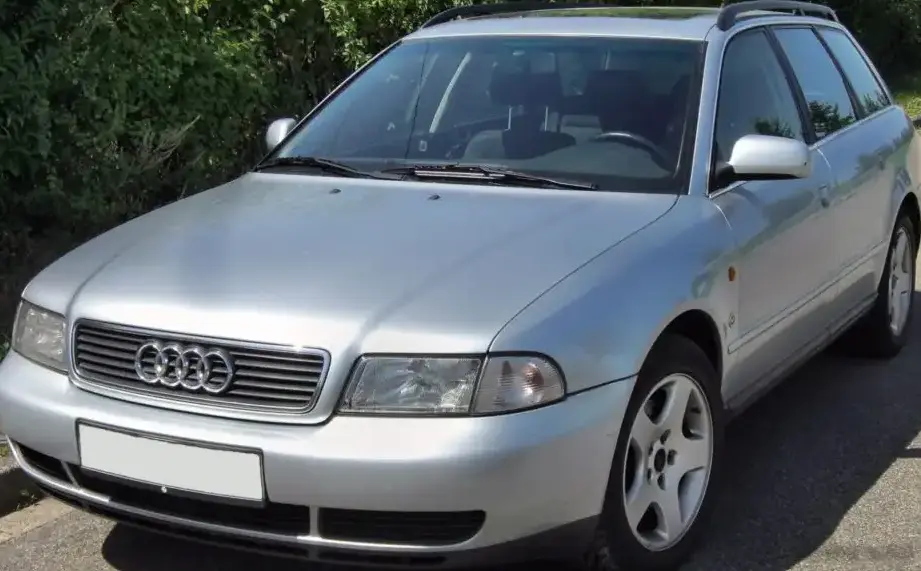
The Audi A4 Avant (B5, Typ 8D) 1.6i, produced between 1997 and 1999, represented the entry point into the A4 Avant (wagon) model range during that period. Positioned as a more affordable and fuel-efficient option, it catered to buyers prioritizing practicality and lower running costs over outright performance. This variant was part of the B5 generation A4, which utilized the Volkswagen Group’s 1HX0 platform, also underpinning the VW Passat and Skoda Octavia. The 1.6i model offered a spacious and well-built estate car, appealing to families and those needing versatile cargo capacity. While not a performance leader, it provided a comfortable and reliable driving experience.
Technical Specifications
| Brand | Audi |
| Model | A4 |
| Generation | A4 Avant (B5, Typ 8D) |
| Type (Engine) | 1.6i (101 Hp) |
| Start of production | 1997 |
| End of production | 1999 |
| Powertrain Architecture | Internal Combustion engine |
| Body type | Station wagon (estate) |
| Seats | 5 |
| Doors | 5 |
| Fuel consumption (urban) | 11.5 l/100 km (20.5 US mpg) |
| Fuel consumption (extra urban) | 6 l/100 km (39.2 US mpg) |
| Fuel Type | Petrol (Gasoline) |
| Acceleration 0 – 100 km/h | 12 sec |
| Acceleration 0 – 62 mph | 12 sec |
| Acceleration 0 – 60 mph | 11.4 sec |
| Maximum speed | 186 km/h (115.58 mph) |
| Weight-to-power ratio | 11.9 kg/Hp |
| Weight-to-torque ratio | 8.3 kg/Nm |
| Power | 101 Hp @ 5600 rpm |
| Torque | 145 Nm @ 3800 rpm (106.95 lb.-ft. @ 3800 rpm) |
| Engine layout | Front, Longitudinal |
| Engine Model/Code | ADP, AHL, ANA, ARM |
| Engine displacement | 1595 cm3 (97.33 cu. in.) |
| Number of cylinders | 4 |
| Engine configuration | Inline |
| Cylinder Bore | 81 mm (3.19 in.) |
| Piston Stroke | 77.4 mm (3.05 in.) |
| Compression ratio | 10:1 |
| Number of valves per cylinder | 2 |
| Fuel injection system | Multi-port manifold injection |
| Engine aspiration | Naturally aspirated engine |
| Valvetrain | OHC |
| Engine oil capacity | 3.5 l (3.7 US qt | 3.08 UK qt) |
| Coolant capacity | 7.5 l (7.93 US qt | 6.6 UK qt) |
| Kerb Weight | 1200 kg (2645.55 lbs.) |
| Max. weight | 1750 kg (3858.09 lbs.) |
| Max load | 550 kg (1212.54 lbs.) |
| Trunk (boot) space – minimum | 390 l (13.77 cu. ft.) |
| Trunk (boot) space – maximum | 1270 l (44.85 cu. ft.) |
| Fuel tank capacity | 62 l (16.38 US gal | 13.64 UK gal) |
| Length | 4478 mm (176.3 in.) |
| Width | 1733 mm (68.23 in.) |
| Height | 1417 mm (55.79 in.) |
| Wheelbase | 2622 mm (103.23 in.) |
| Front track | 1498 mm (58.98 in.) |
| Rear track | 1479 mm (58.23 in.) |
| Drag coefficient (Cd) | 0.31 |
| Minimum turning circle | 11.1 m (36.42 ft.) |
| Drivetrain Architecture | Front wheel drive |
| Number of gears | 5 |
| Gearbox type | Manual transmission |
| Front suspension | Wishbone |
| Rear suspension | Suspension with traction connecting levers |
| Front brakes | Disc |
| Rear brakes | Disc |
| Assisting systems | ABS (Anti-lock braking system) |
| Steering type | Steering rack and pinion |
| Power steering | Hydraulic |
| Tires size | 195/65 R15 |
| Wheel rims size | 15 |
Powertrain & Engine Architecture
The 1.6i Avant utilized various iterations of the Volkswagen Group’s inline-four cylinder engine, most commonly identified by engine codes ADP, AHL, ANA, and ARM. These engines featured a cast iron block with an aluminum cylinder head, employing a single overhead camshaft (OHC) design operating two valves per cylinder. Fuel delivery was managed by a multi-port fuel injection system, providing adequate, though not exceptional, combustion control. The engine’s 1595cc displacement produced 101 horsepower at 5600 rpm and 145 Nm (107 lb-ft) of torque at 3800 rpm. The engine was mounted longitudinally in the front of the vehicle, driving the front wheels. The standard transmission was a five-speed manual gearbox, offering a relatively direct and engaging driving experience. While an automatic transmission was available, it impacted performance and fuel economy.
Driving Characteristics
The 1.6i A4 Avant, particularly with the five-speed manual transmission, offered a reasonably engaging driving experience for its class. Acceleration from 0-60 mph took around 11.4 seconds, and top speed was approximately 115 mph. The engine felt somewhat strained at higher speeds or when fully loaded, requiring frequent downshifts to maintain momentum. The automatic transmission, while providing convenience, further diminished acceleration and responsiveness. The suspension, tuned for comfort, provided a compliant ride, absorbing bumps and imperfections in the road effectively. Steering was precise, though lacking in significant feedback. Compared to the more powerful 1.8L and 2.8L V6 variants, the 1.6i felt noticeably slower, but its lighter weight contributed to better handling in corners.
Equipment & Trim Levels
The 1.6i A4 Avant typically came with a modest level of standard equipment. Interior features generally included cloth upholstery, manual air conditioning, and a basic stereo system. Power windows and central locking were common, but features like leather seats, sunroofs, and upgraded audio systems were usually optional extras. Trim levels varied slightly depending on the market, but generally, the 1.6i represented the entry-level offering. Optional packages could add features like alloy wheels, fog lights, and a trip computer. The interior design was functional and well-built, reflecting Audi’s reputation for quality.
Chassis & Braking
The B5 A4 Avant featured an independent front suspension with wishbones and a semi-independent rear suspension utilizing trailing arms. This setup provided a good balance between ride comfort and handling. Brakes consisted of ventilated disc brakes on all four wheels, providing adequate stopping power for the vehicle’s weight and performance. Anti-lock Braking System (ABS) was standard, enhancing safety. The 1.6i models typically had smaller diameter wheels (15-inch) and narrower tires (195/65 R15) compared to higher-spec variants, contributing to a slightly less sporty feel.
Market Reception & Comparison
The 1.6i A4 Avant was generally well-received as a practical and affordable estate car. Critics acknowledged its spacious interior, comfortable ride, and build quality. However, the engine’s performance was often criticized as being underpowered, particularly when compared to the more potent 1.8L and 2.8L options. Fuel economy was a strong point, making it an attractive choice for those prioritizing running costs. Compared to rivals like the Ford Mondeo Estate and Vauxhall/Opel Vectra Estate, the A4 Avant offered a more premium feel and a higher level of perceived quality, but at a slightly higher price point.
Legacy
The 1.6i A4 Avant, while not the most sought-after variant, has proven to be a relatively reliable and durable vehicle. The engine, while not particularly powerful, is known for its longevity when properly maintained. Today, these cars are increasingly rare and are often found in the hands of enthusiasts or as affordable transportation. Parts availability is generally good, thanks to the widespread use of the engine and platform across the Volkswagen Group. The 1.6i A4 Avant represents a solid and practical choice for those seeking a classic Audi estate car with a focus on affordability and usability.