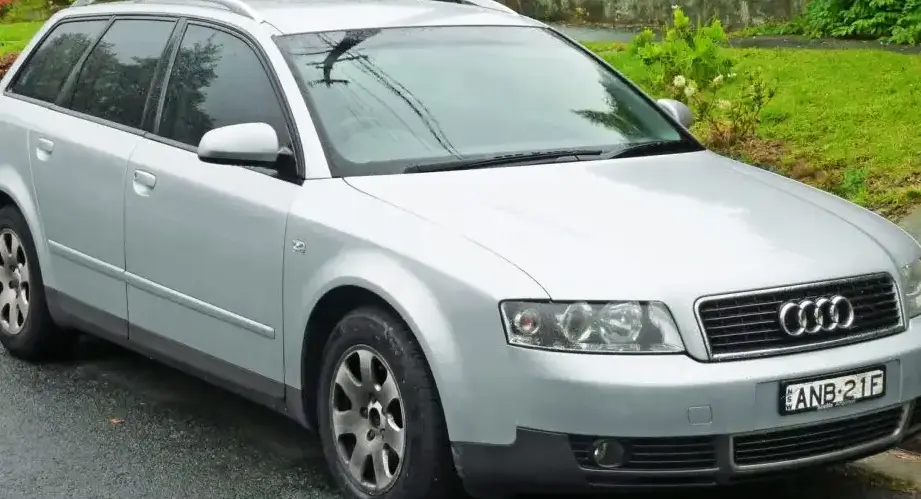
The Audi A4 Avant (B6 8E) 1.8T, produced from 2001 through June 2002, represents a key iteration of Audi’s popular compact executive wagon. Positioned within the B6 generation (2001-2005) of the A4 series, the 1.8T Avant offered a blend of practicality, performance, and Audi’s signature refinement. This variant occupied a mid-range position in the A4 lineup, serving as a more accessible entry point compared to the higher-performance models like the 3.0 V6, while offering a more engaging driving experience than the base 1.6-liter engine available in some European markets. The B6 A4 Avant was a significant model for Audi, building upon the success of the B5 generation and introducing a more modern design and improved technology.
Technical Specifications
| Brand | Audi |
| Model | A4 |
| Generation | A4 Avant (B6 8E) |
| Type (Engine) | 1.8 T (150 Hp) |
| Start of production | 2001 |
| End of production | June, 2002 |
| Powertrain Architecture | Internal Combustion engine |
| Body type | Station wagon (estate) |
| Seats | 5 |
| Doors | 5 |
| Fuel consumption (urban) | 11.3 l/100 km (20.8 US mpg, 25 UK mpg, 8.8 km/l) |
| Fuel consumption (extra urban) | 6.4 l/100 km (36.8 US mpg, 44.1 UK mpg, 15.6 km/l) |
| Fuel consumption (combined) | 8.2 l/100 km (28.7 US mpg, 34.4 UK mpg, 12.2 km/l) |
| Fuel Type | Petrol (Gasoline) |
| Acceleration 0 – 100 km/h | 9.1 sec |
| Acceleration 0 – 62 mph | 9.1 sec |
| Acceleration 0 – 60 mph | 8.6 sec |
| Maximum speed | 219 km/h (136.08 mph) |
| Weight-to-power ratio | 9.5 kg/Hp, 104.9 Hp/tonne |
| Weight-to-torque ratio | 6.8 kg/Nm, 146.9 Nm/tonne |
| Power | 150 Hp @ 5700 rpm |
| Power per litre | 84.2 Hp/l |
| Torque | 210 Nm @ 1750-4600 rpm (154.89 lb.-ft. @ 1750-4600 rpm) |
| Engine layout | Front, Longitudinal |
| Engine Model/Code | AVJ |
| Engine displacement | 1781 cm3 (108.68 cu. in.) |
| Number of cylinders | 4 |
| Engine configuration | Inline |
| Cylinder Bore | 81 mm (3.19 in.) |
| Piston Stroke | 86.4 mm (3.4 in.) |
| Compression ratio | 9.3:1 |
| Number of valves per cylinder | 5 |
| Fuel injection system | Multi-port manifold injection |
| Engine aspiration | Turbocharger, Intercooler |
| Valvetrain | DOHC |
| Engine oil capacity | 3.5 l (3.7 US qt | 3.08 UK qt) |
| Coolant | 6.5 l (6.87 US qt | 5.72 UK qt) |
| Kerb Weight | 1430 kg (3152.61 lbs.) |
| Max. weight | 1980 kg (4365.15 lbs.) |
| Max load | 550 kg (1212.54 lbs.) |
| Trunk (boot) space – minimum | 442 l (15.61 cu. ft.) |
| Trunk (boot) space – maximum | 1184 l (41.81 cu. ft.) |
| Fuel tank capacity | 70 l (18.49 US gal | 15.4 UK gal) |
| Length | 4548 mm (179.06 in.) |
| Width | 1772 mm (69.76 in.) |
| Height | 1428 mm (56.22 in.) |
| Wheelbase | 2650 mm (104.33 in.) |
| Front track | 1528 mm (60.16 in.) |
| Rear (Back) track | 1526 mm (60.08 in.) |
| Drag coefficient (Cd) | 0.32 |
| Minimum turning circle | 11.1 m (36.42 ft.) |
| Drivetrain Architecture | The Internal combustion engine (ICE) drives the front wheels of the vehicle. |
| Drive wheel | Front wheel drive |
| Number of gears and type of gearbox | 5 gears, manual transmission |
| Front suspension | Independent multi-link suspension |
| Rear suspension | Independent multi-link suspension |
| Front brakes | Ventilated discs |
| Rear brakes | Disc |
| Assisting systems | ABS (Anti-lock braking system) |
| Steering type | Steering rack and pinion |
| Power steering | Hydraulic Steering |
| Tires size | 195/65 R15 |
| Wheel rims size | 15 |
Powertrain & Engine Architecture
The heart of the A4 Avant 1.8T is the Audi-developed 1.8-liter inline-four cylinder engine, internally designated as the AVJ code. This engine is a turbocharged, multi-point fuel-injected powerplant. The AVJ engine utilizes a single turbocharger with an intercooler to boost power and torque. The engine features a dual overhead camshaft (DOHC) valvetrain with five valves per cylinder (three intake, two exhaust), contributing to its relatively high specific output. The 1.8T engine’s turbocharger provides a noticeable increase in power compared to naturally aspirated engines of similar displacement. The engine’s electronic engine management system carefully controls fuel injection and ignition timing to optimize performance and efficiency. The five-speed manual transmission was standard, providing drivers with direct control over the engine’s power.
Driving Characteristics
The A4 Avant 1.8T offered a balanced driving experience. While not as overtly sporty as the V6 models, the turbocharger provided a useful surge of power, particularly in the mid-range. Acceleration from 0-60 mph took approximately 8.6 seconds, making it competitive within its class. The five-speed manual transmission allowed for precise gear selection, and the engine felt responsive throughout its rev range. Compared to the higher-output 1.8T variants (often found with 180 or 190 hp), the 150 hp version offered a slightly more relaxed driving experience, prioritizing fuel economy and everyday usability. The front-wheel-drive configuration provided good traction in most conditions, although torque steer could be noticeable under hard acceleration.
Equipment & Trim Levels
The A4 Avant 1.8T typically came equipped with a respectable level of standard features. These included power windows, power locks, air conditioning, and an AM/FM stereo system. Higher trim levels offered options such as leather upholstery, sunroof, automatic climate control, and premium audio systems. The interior design was typical of Audi at the time – functional, well-built, and featuring a clean, understated aesthetic. The Avant’s spacious cargo area, with a minimum of 442 liters (15.61 cu. ft.) and a maximum of 1184 liters (41.81 cu. ft.) with the rear seats folded down, made it a practical choice for families and those needing to transport larger items.
Chassis & Braking
The B6 A4 Avant featured fully independent multi-link suspension at both the front and rear, providing a comfortable ride and good handling characteristics. The front suspension utilized coil springs and shock absorbers, while the rear suspension incorporated a separate spring and damper arrangement. The braking system consisted of ventilated discs at the front and solid discs at the rear. Anti-lock braking system (ABS) was standard, enhancing safety and control during emergency braking situations. The steering was a rack-and-pinion system with hydraulic power assistance, providing precise and responsive steering feel.
Market Reception & Comparison
The Audi A4 Avant 1.8T was generally well-received by automotive critics. It was praised for its refined interior, comfortable ride, and practical wagon body style. The 1.8T engine was considered a good compromise between performance and fuel economy. Compared to the more powerful V6 models, the 1.8T Avant offered a lower price point and better fuel efficiency, making it an attractive option for buyers who didn’t require the ultimate in performance. However, some critics noted that the front-wheel-drive configuration could limit handling in certain situations.
Legacy
The Audi A4 Avant (B6 8E) 1.8T has proven to be a relatively reliable vehicle, with many examples still on the road today. The AVJ engine, while not without its potential issues (such as oil consumption and occasional turbocharger failures), is generally considered durable and capable of high mileage with proper maintenance. The B6 A4 Avant remains a popular choice in the used car market, particularly among those seeking a practical, well-built, and refined wagon. Its combination of comfort, practicality, and Audi’s reputation for quality has ensured its enduring appeal.