Technical Specifications
| Brand | Audi |
| Model | A4 |
| Generation | A4 Avant (B6 8E) |
| Type (Engine) | 1.8 T (150 Hp) quattro |
| Start of production | 2001 |
| End of production | June, 2002 |
| Powertrain Architecture | Internal Combustion engine |
| Body type | Station wagon (estate) |
| Seats | 5 |
| Doors | 5 |
| Fuel consumption (urban) | 12.5 l/100 km (18.8 US mpg, 22.6 UK mpg, 8 km/l) |
| Fuel consumption (extra urban) | 7.2 l/100 km (32.7 US mpg, 39.2 UK mpg, 13.9 km/l) |
| Fuel consumption (combined) | 9.2 l/100 km (25.6 US mpg, 30.7 UK mpg, 10.9 km/l) |
| Fuel Type | Petrol (Gasoline) |
| Acceleration 0 – 100 km/h | 9.1 sec |
| Acceleration 0 – 62 mph | 9.1 sec |
| Acceleration 0 – 60 mph | 8.6 sec |
| Maximum speed | 217 km/h (134.84 mph) |
| Weight-to-power ratio | 10.1 kg/Hp, 99.3 Hp/tonne |
| Weight-to-torque ratio | 7.2 kg/Nm, 139.1 Nm/tonne |
| Power | 150 Hp @ 5700 rpm |
| Power per litre | 84.2 Hp/l |
| Torque | 210 Nm @ 1750-4600 rpm (154.89 lb.-ft. @ 1750-4600 rpm) |
| Engine layout | Front, Longitudinal |
| Engine Model/Code | AVJ |
| Engine displacement | 1781 cm3 (108.68 cu. in.) |
| Number of cylinders | 4 |
| Engine configuration | Inline |
| Cylinder Bore | 81 mm (3.19 in.) |
| Piston Stroke | 86.4 mm (3.4 in.) |
| Compression ratio | 9.3:1 |
| Number of valves per cylinder | 5 |
| Fuel injection system | Multi-port manifold injection |
| Engine aspiration | Turbocharger, Intercooler |
| Valvetrain | DOHC |
| Engine oil capacity | 3.5 l (3.7 US qt | 3.08 UK qt) |
| Coolant | 6.5 l (6.87 US qt | 5.72 UK qt) |
| Kerb Weight | 1510 kg (3328.98 lbs.) |
| Max. weight | 2060 kg (4541.52 lbs.) |
| Max load | 550 kg (1212.54 lbs.) |
| Trunk (boot) space – minimum | 442 l (15.61 cu. ft.) |
| Trunk (boot) space – maximum | 1184 l (41.81 cu. ft.) |
| Fuel tank capacity | 66 l (17.44 US gal | 14.52 UK gal) |
| Length | 4548 mm (179.06 in.) |
| Width | 1772 mm (69.76 in.) |
| Height | 1428 mm (56.22 in.) |
| Wheelbase | 2650 mm (104.33 in.) |
| Front track | 1528 mm (60.16 in.) |
| Rear (Back) track | 1526 mm (60.08 in.) |
| Drag coefficient (Cd) | 0.32 |
| Minimum turning circle | 11.1 m (36.42 ft.) |
| Drivetrain Architecture | The Internal combustion engine (ICE) drives permanently the four wheels of the vehicle. |
| Drive wheel | All wheel drive (4×4) |
| Number of gears | 5 gears, manual transmission |
| Front suspension | Independent multi-link suspension |
| Rear suspension | Independent multi-link suspension |
| Front brakes | Ventilated discs |
| Rear brakes | Disc |
| Assisting systems | ABS (Anti-lock braking system) |
| Steering type | Steering rack and pinion |
| Power steering | Hydraulic Steering |
| Tires size | 195/65 R15 |
| Wheel rims size | 15 |
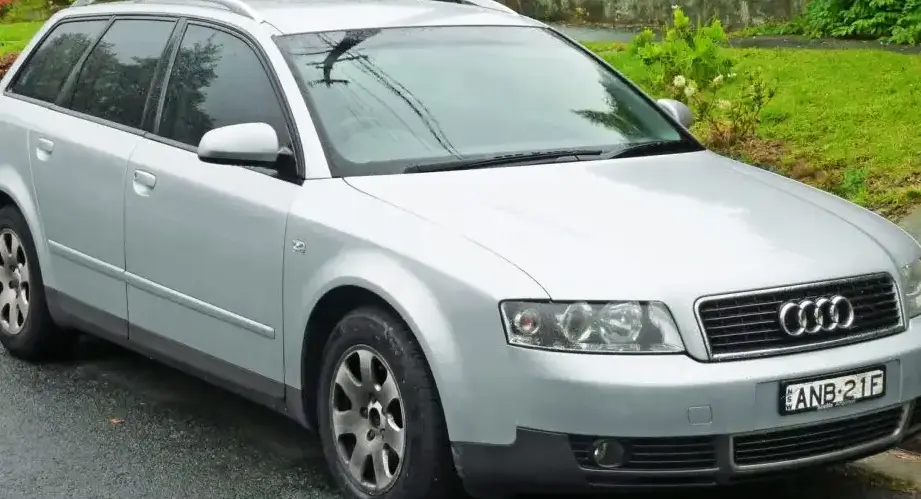
The Audi A4 Avant (B6 8E) 1.8T quattro, produced from 2001 to June 2002, represents a compelling blend of practicality and performance within the broader B6 A4 generation (2002-2005). Positioned as a mid-range offering in the Avant (wagon) body style, this variant combined Audi’s renowned quattro all-wheel drive system with a turbocharged 1.8-liter four-cylinder engine. It served as a popular choice for buyers seeking a versatile vehicle capable of handling both daily commutes and family adventures, offering a step up in performance from the base models while remaining more accessible than the higher-performance S4 or the diesel-powered TDI variants.
Powertrain & Engine Architecture
At the heart of the A4 Avant 1.8T quattro lies the Audi-developed 1.8-liter inline-four cylinder engine, internally designated as the AVJ code. This engine is a member of the EA888 family, known for its robust construction and tuning potential. The AVJ features a cast iron block and an aluminum cylinder head, incorporating five valves per cylinder (three intake, two exhaust) for improved breathing. Fuel delivery is managed by a multi-port fuel injection system, while a K03 turbocharger with an intercooler provides forced induction, boosting power output to 150 horsepower and 210 Nm (155 lb-ft) of torque. The engine’s torque curve is relatively flat, providing usable power across a wide RPM range. The engine is longitudinally mounted, a characteristic of Audi’s quattro drivetrain layout. The 5-speed manual transmission was standard, delivering power to all four wheels through Audi’s Torsen-based quattro all-wheel-drive system.
Driving Characteristics
The 1.8T quattro Avant offered a balanced driving experience. While not as overtly sporty as the A4 with the 2.8-liter V6, it provided ample power for everyday driving and confident acceleration. The turbocharger provides a noticeable boost in the mid-range, making overtaking maneuvers relatively effortless. The quattro all-wheel-drive system significantly enhances traction, particularly in inclement weather conditions. The 5-speed manual transmission offers precise shifts, although the gear ratios are somewhat widely spaced, requiring occasional downshifts to maintain optimal power delivery. Compared to the 1.8T models without quattro, the added weight of the all-wheel-drive system slightly diminishes acceleration, but the improved handling and stability more than compensate for this.
Equipment & Trim Levels
The A4 Avant 1.8T quattro typically came equipped with a respectable level of standard features. These included power windows, power locks, air conditioning, and an AM/FM stereo system. Interior upholstery was typically cloth, although leather options were available. Optional extras included a sunroof, premium audio system, heated front seats, and automatic climate control. The trim level often dictated the availability of certain features, with higher trims offering more luxurious appointments. The dashboard layout was typical of early 2000s Audis, characterized by a clean, functional design with a focus on ergonomics.
Chassis & Braking
The B6 A4 Avant featured an independent multi-link suspension system at both the front and rear, providing a comfortable ride and precise handling. The front suspension utilized coil springs and shock absorbers, while the rear suspension incorporated a more complex arrangement of links and bushings. The quattro models generally featured slightly stiffer springs and dampers to compensate for the added weight. Braking duties were handled by ventilated discs at the front and solid discs at the rear. Anti-lock braking system (ABS) was standard, enhancing braking performance and stability. The steering system employed a rack-and-pinion setup with hydraulic power assistance, providing responsive and accurate steering feel.
Market Reception & Comparison
The Audi A4 Avant 1.8T quattro was generally well-received by automotive critics. It was praised for its blend of practicality, performance, and all-weather capability. Fuel economy was considered reasonable for its class, averaging around 25.6 US mpg in combined driving. Compared to the 2.8-liter V6 A4 Avant, the 1.8T quattro offered a more affordable entry point into the Audi wagon lineup, while still providing a satisfying driving experience. The 1.8T models were also generally considered more reliable than the V6 variants, with fewer reports of mechanical issues. The TDI diesel models offered superior fuel economy but lacked the performance of the 1.8T.
Legacy
The Audi A4 Avant (B6 8E) 1.8T quattro has proven to be a relatively durable and reliable vehicle. The 1.8T engine, when properly maintained, can withstand high mileage. Common issues include turbocharger failure, oil leaks, and occasional problems with the electronic systems. However, parts availability is generally good, and the vehicle remains a popular choice among enthusiasts and those seeking a practical and well-built wagon. Today, well-maintained examples command reasonable prices in the used car market, making them an attractive option for buyers seeking a European-engineered vehicle with a proven track record.