Technical Specifications
| Brand | Audi |
| Model | A4 |
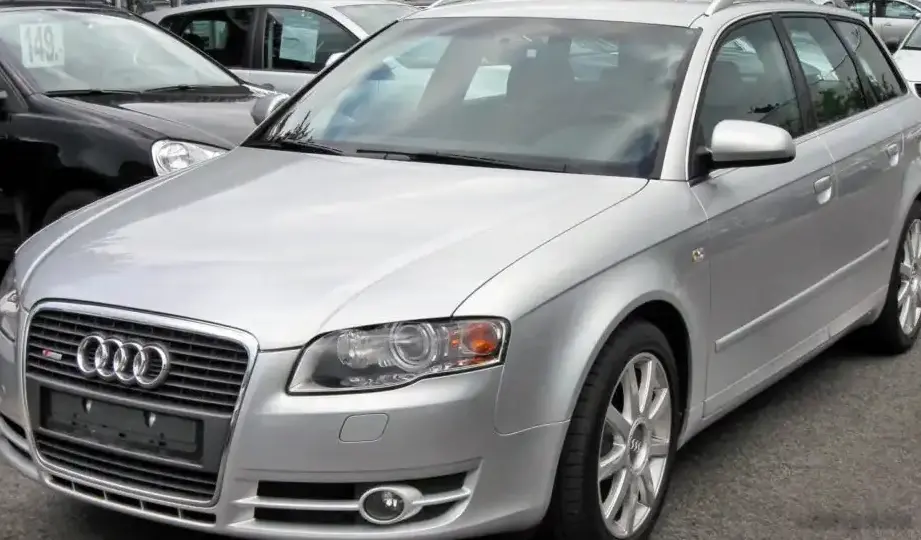
| Generation | A4 Avant (B7 8E) |
| Type (Engine) | 2.0 TDI (170 Hp) |
| Start of production | June, 2006 |
| End of production | June, 2008 |
| Powertrain Architecture | Internal Combustion engine |
| Body type | Station wagon (estate) |
| Seats | 5 |
| Doors | 5 |
| Fuel consumption (economy) – urban | 7.9 l/100 km (29.8 US mpg, 35.8 UK mpg, 12.7 km/l) |
| Fuel consumption (economy) – extra urban | 4.6 l/100 km (51.1 US mpg, 61.4 UK mpg, 21.7 km/l) |
| Fuel consumption (economy) – combined | 5.8 l/100 km (40.6 US mpg, 48.7 UK mpg, 17.2 km/l) |
| CO2 emissions | 154 g/km |
| Fuel Type | Diesel |
| Acceleration 0 – 100 km/h | 8.8 sec |
| Acceleration 0 – 62 mph | 8.8 sec |
| Acceleration 0 – 60 mph | 8.4 sec |
| Maximum speed | 222 km/h (137.94 mph) |
| Emission standard | Euro 4 |
| Weight-to-power ratio | 8.9 kg/Hp, 112.6 Hp/tonne |
| Weight-to-torque ratio | 4.3 kg/Nm, 231.8 Nm/tonne |
| Power | 170 Hp @ 4200 rpm |
| Power per litre | 86.4 Hp/l |
| Torque | 350 Nm @ 1750-2500 rpm (258.15 lb.-ft. @ 1750-2500 rpm) |
| Engine layout | Front, Longitudinal |
| Engine Model/Code | EA188 / BRD |
| Engine displacement | 1968 cm3 (120.09 cu. in.) |
| Number of cylinders | 4 |
| Engine configuration | Inline |
| Cylinder Bore | 81 mm (3.19 in.) |
| Piston Stroke | 95.5 mm (3.76 in.) |
| Compression ratio | 18:1 |
| Number of valves per cylinder | 4 |
| Fuel injection system | Pump-nozzle (Unit Injector) |
| Engine aspiration | Turbocharger, Intercooler |
| Valvetrain | DOHC |
| Engine oil capacity | 3.8 l (4.02 US qt | 3.34 UK qt) |
| Coolant | 8 l (8.45 US qt | 7.04 UK qt) |
| Kerb Weight | 1510 kg (3328.98 lbs.) |
| Max. weight | 2060 kg (4541.52 lbs.) |
| Max load | 550 kg (1212.54 lbs.) |
| Trunk (boot) space – minimum | 442 l (15.61 cu. ft.) |
| Trunk (boot) space – maximum | 1354 l (47.82 cu. ft.) |
| Fuel tank capacity | 70 l (18.49 US gal | 15.4 UK gal) |
| Max. roof load | 75 kg (165.35 lbs.) |
| Permitted trailer load with brakes (8%) | 1800 kg (3968.32 lbs.) |
| Permitted trailer load with brakes (12%) | 1600 kg (3527.4 lbs.) |
| Permitted trailer load without brakes | 750 kg (1653.47 lbs.) |
| Permitted towbar download | 80 kg (176.37 lbs.) |
| Length | 4586 mm (180.55 in.) |
| Width | 1772 mm (69.76 in.) |
| Width including mirrors | 1937 mm (76.26 in.) |
| Height | 1453 mm (57.2 in.) |
| Wheelbase | 2642 mm (104.02 in.) |
| Front track | 1519 mm (59.8 in.) |
| Rear (Back) track | 1514 mm (59.61 in.) |
| Drag coefficient (Cd) | 0.29 |
| Minimum turning circle (turning diameter) | 11.1 m (36.42 ft.) |
| Drivetrain Architecture | The Internal combustion engine (ICE) drives the front wheels of the vehicle. |
| Drive wheel | Front wheel drive |
| Number of gears and type of gearbox | 6 gears, manual transmission |
| Front suspension | Independent multi-link suspension |
| Rear suspension | Independent multi-link suspension |
| Front brakes | Ventilated discs |
| Rear brakes | Disc |
| Assisting systems | ABS (Anti-lock braking system) |
| Steering type | Steering rack and pinion |
| Power steering | Hydraulic Steering |
| Tires size | 215/55 R16 |
| Wheel rims size | 7J x 16 |
The Audi A4 Avant (B7) 2.0 TDI, launched in 2006, was a key component of Audi’s strategy to offer a wider range of efficient and practical vehicles to the European market. Built on the Volkswagen Group’s B7 platform (shared with the VW Passat, Skoda Superb, and others), the Avant body style provided the cargo capacity demanded by families and active individuals. The 2.0 TDI engine, designated with the engine code BRD, was a significant upgrade over earlier diesel offerings, providing a compelling blend of performance and fuel economy. This variant was positioned as a sensible alternative to the more powerful, and expensive, petrol and larger diesel engines available in the A4 Avant range.
Powertrain & Engine Architecture
The heart of the A4 Avant 2.0 TDI is the EA188 series 1968cc inline-four cylinder diesel engine. This engine utilized a pump-nozzle (unit injector) fuel injection system, a technology known for its precise fuel delivery and contribution to efficient combustion. The engine featured a single turbocharger with an intercooler to increase air density and boost power output. The DOHC (Dual Overhead Camshaft) valvetrain, with four valves per cylinder, further enhanced breathing and performance. The engine produced 170 horsepower at 4200 rpm and a substantial 350 Nm (258 lb-ft) of torque between 1750 and 2500 rpm. The engine was mounted longitudinally in the front of the vehicle, driving the front wheels. The 6-speed manual transmission was standard, providing well-spaced gear ratios for both fuel efficiency and responsive acceleration.
Driving Characteristics
The 2.0 TDI with the manual transmission offered a surprisingly capable driving experience. While not a sports car, the ample torque available from low engine speeds provided strong acceleration in everyday driving situations. The 0-60 mph time of around 8.4 seconds was respectable for a wagon of this size and weight. The gear ratios were tuned to prioritize fuel economy, but downshifts were readily available for overtaking or climbing hills. Compared to the more powerful 3.0 TDI, the 2.0 TDI felt less effortless at higher speeds, but it offered a more engaging driving experience due to the need to work the gearbox more frequently. The front-wheel-drive configuration provided predictable handling, although traction could be limited in slippery conditions.
Equipment & Trim Levels
The A4 Avant 2.0 TDI typically came equipped with a reasonable level of standard features. This included power windows, power mirrors, air conditioning, a basic audio system, and alloy wheels. Interior upholstery was typically cloth, although leather options were available. Higher trim levels offered upgrades such as automatic climate control, a more advanced audio system, parking sensors, and a sunroof. Optional extras included navigation systems, heated seats, and upgraded interior trim materials. The dashboard layout was typical of Audi at the time, with a clean and functional design.
Chassis & Braking
The B7 A4 Avant featured an independent multi-link suspension at both the front and rear, providing a comfortable ride and good handling characteristics. The front suspension utilized coil springs and shock absorbers, while the rear suspension incorporated a separate spring and damper arrangement. Brakes consisted of ventilated discs at the front and solid discs at the rear. ABS (Anti-lock Braking System) was standard. The steering was a rack and pinion system with hydraulic power assistance, providing precise and responsive steering feel. Stabilizer bars were fitted front and rear to reduce body roll during cornering.
Market Reception & Comparison
The Audi A4 Avant 2.0 TDI was generally well-received by automotive critics. It was praised for its fuel efficiency, comfortable ride, and spacious interior. Critics noted that the engine, while capable, wasn’t as refined or powerful as some of its competitors. Compared to the 3.0 TDI A4 Avant, the 2.0 TDI offered significantly better fuel economy but lacked the same level of performance. Against other diesel wagons in its class, such as the Volkswagen Passat Variant and Ford Mondeo Estate, the A4 Avant 2.0 TDI stood out for its premium interior and build quality.
Legacy
The EA188 2.0 TDI engine proved to be a durable and reliable powerplant, although early versions were known to have some issues with diesel particulate filter (DPF) clogging. With proper maintenance, these engines can provide many years of service. Today, the A4 Avant 2.0 TDI is a relatively affordable used car, offering a practical and efficient option for those seeking a premium wagon. Its reputation for reliability and relatively low running costs makes it a popular choice among used car buyers. However, potential buyers should be aware of the potential for DPF issues and ensure that the vehicle has been properly maintained.