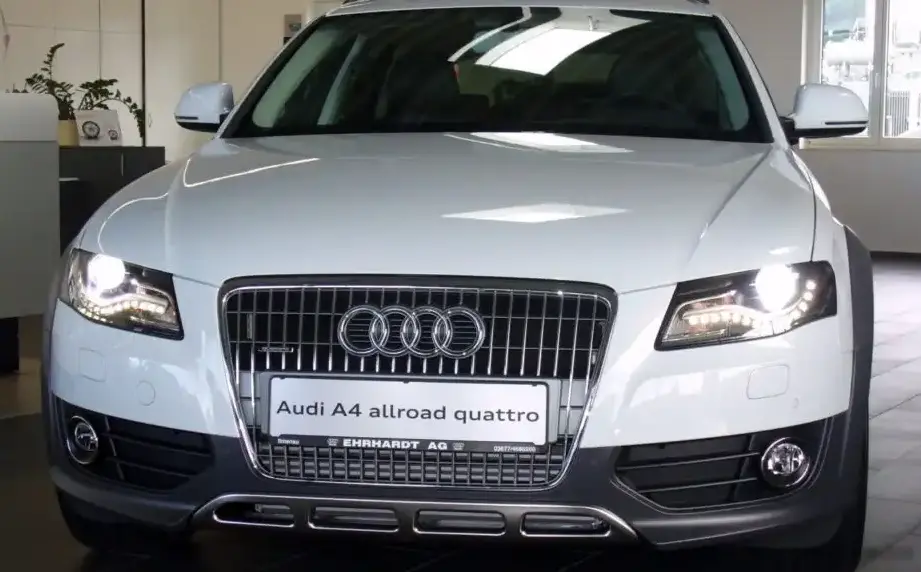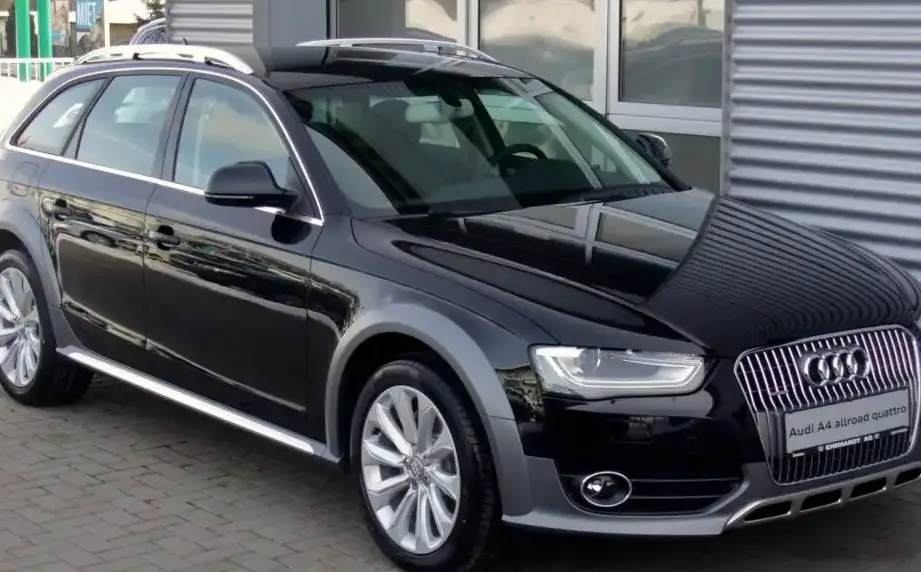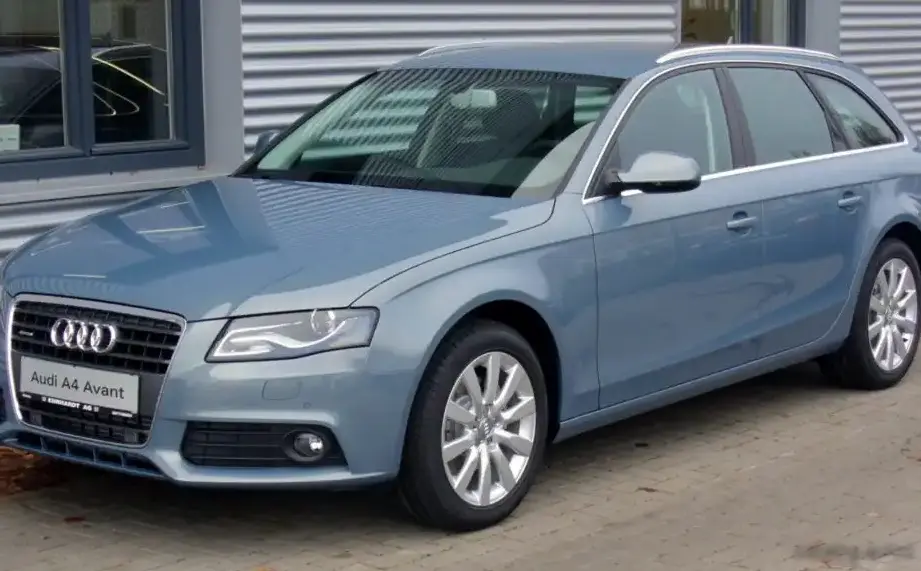
The Audi A4 Avant (B8 8K) 2.0 TFSI with the Multitronic transmission, produced between 2008 and 2011, represented a significant offering in the premium compact executive wagon segment. Positioned as a mid-range variant within the B8 A4 Avant lineup, it bridged the gap between the more economical 1.8 TFSI models and the performance-oriented 3.2 FSI and S4 variants. This particular configuration aimed to deliver a balance of performance, fuel efficiency, and practicality for buyers seeking a versatile and refined vehicle. The B8 generation A4 Avant, built on the Volkswagen Group’s B8 (PL46) platform – also underpinning the Audi Q5 and various Volkswagen models – was a key model for Audi, solidifying its reputation for sophisticated design and engineering.
Technical Specifications
| Brand | Audi |
| Model | A4 |
| Generation | A4 Avant (B8 8K) |
| Type (Engine) | 2.0 TFSI (180 Hp) Multitronic |
| Start of production | 2008 |
| End of production | 2011 |
| Powertrain Architecture | Internal Combustion engine |
| Body type | Station wagon (estate) |
| Seats | 5 |
| Doors | 5 |
| Fuel consumption (economy) – urban | 9.8 l/100 km (24 US mpg, 28.8 UK mpg, 10.2 km/l) |
| Fuel consumption (economy) – extra urban | 5.9 l/100 km (39.9 US mpg, 47.9 UK mpg, 16.9 km/l) |
| Fuel consumption (economy) – combined | 7.3 l/100 km (32.2 US mpg, 38.7 UK mpg, 13.7 km/l) |
| CO2 emissions | 172 g/km |
| Fuel Type | Petrol (Gasoline) |
| Acceleration 0 – 100 km/h | 8.6 sec |
| Acceleration 0 – 62 mph | 8.6 sec |
| Acceleration 0 – 60 mph | 8.2 sec |
| Maximum speed | 218 km/h (135.46 mph) |
| Emission standard | Euro 5 |
| Weight-to-power ratio | 8.5 kg/Hp, 118 Hp/tonne |
| Weight-to-torque ratio | 4.8 kg/Nm, 209.8 Nm/tonne |
| Power | 180 Hp @ 4000-6000 rpm |
| Power per litre | 90.7 Hp/l |
| Torque | 320 Nm @ 1500-3900 rpm (236.02 lb.-ft. @ 1500-3900 rpm) |
| Engine layout | Front, Longitudinal |
| Engine Model/Code | EA888 / CDNB |
| Engine displacement | 1984 cm3 (121.07 cu. in.) |
| Number of cylinders | 4 |
| Engine configuration | Inline |
| Cylinder Bore | 82.5 mm (3.25 in.) |
| Piston Stroke | 92.8 mm (3.65 in.) |
| Compression ratio | 9.6:1 |
| Number of valves per cylinder | 4 |
| Fuel injection system | Direct injection |
| Engine aspiration | Turbocharger, Intercooler |
| Valvetrain | DOHC |
| Engine oil capacity | 4.6 l (4.86 US qt | 4.05 UK qt) |
| Coolant | 7 l (7.4 US qt | 6.16 UK qt) |
| Kerb Weight | 1525 kg (3362.05 lbs.) |
| Max. weight | 2095 kg (4618.68 lbs.) |
| Max load | 570 kg (1256.63 lbs.) |
| Trunk (boot) space – minimum | 490 l (17.3 cu. ft.) |
| Trunk (boot) space – maximum | 1430 l (50.5 cu. ft.) |
| Fuel tank capacity | 65 l (17.17 US gal | 14.3 UK gal) |
| Max. roof load | 90 kg (198.42 lbs.) |
| Permitted trailer load with brakes (8%) | 1700 kg (3747.86 lbs.) |
| Permitted trailer load with brakes (12%) | 1500 kg (3306.93 lbs.) |
| Permitted trailer load without brakes | 750 kg (1653.47 lbs.) |
| Permitted towbar download | 80 kg (176.37 lbs.) |
| Length | 4703 mm (185.16 in.) |
| Width | 1826 mm (71.89 in.) |
| Height | 1436 mm (56.54 in.) |
| Wheelbase | 2808 mm (110.55 in.) |
| Front track | 1564 mm (61.57 in.) |
| Rear (Back) track | 1551 mm (61.06 in.) |
| Drag coefficient (Cd) | 0.319 |
| Minimum turning circle (turning diameter) | 11.4 m (37.4 ft.) |
| Drivetrain Architecture | The Internal combustion engine (ICE) drives the front wheels of the vehicle. |
| Drive wheel | Front wheel drive |
| Number of gears and type of gearbox | automatic transmission Multitronic |
| Front suspension | Independent multi-link suspension |
| Rear suspension | Independent multi-link spring suspension with stabilizer |
| Front brakes | Ventilated discs |
| Rear brakes | Disc |
| Assisting systems | ABS (Anti-lock braking system) |
| Steering type | Steering rack and pinion |
| Power steering | Electric Steering |
| Tires size | 225/55 R16; 225/50 R17 |
| Wheel rims size | 7.5J x 16; 7.5J x 17 |
Powertrain & Engine Architecture
At the heart of the A4 Avant 2.0 TFSI Multitronic lies the EA888 engine, specifically the CDNB variant. This 1984cc, turbocharged, direct-injection four-cylinder engine was a cornerstone of Audi’s powertrain strategy. The direct injection system, coupled with a turbocharger and intercooler, allowed for a good balance of power and efficiency. The engine featured a double overhead camshaft (DOHC) valvetrain with four valves per cylinder, optimizing gas flow for improved performance. The Multitronic transmission, a continuously variable transmission (CVT), was a key differentiator. Unlike traditional automatic transmissions with fixed gear ratios, the Multitronic used a chain-driven system to provide a virtually infinite number of ratios, optimizing engine speed for efficiency or power as needed. This transmission was known for its smooth operation and ability to keep the engine in its optimal power band.
Driving Characteristics
The 180 horsepower and 236 lb-ft of torque delivered by the 2.0 TFSI engine, combined with the Multitronic transmission, resulted in a driving experience focused on refinement and usability. Acceleration from 0-60 mph took approximately 8.2 seconds, and top speed was rated at 135 mph. While not as quick as the higher-output variants, the 2.0 TFSI offered ample power for everyday driving and highway cruising. The Multitronic transmission contributed to smooth, seamless acceleration, although some drivers found it lacked the direct feel of a traditional automatic or manual gearbox. The transmission’s programming prioritized fuel economy, sometimes resulting in a slight delay in response during aggressive acceleration. The front-wheel-drive configuration provided good traction in most conditions, but could exhibit some torque steer under hard acceleration.
Equipment & Trim Levels
The A4 Avant 2.0 TFSI Multitronic typically came standard with features such as automatic climate control, power windows and locks, a multi-function steering wheel, and an Audi Concert audio system. Upholstery was generally cloth, with leather options available as upgrades. Common optional extras included a sunroof, navigation system, parking sensors, and upgraded alloy wheels. Trim levels varied slightly by market, but generally offered packages that bundled popular options together. The interior design was typical of Audi at the time – clean, functional, and built with high-quality materials.
Chassis & Braking
The B8 A4 Avant featured an independent multi-link suspension at all four corners, providing a comfortable ride and good handling characteristics. The front suspension utilized MacPherson struts, while the rear employed a more complex multi-link setup. Stabilizer bars were fitted front and rear to reduce body roll during cornering. Braking duties were handled by ventilated discs at the front and solid discs at the rear, with ABS (Anti-lock Braking System) standard. The suspension tuning was geared towards comfort, but still provided a reasonably engaging driving experience.
Market Reception & Comparison
The A4 Avant 2.0 TFSI Multitronic was generally well-received by automotive critics. It was praised for its refined driving experience, fuel efficiency, and spacious interior. However, some reviewers noted the Multitronic transmission’s lack of engagement compared to manual gearboxes. Compared to the 1.8 TFSI models, the 2.0 TFSI offered a noticeable performance boost. Against the more powerful 3.2 FSI, it provided a more economical option without sacrificing too much in terms of everyday usability. Fuel economy was a strong point, averaging around 32 mpg in combined driving, making it a competitive option in its class.
Legacy
The EA888 engine, in its various iterations, proved to be a durable and reliable powerplant. The Multitronic transmission, however, has a more mixed reputation. While generally smooth and efficient, it can be prone to issues if not properly maintained, particularly regarding fluid changes. Today, the A4 Avant 2.0 TFSI Multitronic represents a good value on the used car market, offering a blend of practicality, refinement, and German engineering. Regular maintenance, especially concerning the transmission, is crucial to ensure long-term reliability. The B8 A4 Avant remains a popular choice for buyers seeking a stylish and versatile wagon.