Technical Specifications
| Brand | Audi |
| Model | A4 |
| Generation | A4 Avant (B8 8K, facelift 2011) |
| Type (Engine) | 1.8 TFSI (170 Hp) |
| Start of production | 2011 |
| End of production | 2015 |
| Powertrain Architecture | Internal Combustion engine |
| Body type | Station wagon (estate) |
| Seats | 5 |
| Doors | 5 |
| Fuel consumption (urban) | 7.7 l/100 km (30.5 US mpg, 36.7 UK mpg, 13 km/l) |
| Fuel consumption (extra urban) | 5.2 l/100 km (45.2 US mpg, 54.3 UK mpg, 19.2 km/l) |
| Fuel consumption (combined) | 6.1 l/100 km (38.6 US mpg, 46.3 UK mpg, 16.4 km/l) |
| CO2 emissions | 141 g/km |
| Fuel Type | Petrol (Gasoline) |
| Acceleration 0 – 100 km/h | 8.3 sec |
| Acceleration 0 – 62 mph | 8.3 sec |
| Acceleration 0 – 60 mph | 7.9 sec |
| Maximum speed | 222 km/h (137.94 mph) |
| Emission standard | Euro 6 |
| Weight-to-power ratio | 8.8 kg/Hp, 114.1 Hp/tonne |
| Weight-to-torque ratio | 4.7 kg/Nm, 214.8 Nm/tonne |
| Power | 170 Hp @ 3800-6200 rpm |
| Power per litre | 94.5 Hp/l |
| Torque | 320 Nm @ 1400-3700 rpm (236.02 lb.-ft. @ 1400-3700 rpm) |
| Engine layout | Front, Longitudinal |
| Engine Model/Code | EA888 / CJEB |
| Engine displacement | 1798 cm3 (109.72 cu. in.) |
| Number of cylinders | 4 |
| Engine configuration | Inline |
| Cylinder Bore | 82.5 mm (3.25 in.) |
| Piston Stroke | 84.1 mm (3.31 in.) |
| Compression ratio | 9.6:1 |
| Number of valves per cylinder | 4 |
| Fuel injection system | Direct injection and Multi-port manifold injection |
| Engine aspiration | Turbocharger, Intercooler |
| Valvetrain | DOHC |
| Engine oil capacity | 4.6 l (4.86 US qt | 4.05 UK qt) |
| Kerb Weight | 1490 kg (3284.89 lbs.) |
| Max. weight | 2060 kg (4541.52 lbs.) |
| Max load | 570 kg (1256.63 lbs.) |
| Trunk (boot) space – minimum | 490 l (17.3 cu. ft.) |
| Trunk (boot) space – maximum | 1430 l (50.5 cu. ft.) |
| Fuel tank capacity | 63 l (16.64 US gal | 13.86 UK gal) |
| Max. roof load | 90 kg (198.42 lbs.) |
| Permitted trailer load with brakes (8%) | 1700 kg (3747.86 lbs.) |
| Permitted trailer load with brakes (12%) | 1500 kg (3306.93 lbs.) |
| Permitted trailer load without brakes | 750 kg (1653.47 lbs.) |
| Permitted towbar download | 80 kg (176.37 lbs.) |
| Length | 4699 mm (185 in.) |
| Width | 1826 mm (71.89 in.) |
| Width including mirrors | 2040 mm (80.31 in.) |
| Height | 1436 mm (56.54 in.) |
| Wheelbase | 2808 mm (110.55 in.) |
| Front track | 1564 mm (61.57 in.) |
| Rear (Back) track | 1551 mm (61.06 in.) |
| Front overhang | 862 mm (33.94 in.) |
| Rear overhang | 1029 mm (40.51 in.) |
| Drag coefficient (Cd) | 0.31 |
| Minimum turning circle (turning diameter) | 11.5 m (37.73 ft.) |
| Drivetrain Architecture | The Internal combustion engine (ICE) drives the front wheels of the vehicle. |
| Drive wheel | Front wheel drive |
| Number of gears and type of gearbox | 6 gears, manual transmission |
| Front suspension | Independent multi-link suspension, Transverse stabilizer |
| Rear suspension | Independent on trapezoidal lever, Transverse stabilizer |
| Front brakes | Ventilated discs |
| Rear brakes | Disc |
| Assisting systems | ABS (Anti-lock braking system) |
| Steering type | Steering rack and pinion |
| Power steering | Electric Steering |
| Tires size | 225/55 R16 |
| Wheel rims size | 7.5J x 16 |
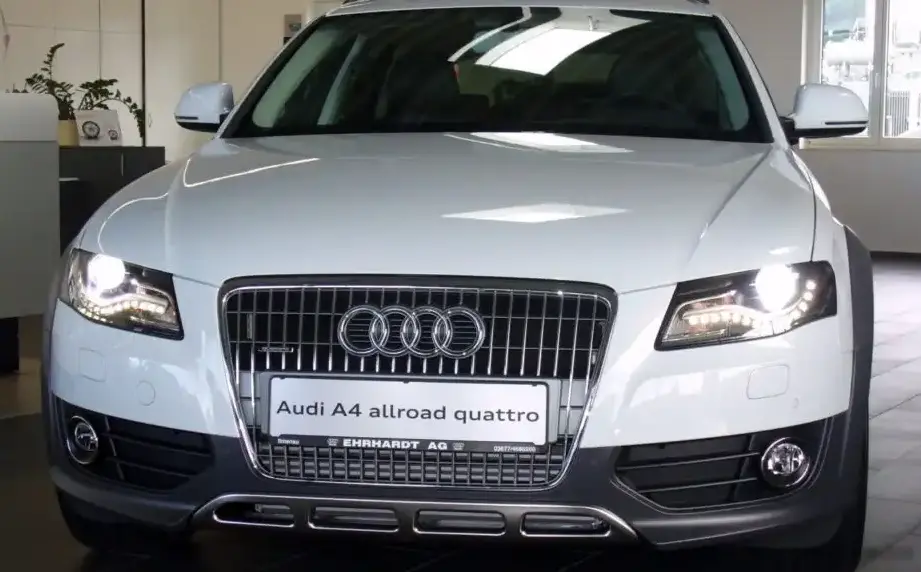
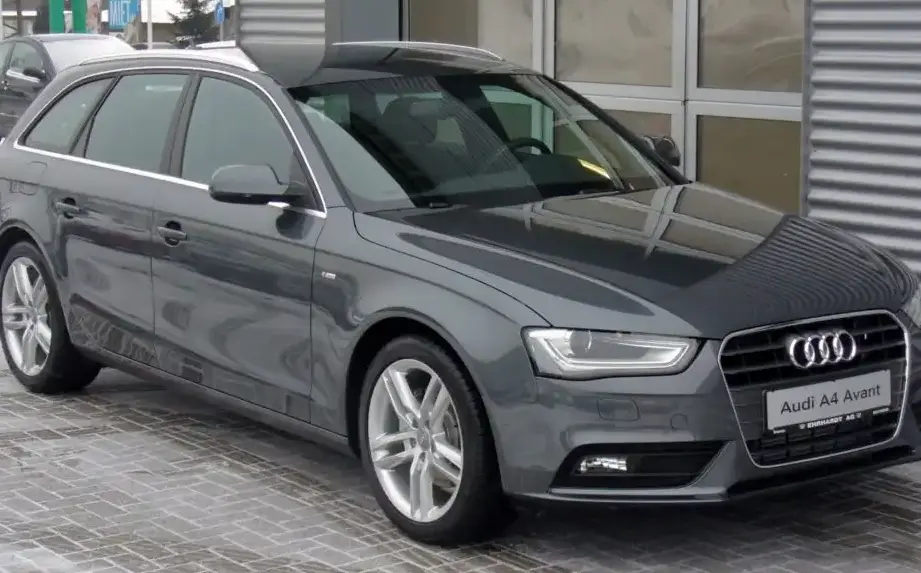
The Audi A4 Avant (B8 8K) facelift 1.8 TFSI, produced between 2011 and 2015, was a significant model within Audi’s lineup, particularly in the European market. Based on the B8 platform – also underpinning the Volkswagen Passat, Skoda Superb, and SEAT Exeo – the A4 Avant successfully blended practicality with Audi’s reputation for quality and refinement. The 1.8 TFSI engine, coupled with a six-speed manual transmission, occupied a crucial middle ground, appealing to buyers who desired a balance between fuel efficiency, performance, and price. It positioned itself below the more potent 2.0 TFSI and diesel options, offering a more accessible entry point into the A4 Avant range.
Powertrain & Engine Architecture
The 1.8 TFSI variant is powered by the EA888 1.8-liter turbocharged four-cylinder engine, specifically the CJEB engine code. This engine employs a sophisticated fuel delivery system combining direct fuel injection (FSI) with multi-point manifold injection, optimizing both power output and fuel economy. A double overhead camshaft (DOHC) valvetrain with four valves per cylinder contributes to the engine’s responsive character. The turbocharger, working in conjunction with an intercooler, significantly boosts power and torque. The engine generates 170 horsepower between 3800 and 6200 rpm, and 320 Nm (236 lb-ft) of torque from 1400 to 3700 rpm. The standard six-speed manual transmission provides precise gear changes and enhances the driving experience. While a continuously variable transmission (CVT), marketed as Multitronic, was available, the manual gearbox was preferred by driving enthusiasts for its greater engagement.
Driving Characteristics
The A4 Avant 1.8 TFSI delivered a well-rounded driving experience. While not offering the outright acceleration of the 2.0 TFSI models, it provided sufficient power for everyday driving and comfortable long-distance journeys. The turbocharger provides a noticeable power boost in the mid-range, facilitating confident overtaking. The six-speed manual transmission’s gear ratios are well-matched to the engine’s torque curve, resulting in smooth and responsive acceleration. Compared to the 2.0 TFSI, the 1.8 TFSI felt less aggressively powered, but it offered improved fuel economy and a more relaxed driving style. The manual transmission also provided a more direct and connected feel compared to the optional CVT automatic.
Equipment & Trim Levels
The A4 Avant 1.8 TFSI typically came equipped with a comprehensive set of standard features. These included alloy wheels, air conditioning, a multi-function steering wheel, an Audi Concert radio system, and electric windows. Higher trim levels, such as SE and S-line, added features like leather upholstery, parking sensors, a more advanced infotainment system, and sportier styling elements. Optional extras included a sunroof, a navigation system, and an upgraded sound system. Interior upholstery was generally cloth on base models, with leather options available on higher trims. The dashboard layout adhered to Audi’s design philosophy of the time, characterized by a clean, minimalist aesthetic and the use of high-quality materials.
Chassis & Braking
The A4 Avant’s chassis featured fully independent suspension – a multi-link setup at the front and a trapezoidal link arrangement at the rear. This configuration provided a comfortable ride quality while maintaining good handling characteristics. Stabilizer bars were fitted to both axles to minimize body roll during cornering. Braking was handled by ventilated discs at the front and solid discs at the rear, offering ample stopping power. Anti-lock Braking System (ABS) was standard, enhancing safety and control. The suspension tuning prioritized comfort, but the A4 Avant still offered a reasonably engaging driving experience.
Market Reception & Comparison
The A4 Avant 1.8 TFSI received generally positive reviews from automotive critics. It was praised for its refined engine, comfortable ride, and the practicality of the estate car body style. Critics acknowledged that while the 1.8 TFSI wasn’t the fastest engine in the lineup, it offered a compelling balance of performance and fuel economy. Compared to the 2.0 TFSI, the 1.8 TFSI was considered a more sensible choice for buyers prioritizing running costs over outright speed. The diesel variants, particularly the 2.0 TDI, offered even better fuel economy, but the 1.8 TFSI provided a smoother and quieter driving experience. Reliability was generally good, although some owners reported minor issues with the turbocharger and fuel injectors.
Legacy
The Audi A4 Avant (B8 8K) 1.8 TFSI has proven to be a relatively reliable and durable vehicle. The EA888 engine, while not entirely without potential issues, is generally considered robust when properly maintained. On the used car market, these A4 Avants represent a good value proposition, offering a blend of practicality, refinement, and affordability. Regular maintenance, including oil changes and timing belt replacements, is crucial for ensuring long-term reliability. The 1.8 TFSI engine’s relatively straightforward design, compared to later, more complex engines, makes it a popular choice for those seeking a reliable and relatively easy-to-maintain estate car.