Technical Specifications
| Brand | Audi |
| Model | A4 |
| Generation | A4 Avant (B8 8K, facelift 2011) |
| Type (Engine) | 2.0 TDI (136 Hp) Multitronic start/stop |
| Start of production | 2011 |
| End of production | 2015 |
| Powertrain Architecture | Internal Combustion engine |
| Body type | Station wagon (estate) |
| Seats | 5 |
| Doors | 5 |
| Fuel consumption (urban) | 5.6 l/100 km (42 US mpg, 50.4 UK mpg, 17.9 km/l) |
| Fuel consumption (extra urban) | 4.5 l/100 km (52.3 US mpg, 62.8 UK mpg, 22.2 km/l) |
| Fuel consumption (combined) | 4.9 l/100 km (48 US mpg, 57.6 UK mpg, 20.4 km/l) |
| CO2 emissions | 129 g/km |
| Fuel Type | Diesel |
| Acceleration 0 – 100 km/h | 9.6 sec |
| Acceleration 0 – 62 mph | 9.6 sec |
| Acceleration 0 – 60 mph | 9.1 sec |
| Maximum speed | 196 km/h (121.79 mph) |
| Emission standard | Euro 5 |
| Weight-to-power ratio | 11.6 kg/Hp, 86.3 Hp/tonne |
| Weight-to-torque ratio | 4.9 kg/Nm, 203.2 Nm/tonne |
| Power | 136 Hp @ 4200 rpm |
| Power per litre | 69.1 Hp/l |
| Torque | 320 Nm @ 1750-2500 rpm (236.02 lb.-ft. @ 1750-2500 rpm) |
| Engine layout | Front, Longitudinal |
| Engine Model/Code | CJCB |
| Engine displacement | 1968 cm3 (120.09 cu. in.) |
| Number of cylinders | 4 |
| Engine configuration | Inline |
| Cylinder Bore | 81 mm (3.19 in.) |
| Piston Stroke | 95.5 mm (3.76 in.) |
| Compression ratio | 16.5:1 |
| Number of valves per cylinder | 4 |
| Fuel injection system | Diesel Commonrail |
| Engine aspiration | Turbocharger, Intercooler |
| Valvetrain | DOHC |
| Engine oil capacity | 5 l (5.28 US qt | 4.4 UK qt) |
| Kerb Weight | 1575 kg (3472.28 lbs.) |
| Max. weight | 2145 kg (4728.92 lbs.) |
| Max load | 570 kg (1256.63 lbs.) |
| Trunk (boot) space – minimum | 490 l (17.3 cu. ft.) |
| Trunk (boot) space – maximum | 1430 l (50.5 cu. ft.) |
| Fuel tank capacity | 63 l (16.64 US gal | 13.86 UK gal) |
| Max. roof load | 90 kg (198.42 lbs.) |
| Permitted trailer load with brakes (8%) | 1900 kg (4188.78 lbs.) |
| Permitted trailer load without brakes | 750 kg (1653.47 lbs.) |
| Permitted towbar download | 80 kg (176.37 lbs.) |
| Length | 4699 mm (185 in.) |
| Width | 1826 mm (71.89 in.) |
| Width including mirrors | 2040 mm (80.31 in.) |
| Height | 1436 mm (56.54 in.) |
| Wheelbase | 2808 mm (110.55 in.) |
| Front track | 1564 mm (61.57 in.) |
| Rear (Back) track | 1551 mm (61.06 in.) |
| Front overhang | 862 mm (33.94 in.) |
| Rear overhang | 1029 mm (40.51 in.) |
| Drag coefficient (Cd) | 0.30 |
| Minimum turning circle (turning diameter) | 11.5 m (37.73 ft.) |
| Drivetrain Architecture | The Internal combustion engine (ICE) drives the front wheels of the vehicle. |
| Drive wheel | Front wheel drive |
| Number of gears and type of gearbox | automatic transmission Multitronic |
| Front suspension | Independent multi-link suspension |
| Rear suspension | Independent on trapezoidal lever |
| Front brakes | Ventilated discs |
| Rear brakes | Disc |
| Assisting systems | ABS (Anti-lock braking system) |
| Steering type | Steering rack and pinion |
| Power steering | Electric Steering |
| Tires size | 205/60 R16 |
| Wheel rims size | 16 |
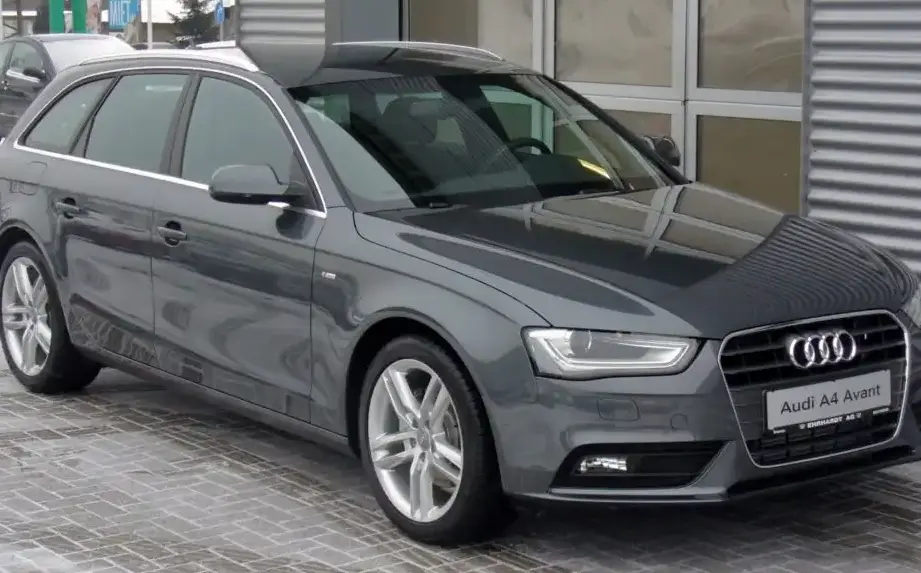
The Audi A4 Avant (B8 8K) facelift, produced from 2011 to 2015, was a significant refresh of the popular A4 series. This particular variant, the 2.0 TDI with 136 horsepower coupled with Audi’s Multitronic continuously variable transmission (CVT) and start/stop technology, was a key offering in the European market, designed to balance fuel efficiency with practicality. Positioned as a mid-range option, it appealed to buyers who desired a comfortable and economical estate car without compromising the Audi brand’s reputation for quality and refinement. The B8 generation A4, built on the Volkswagen Group’s PL46 platform (also known as the A4/A5 platform), aimed to improve upon its predecessor with increased interior space, enhanced driving dynamics, and a broader selection of engine options.
Powertrain & Engine Architecture
The core of this A4 Avant is the 2.0-liter four-cylinder diesel engine, identified by the engine code CJCB. This engine utilizes common rail direct injection (CRDI) technology, employing piezo injectors for precise fuel delivery. A turbocharger, working in conjunction with an intercooler, increases air density, leading to improved combustion and power output. The engine features a double overhead camshaft (DOHC) valvetrain with four valves per cylinder, optimizing gas flow. The Multitronic transmission is a continuously variable transmission (CVT) that provides smooth, stepless gear changes. Unlike conventional automatic transmissions with fixed gear ratios, the Multitronic employs a chain-driven system to offer an infinite number of ratios within its range, optimizing engine efficiency and responsiveness. The integrated start/stop system automatically shuts down the engine when the vehicle is stationary – such as at traffic signals – to further reduce fuel consumption and emissions.
Driving Characteristics
The 136 horsepower and 236 lb-ft of torque generated by the 2.0 TDI engine, when combined with the Multitronic transmission, delivered adequate performance for everyday driving needs. Acceleration from 0 to 60 mph took approximately 9.1 seconds, with a top speed limited to 121.79 mph. While not a particularly sporty configuration, the Multitronic transmission allowed the engine to operate within its most efficient range, resulting in commendable fuel economy. Compared to the more powerful 177 hp version of the 2.0 TDI, this variant felt less responsive during acceleration, but the Multitronic transmission partially compensated by providing seamless power delivery. The Multitronic’s programming prioritized fuel efficiency over outright performance, creating a more relaxed driving experience. In comparison to a manual transmission, the Multitronic offered greater convenience, particularly in congested urban environments.
Equipment & Trim Levels
The 2.0 TDI 136 hp Multitronic Avant typically included a solid set of standard features. These generally encompassed air conditioning, a multi-function steering wheel, an Audi Concert radio system, alloy wheels, and power windows. Safety features such as ABS, electronic stability control (ESC), and multiple airbags were also standard equipment. Optional extras included leather upholstery, a sunroof, parking sensors, a navigation system, and upgraded audio systems. Trim levels varied depending on the specific market, but this variant generally occupied a mid-range position, offering a good balance between features and affordability.
Chassis & Braking
The A4 Avant’s chassis featured fully independent suspension, with a multi-link setup at the front and a trapezoidal link setup at the rear. This configuration provided a comfortable ride and good handling characteristics. The front brakes were ventilated discs, while the rear brakes were solid discs. Electric power steering offered precise and responsive steering feel. The suspension was tuned to prioritize ride comfort, while still providing adequate body control during cornering maneuvers. Stabilizer bars were fitted to both the front and rear axles to minimize body roll.
Market Reception & Comparison
The 2.0 TDI 136 hp Multitronic A4 Avant was well-received in the European market as a practical and economical estate car. Reviewers consistently praised its fuel efficiency, comfortable ride, and refined interior. However, some critics noted that the engine lacked the punch of the higher-output TDI variants. Compared to the 177 hp TDI, this version offered lower running costs but less exhilarating performance. The Multitronic transmission was generally lauded for its smoothness, but some concerns were raised regarding its long-term reliability and potential maintenance expenses. Fuel economy figures around 48 US mpg combined were considered excellent for a vehicle of this size and class.
Legacy
The CJCB engine, while generally reliable, requires regular maintenance, particularly concerning the timing belt and the diesel particulate filter (DPF). The Multitronic transmission, while providing a smooth driving experience, can be susceptible to issues if not properly serviced. Today, these A4 Avants are readily available on the used car market at relatively affordable prices. They represent a good value proposition for buyers seeking a practical, comfortable, and fuel-efficient estate car. However, prospective buyers should be aware of the potential maintenance costs associated with the Multitronic transmission and the DPF system. Overall, the 2.0 TDI 136 hp Multitronic A4 Avant remains a popular choice for those seeking a well-rounded and dependable vehicle.