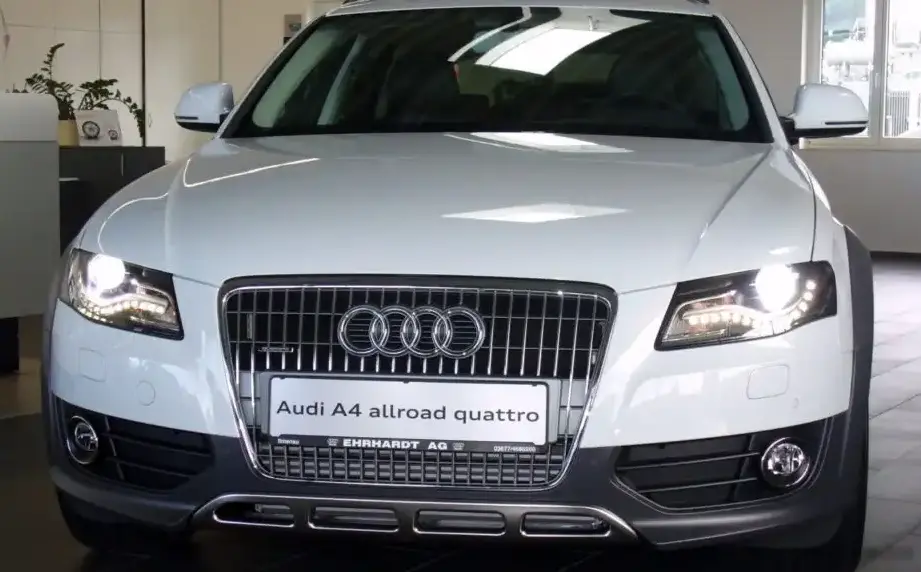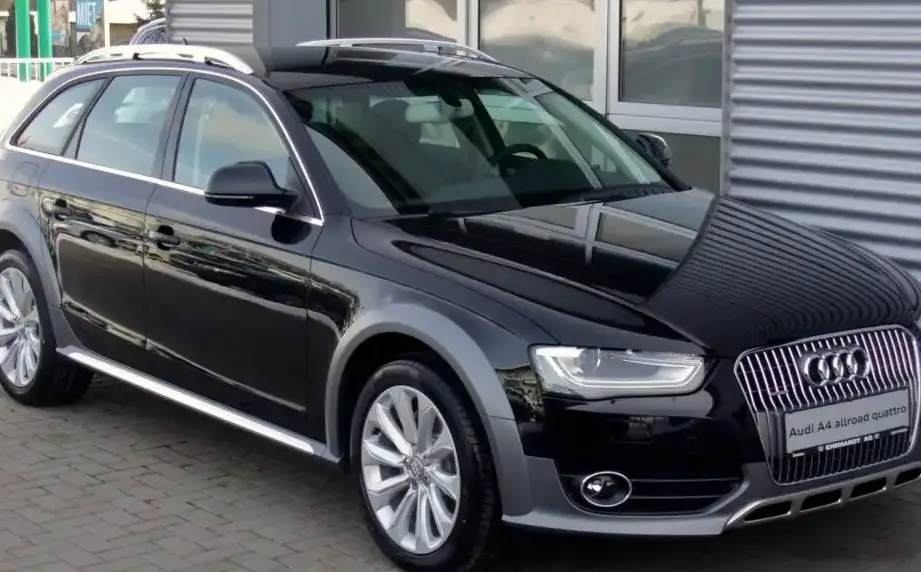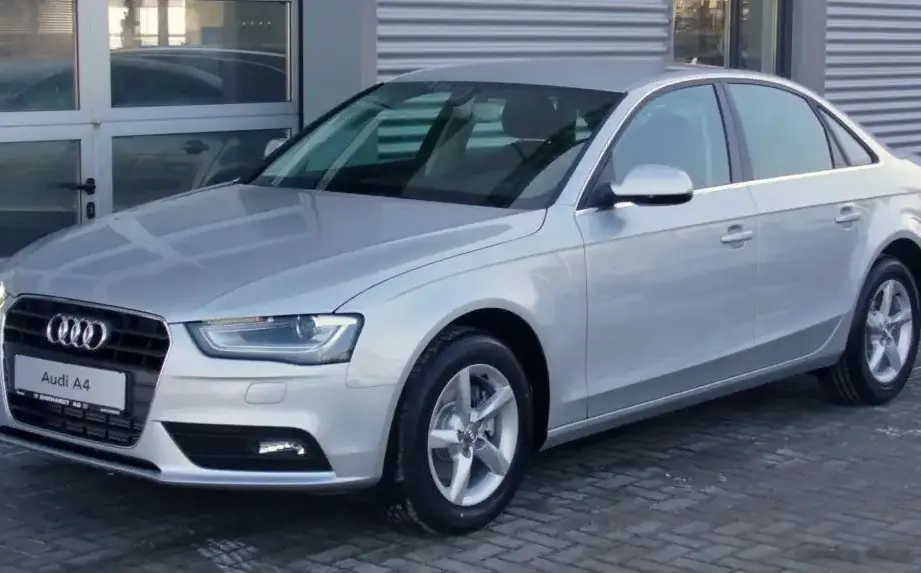
The Audi A4 (B8 8K) facelift, produced from November 2011 to June 2014, represented a significant mid-cycle refresh of Audi’s popular compact executive car. Within the B8 generation, which spanned from 2008 to 2015, the facelift brought revised styling, updated technology, and refined engine options. The 2.0 TDI variant with 163 horsepower paired with Audi’s Multitronic continuously variable transmission (CVT) was a key offering, particularly in European markets, positioned as a balance between fuel efficiency, reasonable performance, and comfortable driving. This configuration aimed to appeal to buyers prioritizing economy and refinement over outright sportiness.
Technical Specifications
| Brand | Audi |
| Model | A4 |
| Generation | A4 (B8 8K, facelift 2011) |
| Type (Engine) | 2.0 TDI (163 Hp) Multitronic |
| Start of production | November, 2011 |
| End of production | June, 2014 |
| Powertrain Architecture | Internal Combustion engine |
| Body type | Sedan |
| Seats | 5 |
| Doors | 4 |
| Fuel consumption (urban) | 5.7 l/100 km (41.3 US mpg, 49.6 UK mpg, 17.5 km/l) |
| Fuel consumption (extra urban) | 4.4 l/100 km (53.5 US mpg, 64.2 UK mpg, 22.7 km/l) |
| Fuel consumption (combined) | 4.8 l/100 km (49 US mpg, 58.9 UK mpg, 20.8 km/l) |
| CO2 emissions | 127 g/km |
| Fuel Type | Diesel |
| Acceleration 0 – 100 km/h | 8.1 sec |
| Acceleration 0 – 62 mph | 8.1 sec |
| Acceleration 0 – 60 mph | 7.7 sec |
| Maximum speed | 218 km/h (135.46 mph) |
| Emission standard | Euro 5 |
| Weight-to-power ratio | 9.3 kg/Hp, 107.2 Hp/tonne |
| Weight-to-torque ratio | 4 kg/Nm, 250 Nm/tonne |
| Power | 163 Hp @ 4200 rpm |
| Power per litre | 82.8 Hp/l |
| Torque | 380 Nm @ 1750-2500 rpm (280.27 lb.-ft. @ 1750-2500 rpm) |
| Engine layout | Front, Longitudinal |
| Engine Model/Code | CGLD, CNHC |
| Engine displacement | 1968 cm3 (120.09 cu. in.) |
| Number of cylinders | 4 |
| Engine configuration | Inline |
| Cylinder Bore | 81 mm (3.19 in.) |
| Piston Stroke | 95.5 mm (3.76 in.) |
| Compression ratio | 16.5:1 |
| Number of valves per cylinder | 4 |
| Fuel injection system | Diesel Commonrail |
| Engine aspiration | Turbocharger, Intercooler |
| Valvetrain | DOHC |
| Engine oil capacity | 4.7 l (4.97 US qt | 4.14 UK qt) |
| Kerb Weight | 1520 kg (3351.03 lbs.) |
| Max. weight | 2070 kg (4563.57 lbs.) |
| Max load | 550 kg (1212.54 lbs.) |
| Trunk (boot) space – minimum | 480 l (16.95 cu. ft.) |
| Trunk (boot) space – maximum | 962 l (33.97 cu. ft.) |
| Fuel tank capacity | 63 l (16.64 US gal | 13.86 UK gal) |
| Max. roof load | 90 kg (198.42 lbs.) |
| Permitted trailer load with brakes (8%) | 1900 kg (4188.78 lbs.) |
| Permitted trailer load without brakes | 750 kg (1653.47 lbs.) |
| Permitted towbar download | 80 kg (176.37 lbs.) |
| Length | 4701 mm (185.08 in.) |
| Width | 1826 mm (71.89 in.) |
| Width including mirrors | 2040 mm (80.31 in.) |
| Height | 1427 mm (56.18 in.) |
| Wheelbase | 2808 mm (110.55 in.) |
| Front track | 1564 mm (61.57 in.) |
| Rear (Back) track | 1551 mm (61.06 in.) |
| Front overhang | 862 mm (33.94 in.) |
| Rear overhang | 1031 mm (40.59 in.) |
| Drag coefficient (Cd) | 0.28 |
| Minimum turning circle (turning diameter) | 11.5 m (37.73 ft.) |
| Drivetrain Architecture | The Internal combustion engine (ICE) drives the front wheels of the vehicle. |
| Drive wheel | Front wheel drive |
| Number of gears and type of gearbox | automatic transmission Multitronic |
| Front suspension | Independent multi-link suspension |
| Rear suspension | Independent on trapezoidal lever |
| Front brakes | Ventilated discs |
| Rear brakes | Disc |
| Assisting systems | ABS (Anti-lock braking system) |
| Steering type | Steering rack and pinion |
| Power steering | Electric Steering |
| Tires size | 225/55 R16 |
| Wheel rims size | 7.5J x 16 |
Powertrain & Engine Architecture
The heart of this A4 variant is the 2.0-liter four-cylinder diesel engine, identified by engine codes CGLD or CNHC depending on specific calibration and market. This engine is a member of the Volkswagen Group’s modular engine family, known for its compact dimensions and efficiency. It features common-rail direct injection, delivering fuel at extremely high pressure for optimized combustion. A turbocharger with an intercooler is employed to boost power output, providing 163 horsepower at 4200 rpm and a substantial 380 Nm (280 lb-ft) of torque between 1750 and 2500 rpm. The engine utilizes a double overhead camshaft (DOHC) valvetrain with four valves per cylinder, enhancing breathing and contributing to its power delivery. The Multitronic transmission is a continuously variable transmission (CVT) offering seamless gear changes and contributing to fuel efficiency. Unlike traditional automatic transmissions with fixed gear ratios, the Multitronic uses a chain-driven system to provide an infinite number of ratios within its operating range.
Driving Characteristics
The 2.0 TDI 163 hp with Multitronic delivers a smooth and refined driving experience. While not as brisk as higher-powered A4 variants like the 2.0 TFSI or the 3.0 TDI, it provides adequate performance for everyday driving and highway cruising. The Multitronic transmission is programmed to prioritize fuel economy, resulting in relatively relaxed acceleration. The CVT’s ability to keep the engine within its optimal torque band contributes to good in-gear acceleration. Compared to the six-speed manual transmission available on other A4 models, the Multitronic offers greater convenience, particularly in urban environments. However, some drivers may find the CVT’s lack of distinct gear shifts less engaging than a traditional automatic or manual gearbox. The engine’s strong low-end torque makes it easy to navigate traffic and overtake slower vehicles.
Equipment & Trim Levels
The 2.0 TDI 163 hp Multitronic typically fell into the mid-range of the A4 lineup. Standard equipment generally included features like air conditioning, a multi-function steering wheel, power windows, and an audio system with auxiliary input. Higher trim levels, such as SE or S-line, added features like leather upholstery, upgraded audio systems, parking sensors, and alloy wheels. Optional extras included navigation systems, sunroofs, and advanced driver-assistance systems like adaptive cruise control. Interior upholstery was typically cloth on base models, with leather options available on higher trims. The dashboard layout was consistent across the B8 range, featuring a clean and functional design.
Chassis & Braking
The A4 B8 utilizes a sophisticated chassis design. The front suspension features a multi-link setup, providing excellent ride comfort and handling. The rear suspension employs a trapezoidal link design. The 2.0 TDI models typically featured ventilated disc brakes at the front and solid discs at the rear. Anti-lock Braking System (ABS) was standard. Stabilizer bars were fitted to both the front and rear axles to reduce body roll during cornering. The suspension tuning was generally geared towards comfort, but the A4 still offered a reasonably engaging driving experience.
Market Reception & Comparison
The 2.0 TDI 163 hp Multitronic A4 was well-received in European markets, where diesel engines are popular due to their fuel efficiency and low running costs. Critics praised the engine’s refinement and the Multitronic transmission’s smoothness. Compared to the more powerful 3.0 TDI, the 2.0 TDI offered lower fuel consumption but less outright performance. The 2.0 TFSI petrol engine provided similar performance but with higher fuel costs. The 2.0 TDI’s fuel economy was a key selling point, consistently achieving around 4.8 l/100 km (49 US mpg) in combined driving. Reliability was generally good, although the Multitronic transmission required regular servicing to ensure optimal performance.
Legacy
The 2.0 TDI engine with the Multitronic transmission proved to be a durable and reliable powertrain combination. While the Multitronic transmission has a reputation for requiring more frequent maintenance than traditional automatics, properly maintained units can provide years of trouble-free service. On the used car market, these A4 variants remain popular due to their fuel efficiency, comfortable ride, and relatively affordable price point. The B8 A4, in general, is considered a well-built and refined vehicle, and the 2.0 TDI Multitronic represents a sensible and practical choice for buyers seeking a comfortable and economical compact executive car.