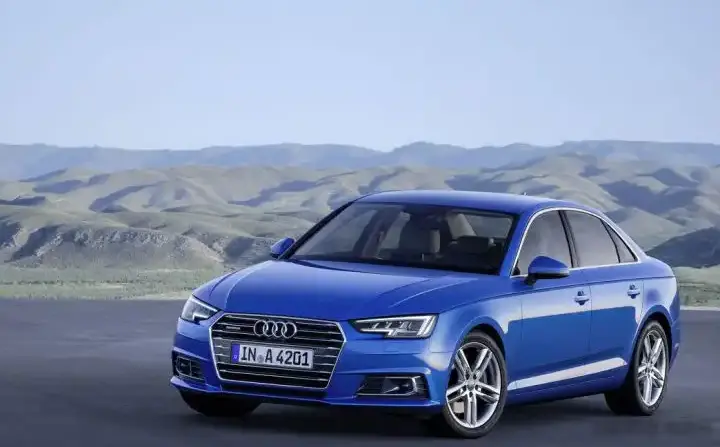
The Audi A4 (B9 8W) 2.0 TDI ultra, producing 150 horsepower, was a key variant within the fifth generation of Audi’s popular executive sedan, produced from 2015 to 2018. Positioned as a fuel-efficient option within the A4 lineup, it aimed to balance performance with economy, appealing to drivers prioritizing lower running costs. This model represented Audi’s efforts to meet increasingly stringent European emissions regulations while maintaining a competitive offering in the premium compact segment. It was primarily marketed in Europe, where diesel engines held a significant market share, though limited numbers were available in other regions.
Technical Specifications
| Brand | Audi |
| Model | A4 |
| Generation | A4 (B9 8W) |
| Type (Engine) | 2.0 TDI ultra (150 Hp) |
| Start of production | 2015 |
| End of production | 2018 |
| Powertrain Architecture | Internal Combustion engine |
| Body type | Sedan |
| Seats | 5 |
| Doors | 4 |
| Fuel consumption (urban) | 4.4-4.5 l/100 km (53.5 – 52.3 US mpg, 64.2 – 62.8 UK mpg, 22.7 – 22.2 km/l) |
| Fuel consumption (extra urban) | 3.3-3.4 l/100 km (71.3 – 69.2 US mpg, 85.6 – 83.1 UK mpg, 30.3 – 29.4 km/l) |
| Fuel consumption (combined) | 3.7-3.8 l/100 km (63.6 – 61.9 US mpg, 76.3 – 74.3 UK mpg, 27 – 26.3 km/l) |
| CO2 emissions | 95-99 g/km |
| Fuel Type | Diesel |
| Acceleration 0 – 100 km/h | 8.9 sec |
| Acceleration 0 – 62 mph | 8.9 sec |
| Acceleration 0 – 60 mph | 8.5 sec |
| Maximum speed | 210 km/h (130.49 mph) |
| Emission standard | Euro 6 |
| Weight-to-power ratio | 9.5 kg/Hp, 104.9 Hp/tonne |
| Weight-to-torque ratio | 4.5 kg/Nm, 223.8 Nm/tonne |
| Power | 150 Hp @ 3250-4200 rpm |
| Power per litre | 76.2 Hp/l |
| Torque | 320 Nm @ 1500-3250 rpm (236.02 lb.-ft. @ 1500-3250 rpm) |
| Engine layout | Front, Longitudinal |
| Engine Model/Code | DEUA |
| Engine displacement | 1968 cm3 (120.09 cu. in.) |
| Number of cylinders | 4 |
| Engine configuration | Inline |
| Cylinder Bore | 81 mm (3.19 in.) |
| Piston Stroke | 95.5 mm (3.76 in.) |
| Compression ratio | 16.2:1 |
| Number of valves per cylinder | 4 |
| Fuel injection system | Diesel Commonrail |
| Engine aspiration | Turbocharger, Intercooler |
| Valvetrain | DOHC |
| Engine oil capacity | 4.7 l (4.97 US qt | 4.14 UK qt) |
| Kerb Weight | 1430 kg (3152.61 lbs.) |
| Max. weight | 2030 kg (4475.38 lbs.) |
| Max load | 600 kg (1322.77 lbs.) |
| Trunk (boot) space – minimum | 480 l (16.95 cu. ft.) |
| Trunk (boot) space – maximum | 965 l (34.08 cu. ft.) |
| Fuel tank capacity | 40 l (10.57 US gal | 8.8 UK gal) |
| Max. roof load | 90 kg (198.42 lbs.) |
| Permitted trailer load with brakes (8%) | 1600 kg (3527.4 lbs.) |
| Permitted trailer load with brakes (12%) | 1400 kg (3086.47 lbs.) |
| Permitted trailer load without brakes | 750 kg (1653.47 lbs.) |
| Permitted towbar download | 80 kg (176.37 lbs.) |
| Length | 4726 mm (186.06 in.) |
| Width | 1842 mm (72.52 in.) |
| Width including mirrors | 2022 mm (79.61 in.) |
| Height | 1424 mm (56.06 in.) |
| Wheelbase | 2820 mm (111.02 in.) |
| Front track | 1572 mm (61.89 in.) |
| Rear (Back) track | 1555 mm (61.22 in.) |
| Front overhang | 880 mm (34.65 in.) |
| Rear overhang | 1026 mm (40.39 in.) |
| Drag coefficient (Cd) | 0.23 |
| Minimum turning circle (turning diameter) | 11.6 m (38.06 ft.) |
| Drivetrain Architecture | The Internal combustion engine (ICE) drives the front wheels of the vehicle. |
| Drive wheel | Front wheel drive |
| Number of gears and type of gearbox | 6 gears, manual transmission |
| Front suspension | Independent multi-link suspension |
| Rear suspension | Independent multi-link suspension |
| Front brakes | Ventilated discs |
| Rear brakes | Ventilated discs |
| Assisting systems | ABS (Anti-lock braking system) |
| Steering type | Steering rack and pinion |
| Power steering | Electric Steering |
| Tires size | 205/60 R16; 195/65 R16; 225/50 R17 |
| Wheel rims size | 7J x 16; 17 |
INTRODUCTION
The Audi A4 (B9) 2.0 TDI ultra 150 hp, launched in 2015, represented a significant step in Audi’s pursuit of efficiency within the executive car segment. Built on the Volkswagen Group’s MLB Evo platform (1HX0/A3), this variant was designed to deliver competitive fuel economy and reduced emissions without sacrificing the premium feel and technology expected of the A4. It occupied the lower-mid range of the B9 A4 lineup, serving as an entry point for buyers seeking a diesel-powered A4, positioned below the more powerful 190 hp TDI variants and the petrol-powered models.
Powertrain & Engine Architecture
At the heart of the A4 2.0 TDI ultra lay the DEUA engine, a 2.0-liter inline-four cylinder diesel engine. This engine utilized a sophisticated common rail direct injection system, delivering fuel at pressures up to 2,500 bar for optimized combustion. The engine featured a single turbocharger with an intercooler, enhancing power and efficiency. The DOHC valvetrain, with four valves per cylinder, contributed to improved breathing and overall performance. The 150 hp output was achieved through careful calibration of the engine management system, prioritizing fuel economy. This specific variant was typically paired with a six-speed manual transmission, although a seven-speed S tronic dual-clutch transmission was also available as an option. The engine’s longitudinal mounting allowed for front-wheel drive or Audi’s quattro all-wheel drive system, depending on the configuration.
Driving Characteristics
The 150 hp 2.0 TDI ultra offered a respectable driving experience, though it wasn’t designed for outright performance. Acceleration from 0-60 mph took around 8.5 seconds, and top speed was limited to 130 mph. The engine delivered its peak torque of 320 Nm (236 lb-ft) between 1500 and 3250 rpm, providing ample pulling power for everyday driving and overtaking maneuvers. The six-speed manual transmission offered precise shifts, while the optional S tronic provided quicker and smoother gear changes. Compared to the more powerful 190 hp TDI, the 150 hp version felt less responsive, particularly at higher speeds. However, the lower power output also contributed to improved fuel economy and reduced strain on the drivetrain.
Equipment & Trim Levels
The A4 2.0 TDI ultra typically came equipped with a generous level of standard features. These included Audi’s MMI infotainment system with a 7-inch display, Bluetooth connectivity, automatic climate control, and a leather-wrapped steering wheel. Standard safety features included ABS, ESP, and multiple airbags. Higher trim levels, such as Sport and S line, added features like sport seats, upgraded interior trim, and exterior styling enhancements. Optional extras included a larger MMI display, navigation system, advanced driver assistance systems (such as adaptive cruise control and lane keep assist), and a premium sound system. Interior upholstery was typically cloth in the base models, with leather options available on higher trims.
Chassis & Braking
The B9 A4 featured a sophisticated chassis design, utilizing independent multi-link suspension at both the front and rear. This setup provided a comfortable ride and precise handling. The front suspension incorporated aluminum components to reduce weight, while the rear suspension was optimized for stability and control. Braking duties were handled by ventilated discs on all four wheels, providing ample stopping power. The A4 2.0 TDI ultra, being a lighter variant, often featured slightly smaller brake rotors compared to the higher-powered models. The electric power steering system offered precise and responsive steering feel.
Market Reception & Comparison
The Audi A4 2.0 TDI ultra was generally well-received by automotive critics, who praised its fuel efficiency and comfortable ride. However, some reviewers noted that the 150 hp engine could feel underpowered, particularly when fully loaded or driving on steep inclines. Compared to the 190 hp TDI, the 150 hp version offered significantly better fuel economy, achieving up to 61.9 US mpg on the combined cycle. The 150 hp TDI also tended to be more affordable to purchase and insure. Against competitors like the BMW 320d and Mercedes-Benz C220d, the A4 2.0 TDI ultra offered a compelling combination of efficiency, comfort, and technology.
Legacy
The 2.0 TDI ultra engine proved to be a reliable and durable powertrain. While diesel engines, in general, have faced increased scrutiny regarding emissions, the DEUA engine, when properly maintained, has demonstrated long-term reliability. In the used car market, the A4 2.0 TDI ultra remains a popular choice for buyers seeking a fuel-efficient and comfortable executive sedan. However, potential buyers should be aware of the potential for diesel particulate filter (DPF) issues, particularly if the vehicle has been primarily used for short journeys. Regular servicing and the use of high-quality diesel fuel are essential for maintaining the longevity of this powertrain.