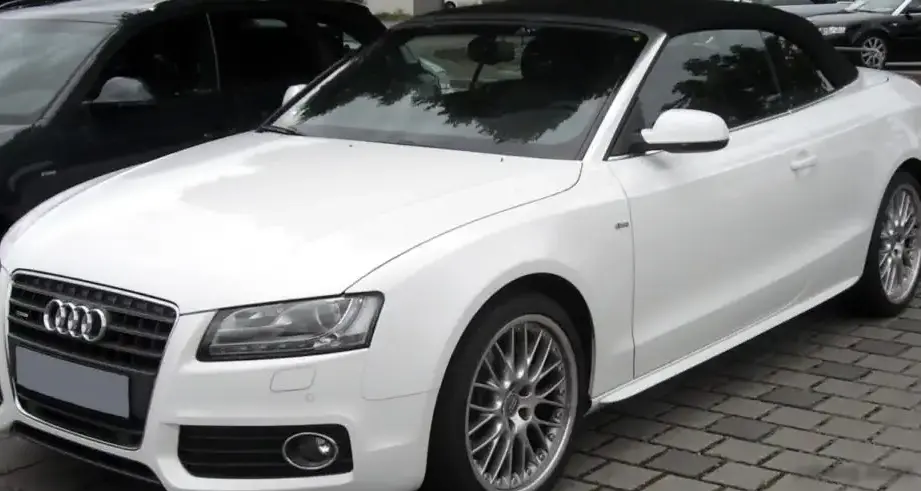
The Audi A5 Cabriolet 8F7, produced from 2009 to 2011, represented Audi’s foray into the premium mid-size convertible market. The 3.0 TDI V6 quattro S tronic variant, introduced in November 2008, occupied a position as a high-performance, technologically advanced option within the A5 Cabriolet range. It catered to buyers seeking a blend of open-air driving enjoyment, strong diesel torque, and all-weather capability provided by Audi’s quattro all-wheel drive system. This model sat above the entry-level 2.0 TDI and 2.0 TFSI trims, offering a significant performance upgrade while remaining below the more focused S5 Cabriolet.
Technical Specifications
| Brand | Audi |
| Model | A5 |
| Generation | A5 Cabriolet (8F7) |
| Type (Engine) | 3.0 TDI V6 (240 Hp) quattro S tronic |
| Start of production | November, 2008 |
| End of production | 2011 |
| Powertrain Architecture | Internal Combustion engine |
| Body type | Cabriolet |
| Seats | 4 |
| Doors | 2 |
| Fuel consumption (urban) | 8.5 l/100 km (27.7 US mpg, 33.2 UK mpg, 11.8 km/l) |
| Fuel consumption (extra urban) | 5.8 l/100 km (40.6 US mpg, 48.7 UK mpg, 17.2 km/l) |
| Fuel consumption (combined) | 6.8 l/100 km (34.6 US mpg, 41.5 UK mpg, 14.7 km/l) |
| CO2 emissions | 179 g/km |
| Fuel Type | Diesel |
| Acceleration 0 – 100 km/h | 6.4 sec |
| Acceleration 0 – 62 mph | 6.4 sec |
| Acceleration 0 – 60 mph | 6.1 sec |
| Maximum speed | 247 km/h (153.48 mph) |
| Emission standard | Euro 5 |
| Weight-to-power ratio | 7.8 kg/Hp, 129 Hp/tonne |
| Weight-to-torque ratio | 3.7 kg/Nm, 268.8 Nm/tonne |
| Power | 240 Hp @ 4000-4400 rpm |
| Power per litre | 80.9 Hp/l |
| Torque | 500 Nm @ 1500-3000 rpm (368.78 lb.-ft. @ 1500-3000 rpm) |
| Engine layout | Front, Longitudinal |
| Engine Model/Code | CAPA, CCWA |
| Engine displacement | 2967 cm3 (181.06 cu. in.) |
| Number of cylinders | 6 |
| Engine configuration | V-engine |
| Cylinder Bore | 83 mm (3.27 in.) |
| Piston Stroke | 91.4 mm (3.6 in.) |
| Compression ratio | 16.8:1 |
| Number of valves per cylinder | 4 |
| Fuel injection system | Diesel Commonrail |
| Engine aspiration | Turbocharger, Intercooler |
| Valvetrain | DOHC |
| Engine oil capacity | 6.9 l (7.29 US qt | 6.07 UK qt) |
| Kerb Weight | 1860 kg (4100.6 lbs.) |
| Max. weight | 2360 kg (5202.91 lbs.) |
| Max load | 500 kg (1102.31 lbs.) |
| Trunk (boot) space – minimum | 320 l (11.3 cu. ft.) |
| Trunk (boot) space – maximum | 750 l (26.49 cu. ft.) |
| Fuel tank capacity | 64 l (16.91 US gal | 14.08 UK gal) |
| Permitted trailer load with brakes (8%) | 2100 kg (4629.71 lbs.) |
| Permitted trailer load with brakes (12%) | 1900 kg (4188.78 lbs.) |
| Permitted trailer load without brakes | 750 kg (1653.47 lbs.) |
| Permitted towbar download | 80 kg (176.37 lbs.) |
| Length | 4625 mm (182.09 in.) |
| Width | 1854 mm (72.99 in.) |
| Height | 1383 mm (54.45 in.) |
| Wheelbase | 2751 mm (108.31 in.) |
| Front track | 1590 mm (62.6 in.) |
| Rear (Back) track | 1577 mm (62.09 in.) |
| Drag coefficient (Cd) | 0.309 |
| Minimum turning circle (turning diameter) | 11.4 m (37.4 ft.) |
| Drivetrain Architecture | The Internal combustion engine (ICE) drives the front wheels of the vehicle. |
| Drive wheel | Front wheel drive |
| Number of gears and type of gearbox | 7 gears, automatic transmission S tronic |
| Front suspension | Independent multi-link suspension |
| Rear suspension | Independent multi-link spring suspension with stabilizer |
| Front brakes | Ventilated discs |
| Rear brakes | Disc |
| Assisting systems | ABS (Anti-lock braking system) |
| Steering type | Steering rack and pinion |
| Power steering | Electric Steering |
| Tires size | 225/50 R17 |
| Wheel rims size | 7.5J x 17 |
Powertrain & Engine Architecture
At the heart of the A5 Cabriolet 3.0 TDI quattro S tronic lies the CAPA or CCWA engine code, a 3.0-liter V6 turbocharged diesel engine. This engine utilized a common rail direct injection system, delivering fuel at extremely high pressures for optimized combustion. The engine featured a double overhead camshaft (DOHC) valvetrain with four valves per cylinder, enhancing breathing and contributing to its power output. A variable geometry turbocharger, coupled with an intercooler, minimized turbo lag and maximized boost across the rev range. The engine’s robust construction and advanced technologies allowed it to produce 240 horsepower at 4000-4400 rpm and a substantial 500 Nm (368 lb-ft) of torque between 1500-3000 rpm. This torque output was a key characteristic, providing strong acceleration and effortless cruising. The S tronic 7-speed dual-clutch transmission, standard on this variant, offered rapid and smooth gear changes, further enhancing the driving experience. This transmission allowed for both fully automatic operation and manual gear selection via steering wheel-mounted paddles.
Driving Characteristics
The 3.0 TDI quattro S tronic A5 Cabriolet delivered a refined and capable driving experience. The abundant torque from the diesel engine provided strong acceleration in virtually any gear, making overtaking maneuvers easy and confident. The S tronic transmission’s quick shifts minimized power interruption, contributing to a seamless flow of acceleration. The quattro all-wheel drive system provided excellent traction, particularly in adverse weather conditions, inspiring confidence on both dry and wet roads. Compared to the 2.0 TDI or 2.0 TFSI models, the 3.0 TDI offered a noticeably more powerful and responsive driving experience. While the 2.0-liter engines prioritized fuel economy, the 3.0 TDI focused on providing a more engaging and dynamic driving experience without sacrificing reasonable fuel efficiency. The gear ratios in the S tronic transmission were well-matched to the engine’s torque curve, ensuring optimal performance in a variety of driving situations.
Equipment & Trim Levels
The 3.0 TDI quattro S tronic variant typically came well-equipped as standard. Features included leather upholstery, automatic climate control, a multi-function steering wheel, and an Audi Concert audio system. Xenon plus headlights with LED daytime running lights were also common. Optional extras included Audi’s navigation system, advanced parking systems, and upgraded sound systems from Bang & Olufsen. Interior trim options allowed for personalization, with choices in wood or aluminum inlays. The Cabriolet’s soft top was electronically operated and available in a range of colors.
Chassis & Braking
The A5 Cabriolet’s chassis featured an independent multi-link suspension at both the front and rear, providing a comfortable ride and precise handling. The front suspension utilized coil springs and shock absorbers, while the rear suspension incorporated a stabilizer bar to reduce body roll during cornering. Braking duties were handled by ventilated disc brakes at the front and solid discs at the rear, providing ample stopping power. The anti-lock braking system (ABS) and electronic stability control (ESC) were standard features, enhancing safety and stability.
Market Reception & Comparison
The Audi A5 Cabriolet 3.0 TDI quattro S tronic was generally well-received by automotive critics. It was praised for its powerful engine, refined ride, and sophisticated interior. The combination of diesel efficiency and all-wheel drive capability was seen as a significant advantage. Compared to its competitors, such as the BMW 3 Series Convertible and Mercedes-Benz C-Class Cabriolet, the A5 offered a compelling blend of performance, luxury, and practicality. Fuel economy was a strong point, with combined figures around 34.6 US mpg, making it a relatively economical choice for a performance convertible. Reliability reports generally indicated good long-term dependability, although diesel particulate filter (DPF) maintenance was a consideration.
Legacy
The 3.0 TDI engine, in its various iterations, proved to be a durable and reliable powerplant. The S tronic transmission, while requiring more specialized maintenance than a traditional automatic, also demonstrated good longevity when properly serviced. Today, the A5 Cabriolet 3.0 TDI quattro S tronic remains a desirable used car, offering a compelling combination of style, performance, and practicality. Well-maintained examples command a premium in the used car market, reflecting their enduring appeal and the reputation for quality associated with the Audi brand. The engine’s torque output and the quattro system’s all-weather capability continue to make it a relevant and enjoyable vehicle for enthusiasts.