Technical Specifications
| Brand | Audi |
| Model | A5 |
| Generation | A5 Coupe (F5, facelift 2019) |
| Type (Engine) | 40 TFSI (190 Hp) Mild Hybrid S tronic |
| Start of production | 2019 |
| End of production | 2020 |
| Powertrain Architecture | MHEV (Mild Hybrid Electric Vehicle) |
| Body type | Coupe |
| Seats | 4 |
| Doors | 2 |
| Fuel consumption at Low speed (WLTP) | 9.3 l/100 km (25.3 US mpg) |
| Fuel consumption at Medium speed (WLTP) | 7.2 l/100 km (32.7 US mpg) |
| Fuel consumption at high speed (WLTP) | 6.2 l/100 km (37.9 US mpg) |
| Fuel consumption at very high speed (WLTP) | 6.9 l/100 km (34.1 US mpg) |
| Combined fuel consumption (WLTP) | 7.0 l/100 km (33.6 US mpg) |
| CO2 emissions (WLTP) | 160 g/km |
| Fuel consumption (urban – NEDC) | 7.4-7.7 l/100 km (31.8 – 30.5 US mpg) |
| Fuel consumption (extra urban – NEDC) | 4.7-5.1 l/100 km (50 – 46.1 US mpg) |
| Fuel consumption (combined – NEDC) | 5.8-5.9 l/100 km (40.6 – 39.9 US mpg) |
| CO2 emissions (NEDC) | 131-136 g/km |
| Fuel Type | Petrol (Gasoline) |
| Acceleration 0 – 100 km/h | 7.3 sec |
| Acceleration 0 – 62 mph | 7.3 sec |
| Acceleration 0 – 60 mph | 6.9 sec |
| Maximum speed | 241 km/h (149.75 mph) |
| Emission standard | Euro 6 |
| Weight-to-power ratio | 7.7 kg/Hp |
| Weight-to-torque ratio | 4.5 kg/Nm |
| Power | 190 Hp @ 4200-6000 rpm |
| Torque | 320 Nm @ 1450-4200 rpm (236.02 lb.-ft.) |
| Engine layout | Front, Longitudinal |
| Engine Model/Code | DLVA |
| Engine displacement | 1984 cm3 (121.07 cu. in.) |
| Number of cylinders | 4 |
| Engine configuration | Inline |
| Cylinder Bore | 82.5 mm (3.25 in.) |
| Piston Stroke | 92.8 mm (3.65 in.) |
| Number of valves per cylinder | 4 |
| Fuel injection system | Direct injection |
| Engine aspiration | Turbocharger, Intercooler |
| Engine oil capacity | 5.2 l (5.49 US qt | 4.58 UK qt) |
| Kerb Weight | 1455 kg (3207.73 lbs.) |
| Max. weight | 1965 kg (4332.08 lbs.) |
| Max load | 510 kg (1124.36 lbs.) |
| Trunk (boot) space – minimum | 450 l (15.89 cu. ft.) |
| Fuel tank capacity | 54 l (14.27 US gal | 11.88 UK gal) |
| Max. roof load | 75 kg (165.35 lbs.) |
| Permitted trailer load with brakes (8%) | 1700 kg (3747.86 lbs.) |
| Permitted trailer load with brakes (12%) | 1500 kg (3306.93 lbs.) |
| Permitted trailer load without brakes | 750 kg (1653.47 lbs.) |
| Permitted towbar download | 80 kg (176.37 lbs.) |
| Length | 4697 mm (184.92 in.) |
| Width | 1846 mm (72.68 in.) |
| Width including mirrors | 2029 mm (79.88 in.) |
| Height | 1371 mm (53.98 in.) |
| Wheelbase | 2764 mm (108.82 in.) |
| Front track | 1587 mm (62.48 in.) |
| Rear track | 1568 mm (61.73 in.) |
| Front overhang | 898 mm (35.35 in.) |
| Rear overhang | 1035 mm (40.75 in.) |
| Minimum turning circle | 11.5 m (37.73 ft.) |
| Drivetrain Architecture | ICE and electric motor drive front wheels |
| Drive wheel | Front wheel drive |
| Number of gears | 7 |
| Gearbox type | Automatic transmission S tronic |
| Front suspension | Independent multi-link |
| Rear suspension | Independent multi-link with stabilizer |
| Front brakes | Ventilated discs |
| Rear brakes | Disc |
| Assisting systems | ABS |
| Steering type | Steering rack and pinion |
| Power steering | Electric |
| Tires size | 225/50 R17; 245/40 R18 |
| Wheel rims size | 7.5J x 17; 8.5J x 18 |
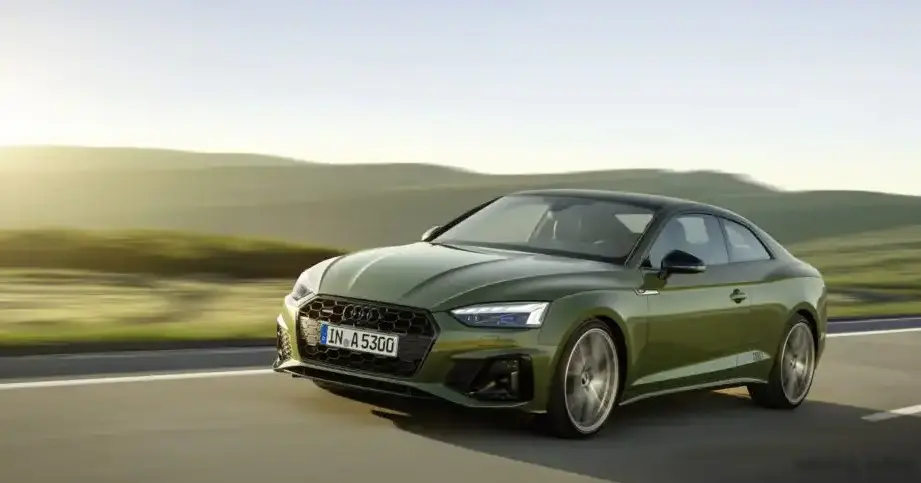
The Audi A5 Coupe (F5) facelift 40 TFSI, launched in 2019, built upon the success of the second-generation A5, offering a refined and technologically advanced grand tourer. This variant specifically targeted buyers seeking a blend of performance and efficiency, slotting into the middle of the A5 Coupe range. The introduction of mild hybrid technology marked a significant step towards improved fuel economy and reduced emissions. The “40 TFSI” designation, part of Audi’s new naming convention, indicated the car’s power output relative to other models in the lineup. This model year saw a refresh of the A5, including updated styling, enhanced infotainment systems, and the integration of mild hybrid systems across several engine options.
Powertrain & Engine Architecture
At the heart of the 40 TFSI lies the EA888 2.0-liter turbocharged four-cylinder engine, specifically coded DLVA. This engine utilizes direct fuel injection and an intercooled turbocharger to deliver a responsive and efficient driving experience. The engine produces 190 horsepower at 4200-6000 rpm and 320 Nm (236 lb-ft) of torque between 1450-4200 rpm. The mild hybrid system, a 48-volt system, incorporates a belt starter generator (BSG) and a small lithium-ion battery. The BSG allows for extended engine-off coasting, regenerative braking, and a smoother start-stop function, contributing to fuel savings. The engine’s valvetrain features dual overhead camshafts and four valves per cylinder. Paired with the engine is Audi’s renowned seven-speed S tronic dual-clutch transmission, known for its quick and seamless gear changes. This transmission offers both automatic and manual shift modes, providing drivers with control over the driving experience.
Driving Characteristics
The 40 TFSI S tronic combination delivers a balanced driving experience. While not as overtly sporty as the higher-output variants, it provides ample power for everyday driving and comfortable highway cruising. The S tronic transmission contributes to brisk acceleration, with a 0-60 mph time of around 6.9 seconds. The mild hybrid system enhances responsiveness by providing a small power boost during acceleration. The gear ratios are tuned for a blend of performance and fuel efficiency, with taller gears for relaxed cruising and shorter gears for quicker acceleration. Compared to the manual transmission versions of the same engine, the S tronic offers smoother shifts and reduced driver fatigue, but some enthusiasts may prefer the greater engagement of a manual gearbox. The 40 TFSI feels more refined and easier to drive than the more powerful models, making it a good choice for those prioritizing comfort and convenience.
Equipment & Trim Levels
The 40 TFSI typically came well-equipped as standard. Common features included Audi’s MMI infotainment system with a 7-inch touchscreen display (upgradable to a larger screen), Audi Virtual Cockpit (digital instrument cluster), three-zone automatic climate control, leather upholstery, and LED headlights. Optional extras included a Bang & Olufsen sound system, navigation system, adaptive cruise control, and a panoramic sunroof. Trim levels varied by market, but generally offered options for upgraded interior materials, exterior styling enhancements, and additional driver-assistance features. The Sport trim often included sport seats, lowered suspension, and unique exterior accents.
Chassis & Braking
The A5 Coupe features a sophisticated chassis design with independent multi-link suspension at all four corners. The front suspension utilizes aluminum components to reduce weight, while the rear suspension incorporates a stabilizer bar to minimize body roll. The 40 TFSI variant typically came equipped with ventilated front disc brakes and solid rear disc brakes. ABS (Anti-lock Braking System) is standard, providing enhanced braking performance and stability. The steering system is an electric power-assisted rack and pinion system, offering precise and responsive steering feel. The suspension tuning is geared towards comfort and stability, providing a smooth ride over a variety of road surfaces.
Market Reception & Comparison
The Audi A5 Coupe 40 TFSI was generally well-received by automotive critics. It was praised for its refined driving experience, comfortable interior, and efficient engine. The mild hybrid system was seen as a positive step towards reducing emissions and improving fuel economy. Compared to the higher-output 45 TFSI variant, the 40 TFSI offered a more affordable entry point into the A5 Coupe range, while still providing a satisfying driving experience. The 40 TFSI also compared favorably to its rivals, such as the BMW 4 Series and Mercedes-Benz C-Class Coupe, offering a compelling combination of style, performance, and technology. Fuel economy figures were competitive within its class, and the mild hybrid system helped to further improve efficiency.
Legacy
The EA888 engine, in its various iterations, has proven to be a reliable and durable powerplant. The mild hybrid system, while relatively new at the time of its introduction, has also demonstrated good long-term reliability. The 40 TFSI variant of the A5 Coupe has become a popular choice in the used car market, offering a good balance of value, performance, and efficiency. Regular maintenance, including oil changes and timing belt replacements (where applicable), is crucial for ensuring the longevity of the engine and transmission. The A5 Coupe (F5) facelift, including the 40 TFSI variant, represents a significant step forward in Audi’s grand touring tradition, offering a refined and technologically advanced driving experience.