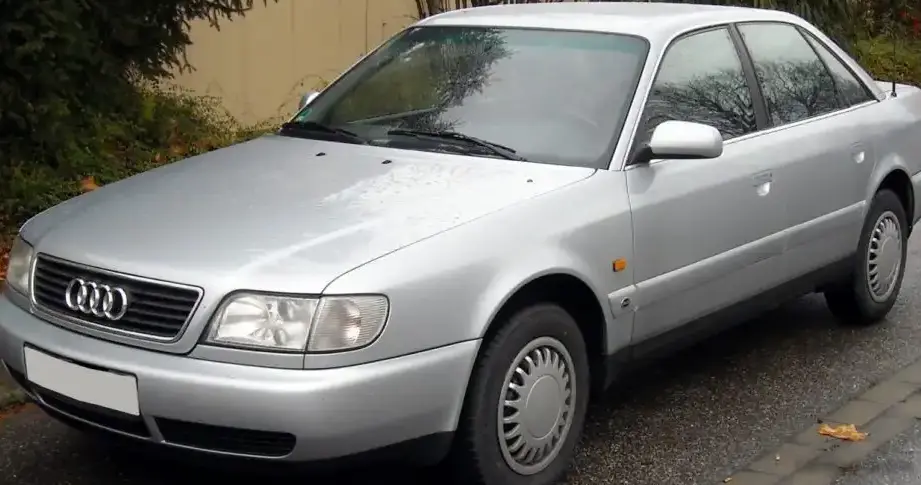
The Audi A6 Avant (4B, C5 facelift) 2.7 T V6 quattro Tiptronic, produced from 2001 to 2004, represents a compelling blend of performance, practicality, and luxury within the C5 A6 generation. This variant occupied a premium position in the A6 Avant lineup, offering a significant step up in power and refinement compared to the base 1.8T and 2.4 models. It was positioned below the flagship S6 Avant, providing a balance between everyday usability and spirited driving. The facelifted C5 A6, introduced in 2001, brought revised styling, improved interior materials, and updated technology, solidifying the A6’s reputation as a formidable competitor in the executive wagon segment.
Technical Specifications
| Brand | Audi |
| Model | A6 |
| Generation | A6 Avant (4B,C5, facelift 2001) |
| Type (Engine) | 2.7 T V6 (250 Hp) quattro Tiptronic |
| Start of production | 2001 |
| End of production | 2004 |
| Powertrain Architecture | Internal Combustion engine |
| Body type | Station wagon (estate) |
| Seats | 5 |
| Doors | 5 |
| Fuel consumption (urban) | 18.1 l/100 km (13 US mpg, 15.6 UK mpg, 5.5 km/l) |
| Fuel consumption (extra urban) | 8.8 l/100 km (26.7 US mpg, 32.1 UK mpg, 11.4 km/l) |
| Fuel consumption (combined) | 11.7 l/100 km (20.1 US mpg, 24.1 UK mpg, 8.5 km/l) |
| CO2 emissions | 293 g/km |
| Fuel Type | Petrol (Gasoline) |
| Acceleration 0 – 100 km/h | 7.6 sec |
| Acceleration 0 – 62 mph | 7.6 sec |
| Acceleration 0 – 60 mph | 7.2 sec |
| Maximum speed | 243 km/h (150.99 mph) |
| Emission standard | Euro 3 |
| Weight-to-power ratio | 7 kg/Hp, 142 Hp/tonne |
| Weight-to-torque ratio | 5 kg/Nm, 198.9 Nm/tonne |
| Power | 250 Hp @ 5800 rpm |
| Power per litre | 93.6 Hp/l |
| Torque | 350 Nm @ 1800-4500 rpm (258.15 lb.-ft. @ 1800-4500 rpm) |
| Engine layout | Front, Longitudinal |
| Engine Model/Code | ARJ, BES |
| Engine displacement | 2671 cm3 (162.99 cu. in.) |
| Number of cylinders | 6 |
| Engine configuration | V-engine |
| Cylinder Bore | 81 mm (3.19 in.) |
| Piston Stroke | 86.4 mm (3.4 in.) |
| Compression ratio | 9.3:1 |
| Number of valves per cylinder | 5 |
| Fuel injection system | Multi-port manifold injection |
| Engine aspiration | BiTurbo, Intercooler |
| Valvetrain | DOHC |
| Engine oil capacity | 6 l (6.34 US qt | 5.28 UK qt) |
| Coolant | 6 l (6.34 US qt | 5.28 UK qt) |
| Kerb Weight | 1760 kg (3880.14 lbs.) |
| Max. weight | 2310 kg (5092.68 lbs.) |
| Max load | 550 kg (1212.54 lbs.) |
| Trunk (boot) space – minimum | 455 l (16.07 cu. ft.) |
| Trunk (boot) space – maximum | 1590 l (56.15 cu. ft.) |
| Fuel tank capacity | 70 l (18.49 US gal | 15.4 UK gal) |
| Max. roof load | 100 kg (220.46 lbs.) |
| Permitted trailer load with brakes (8%) | 2100 kg (4629.71 lbs.) |
| Permitted trailer load with brakes (12%) | 1900 kg (4188.78 lbs.) |
| Permitted trailer load without brakes | 750 kg (1653.47 lbs.) |
| Permitted towbar download | 85 kg (187.39 lbs.) |
| Length | 4796 mm (188.82 in.) |
| Width | 1810 mm (71.26 in.) |
| Height | 1477 mm (58.15 in.) |
| Wheelbase | 2759 mm (108.62 in.) |
| Front track | 1540 mm (60.63 in.) |
| Rear (Back) track | 1569 mm (61.77 in.) |
| Drag coefficient (Cd) | 0.33 |
| Minimum turning circle | 11.68 m (38.32 ft.) |
| Drive wheel | All wheel drive (4×4) |
| Number of gears and type of gearbox | 5 gears, automatic transmission Tiptronic |
| Front suspension | Independent multi-link suspension |
| Rear suspension | Semi-independent, coil spring |
| Front brakes | Ventilated discs |
| Rear brakes | Disc |
| Assisting systems | ABS (Anti-lock braking system) |
| Steering type | Steering rack and pinion |
| Power steering | Hydraulic Steering |
| Tires size | 215/55 R16 |
| Wheel rims size | 7J x 16 |
INTRODUCTION
The Audi A6 Avant (4B, C5 facelift) 2.7 T V6 quattro Tiptronic, produced between 2001 and 2004, represents a high-performance variant of Audi’s popular executive wagon. Built on the 4B/C5 platform, this model benefited from the mid-cycle facelift, bringing cosmetic and technological updates. The 2.7-liter twin-turbocharged V6 engine, coupled with Audi’s quattro all-wheel-drive system and a five-speed Tiptronic automatic transmission, delivered a compelling combination of power, all-weather capability, and relative ease of use. In the US market, the A6 Avant was a relatively niche offering, appealing to buyers who prioritized practicality and performance over the more common sedan body style.
Powertrain & Engine Architecture
At the heart of the 2.7 T V6 quattro Tiptronic lies the Audi-developed 2.7-liter V6 engine, designated with engine codes ARJ or BES depending on specific calibration and market. This engine is characterized by its 60-degree V-angle and utilizes a bi-turbocharger setup – one turbocharger per cylinder bank – to deliver increased power and torque. The turbochargers are relatively small, contributing to quick spool-up and minimal turbo lag. Fuel is delivered via a multi-port fuel injection system, and the engine features a double overhead camshaft (DOHC) valvetrain with five valves per cylinder (three intake, two exhaust). The Tiptronic transmission is a conventional torque-converter automatic, but it includes a manual shift mode allowing the driver to select gears for more control. The transmission is robust and designed to handle the engine’s substantial torque output.
Driving Characteristics
The 2.7 T V6 quattro Tiptronic offers a distinctly different driving experience compared to the naturally aspirated A6 variants. The twin-turbochargers provide a broad torque curve, delivering strong acceleration from low engine speeds. While not as overtly aggressive as the S6, the 2.7 T offers ample power for confident overtaking and highway cruising. The Tiptronic transmission generally shifts smoothly, but can sometimes feel hesitant in automatic mode. Utilizing the manual shift function allows for more precise control, particularly during spirited driving. The quattro all-wheel-drive system provides excellent traction in all weather conditions, enhancing stability and confidence. Compared to a manual transmission equipped 2.7T, the Tiptronic version sacrifices some responsiveness, but gains in ease of use, especially in stop-and-go traffic.
Equipment & Trim Levels
The A6 Avant 2.7 T quattro Tiptronic typically came well-equipped, reflecting its position as a premium model. Standard features often included leather upholstery, power-adjustable front seats with memory function, automatic climate control, a premium audio system, and alloy wheels. Optional extras included a sunroof, navigation system, heated seats, and upgraded interior trim materials. The interior design was characterized by Audi’s typically understated elegance, with a focus on functionality and build quality. The dashboard layout was clean and intuitive, with logically placed controls.
Chassis & Braking
The C5 A6 Avant featured an independent multi-link front suspension and a semi-independent coil spring rear suspension. This setup provided a comfortable ride while maintaining good handling characteristics. The quattro all-wheel-drive system distributes power between the front and rear axles as needed, optimizing traction. Braking duties were handled by ventilated discs at the front and solid discs at the rear, with ABS (Anti-lock Braking System) standard. The braking system was generally effective, providing ample stopping power for everyday driving and more demanding situations.
Market Reception & Comparison
The A6 Avant 2.7 T quattro Tiptronic was generally well-received by automotive critics. It was praised for its powerful engine, comfortable ride, and all-weather capability. However, some reviewers noted the Tiptronic transmission could feel sluggish at times, and fuel economy was not a strong point. Compared to the 1.8T and 2.4 models, the 2.7 T offered a significant performance upgrade, but at a higher price point. Compared to the S6 Avant, it provided a more balanced blend of performance and practicality, with a lower purchase price and potentially lower running costs.
Legacy
The Audi A6 Avant (4B, C5) 2.7 T V6 quattro Tiptronic has developed a loyal following among enthusiasts. The 2.7T engine, while capable of producing impressive power, can be prone to certain issues, such as carbon buildup on the intake valves and potential turbocharger failures. However, with proper maintenance, these engines can be remarkably durable. Today, well-maintained examples are sought after by those who appreciate the combination of performance, practicality, and Audi’s signature build quality. The Tiptronic transmission, while not as desirable as a manual, remains a viable option for those seeking a more relaxed driving experience. The C5 A6 Avant, particularly the 2.7 T variant, represents a high point in Audi’s wagon history.