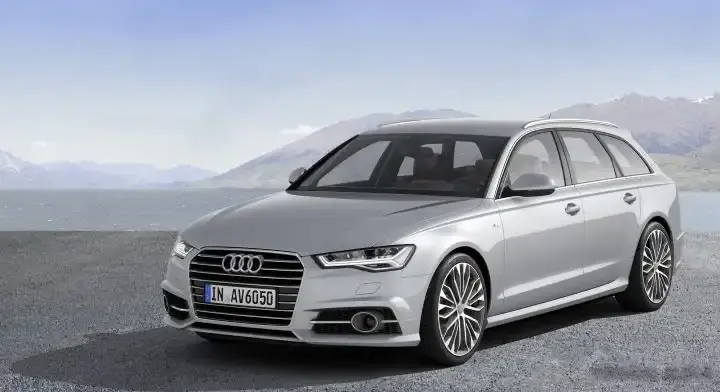
The Audi A6 Avant (4G, C7 facelift) 2.0 TFSI quattro S tronic, produced from 2015 to 2016, represents a refined iteration of Audi’s popular executive wagon. This variant occupied a strong mid-range position within the C7 facelift A6 lineup, offering a compelling blend of performance, practicality, and technology. It built upon the foundation of the 4G A6 generation, which debuted in 2011, and benefited from the styling and technological updates introduced with the 2014 facelift. The A6 Avant, as a whole, served as Audi’s offering in the premium wagon segment, competing with vehicles like the BMW 5 Series Touring and Mercedes-Benz E-Class Estate, primarily targeting the European market where wagons maintain significant popularity. In the US, the A6 Avant saw limited sales, catering to a niche audience seeking a more versatile luxury vehicle.
Technical Specifications
| Brand | Audi |
| Model | A6 |
| Generation | A6 Avant (4G, C7 facelift 2014) |
| Type (Engine) | 2.0 TFSI (252 Hp) quattro S tronic |
| Start of production | 2015 |
| End of production | 2016 |
| Powertrain Architecture | Internal Combustion engine |
| Body type | Station wagon (estate) |
| Seats | 5 |
| Doors | 5 |
| Fuel consumption (urban) | 8.5-8.6 l/100 km (27.7 – 27.4 US mpg) |
| Fuel consumption (extra urban) | 6-6.2 l/100 km (39.2 – 37.9 US mpg) |
| Fuel consumption (combined) | 6.9-7.1 l/100 km (34.1 – 33.1 US mpg) |
| CO2 emissions | 157-163 g/km |
| Fuel Type | Petrol (Gasoline) |
| Acceleration 0 – 100 km/h | 6.7 sec |
| Acceleration 0 – 62 mph | 6.7 sec |
| Acceleration 0 – 60 mph | 6.4 sec |
| Maximum speed | 250 km/h (155.34 mph) |
| Emission standard | Euro 6 |
| Weight-to-power ratio | 6.8 kg/Hp |
| Weight-to-torque ratio | 4.7 kg/Nm |
| Power | 252 Hp @ 5000-6000 rpm |
| Torque | 370 Nm @ 1600-4500 rpm (272.9 lb.-ft. @ 1600-4500 rpm) |
| Engine layout | Front, Longitudinal |
| Engine Model/Code | EA888 / CYPA |
| Engine displacement | 1984 cm3 (121.07 cu. in.) |
| Number of cylinders | 4 |
| Engine configuration | Inline |
| Cylinder Bore | 82.5 mm (3.25 in.) |
| Piston Stroke | 92.8 mm (3.65 in.) |
| Compression ratio | 9.6:1 |
| Number of valves per cylinder | 4 |
| Fuel injection system | Direct injection and Multi-port manifold injection |
| Engine aspiration | Turbocharger, Intercooler |
| Valvetrain | DOHC |
| Engine oil capacity | 4.7 l (4.97 US qt | 4.14 UK qt) |
| Coolant | 8.5 l (8.98 US qt | 7.48 UK qt) |
| Kerb Weight | 1725 kg (3802.97 lbs.) |
| Max. weight | 2355 kg (5191.89 lbs.) |
| Max load | 630 kg (1388.91 lbs.) |
| Trunk (boot) space – minimum | 565 l (19.95 cu. ft.) |
| Trunk (boot) space – maximum | 1680 l (59.33 cu. ft.) |
| Fuel tank capacity | 75 l (19.81 US gal | 16.5 UK gal) |
| Max. roof load | 100 kg (220.46 lbs.) |
| Permitted trailer load with brakes (8%) | 1800 kg (3968.32 lbs.) |
| Permitted trailer load with brakes (12%) | 1600 kg (3527.4 lbs.) |
| Permitted trailer load without brakes | 750 kg (1653.47 lbs.) |
| Permitted towbar download | 85 kg (187.39 lbs.) |
| Length | 4943 mm (194.61 in.) |
| Width | 1874 mm (73.78 in.) |
| Width including mirrors | 2086 mm (82.13 in.) |
| Height | 1461 mm (57.52 in.) |
| Wheelbase | 2912 mm (114.65 in.) |
| Front track | 1627 mm (64.06 in.) |
| Rear (Back) track | 1618 mm (63.7 in.) |
| Front overhang | 930 mm (36.61 in.) |
| Rear overhang | 1101 mm (43.35 in.) |
| Drag coefficient (Cd) | 0.30 |
| Minimum turning circle (turning diameter) | 11.9 m (39.04 ft.) |
| Drivetrain Architecture | The Internal combustion engine (ICE) drives permanently the four wheels of the vehicle. |
| Drive wheel | All wheel drive (4×4) |
| Number of gears and type of gearbox | 7 gears, automatic transmission S tronic |
| Front suspension | Independent multi-link suspension, Transverse stabilizer |
| Rear suspension | Independent on trapezoidal lever, Transverse stabilizer |
| Front brakes | Ventilated discs |
| Rear brakes | Ventilated discs |
| Assisting systems | ABS (Anti-lock braking system) |
| Steering type | Steering rack and pinion |
| Power steering | Electric Steering |
| Tires size | 225/50 R17 |
| Wheel rims size | 8J x 17 |
Powertrain & Engine Architecture
At the heart of the A6 Avant 2.0 TFSI quattro S tronic lies the EA888 2.0-liter turbocharged inline-four cylinder engine, specifically the CYPA code variant. This engine is a cornerstone of the Volkswagen Group’s powertrain strategy, known for its blend of efficiency and performance. The CYPA features direct fuel injection combined with multi-point injection, optimizing combustion for both power and fuel economy. The engine utilizes a single turbocharger with an intercooler to mitigate turbo lag and maintain consistent boost pressure. The valvetrain employs a dual overhead camshaft (DOHC) design with four valves per cylinder, enhancing volumetric efficiency. The S tronic 7-speed dual-clutch transmission (DCT) is a key component, offering rapid and smooth gear changes. This transmission allows for both fully automatic operation and manual control via steering wheel-mounted paddles. The quattro all-wheel-drive system distributes power between the front and rear axles as needed, providing enhanced traction and stability, particularly in adverse weather conditions.
Driving Characteristics
The 252 horsepower and 370 Nm (272.9 lb-ft) of torque delivered by the 2.0 TFSI engine, coupled with the S tronic transmission and quattro all-wheel drive, resulted in a responsive and capable driving experience. Acceleration from 0 to 60 mph took approximately 6.4 seconds. While not as overtly sporty as the A6 variants equipped with the 3.0-liter supercharged V6, the 2.0 TFSI offered ample power for everyday driving and highway overtaking. The S tronic transmission’s quick shifts contributed to a feeling of immediacy, and the quattro system provided confident handling in various conditions. Compared to the manual transmission versions of the same engine, the S tronic offered greater convenience and ease of use, although some enthusiasts might have preferred the more engaging feel of a manual gearbox. The gear ratios were tuned for a balance between acceleration and fuel efficiency, with a relatively tall seventh gear for relaxed cruising.
Equipment & Trim Levels
The A6 Avant 2.0 TFSI quattro S tronic typically came well-equipped as standard. Features included leather upholstery, tri-zone automatic climate control, a multi-function steering wheel, and the Audi MMI infotainment system with a central display screen. Standard safety features encompassed ABS, electronic stability control, and multiple airbags. Optional extras included features like a navigation system, a premium sound system (Bang & Olufsen), adaptive cruise control, and parking assistance systems. Trim levels varied slightly depending on the market, but generally, this variant sat in the mid-range of the A6 Avant lineup, offering a step up in performance and features compared to the base models.
Chassis & Braking
The A6 Avant featured an independent suspension system on both the front and rear axles. The front suspension utilized a multi-link setup, while the rear employed a trapezoidal link design. Both ends were equipped with transverse stabilizers to reduce body roll during cornering. The braking system consisted of ventilated discs on all four wheels, providing ample stopping power. The electronic stability control system worked in conjunction with the ABS to maintain control during emergency braking maneuvers. The chassis was tuned to provide a comfortable ride quality while still offering responsive handling.
Market Reception & Comparison
The A6 Avant 2.0 TFSI quattro S tronic was generally well-received by automotive critics. It was praised for its refined engine, smooth transmission, and comfortable ride. Fuel economy was considered respectable for a vehicle of its size and performance, averaging around 34 mpg combined. Compared to the higher-output V6 models, the 2.0 TFSI offered a more affordable entry point into the A6 Avant range, with lower running costs due to its smaller engine capacity. However, some reviewers noted that the 2.0 TFSI engine lacked the outright punch and character of the V6. The 1.8 TFSI variants, while more economical, were often criticized for feeling underpowered, making the 2.0 TFSI a sweet spot for many buyers.
Legacy
The EA888 2.0 TFSI engine, in its various iterations, has proven to be a relatively reliable powertrain. However, like any turbocharged engine, it is susceptible to issues such as carbon buildup on the intake valves and potential oil consumption. The S tronic transmission, while generally robust, requires regular maintenance, including fluid changes, to ensure long-term reliability. Today, the A6 Avant 2.0 TFSI quattro S tronic represents a compelling option in the used car market, offering a blend of luxury, practicality, and performance at a reasonable price point. Well-maintained examples continue to provide a comfortable and capable driving experience.