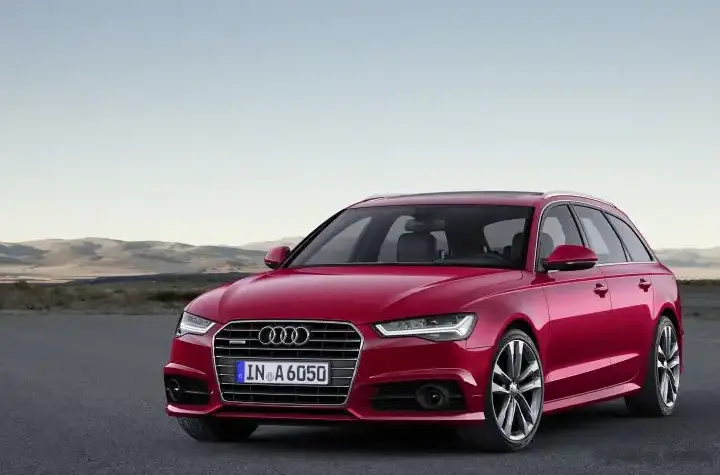
The Audi A6 Avant (4G, C7 facelift) 3.0 TDI quattro S tronic, produced from 2016 to 2018, represents a refined iteration of Audi’s popular executive wagon. This variant occupied a strong mid-to-upper position within the C7 facelift range, offering a compelling blend of performance, practicality, and technology. It was primarily marketed in Europe and other regions where wagons maintain significant popularity, serving as a sophisticated alternative to SUVs for buyers needing ample cargo space and a dynamic driving experience. The “facelift” designation refers to a series of cosmetic and technological updates applied to the C7 generation A6, enhancing its appeal and competitiveness.
Technical Specifications
| Brand | Audi |
| Model | A6 |
| Generation | A6 Avant (4G, C7 facelift 2016) |
| Type (Engine) | 3.0 TDI (218 Hp) quattro S tronic |
| Start of production | 2016 |
| End of production | 2018 |
| Powertrain Architecture | Internal Combustion engine |
| Body type | Station wagon (estate) |
| Seats | 5 |
| Doors | 5 |
| Fuel consumption (urban) | 5.7-5.8 l/100 km (41.3 – 40.6 US mpg, 49.6 – 48.7 UK mpg, 17.5 – 17.2 km/l) |
| Fuel consumption (extra urban) | 4.8-5.0 l/100 km (49 – 47 US mpg, 58.9 – 56.5 UK mpg, 20.8 – 20 km/l) |
| Fuel consumption (combined) | 5.1-5.3 l/100 km (46.1 – 44.4 US mpg, 55.4 – 53.3 UK mpg, 19.6 – 18.9 km/l) |
| CO2 emissions | 134-139 g/km |
| Fuel Type | Diesel |
| Acceleration 0 – 100 km/h | 6.8 sec |
| Acceleration 0 – 62 mph | 6.8 sec |
| Acceleration 0 – 60 mph | 6.5 sec |
| Maximum speed | 237 km/h (147.26 mph) |
| Emission standard | Euro 6 |
| Weight-to-power ratio | 8.4 kg/Hp, 119.1 Hp/tonne |
| Weight-to-torque ratio | 3.7 kg/Nm, 273.2 Nm/tonne |
| Power | 218 Hp @ 3250-5000 rpm |
| Torque | 500 Nm @ 1250-3000 rpm (368.78 lb.-ft. @ 1250-3000 rpm) |
| Engine layout | Front, Longitudinal |
| Engine Model/Code | CZVA, CZVB |
| Engine displacement | 2967 cm3 (181.06 cu. in.) |
| Number of cylinders | 6 |
| Engine configuration | V-engine |
| Cylinder Bore | 83 mm (3.27 in.) |
| Piston Stroke | 91.4 mm (3.6 in.) |
| Compression ratio | 16:1 |
| Number of valves per cylinder | 4 |
| Fuel injection system | Diesel Commonrail |
| Engine aspiration | Turbocharger, Intercooler |
| Engine oil capacity | 6.1 l (6.45 US qt | 5.37 UK qt) |
| Coolant | 11.5 l (12.15 US qt | 10.12 UK qt) |
| Kerb Weight | 1830 kg (4034.46 lbs.) |
| Max. weight | 2460 kg (5423.37 lbs.) |
| Max load | 630 kg (1388.91 lbs.) |
| Trunk (boot) space – minimum | 565 l (19.95 cu. ft.) |
| Trunk (boot) space – maximum | 1680 l (59.33 cu. ft.) |
| Fuel tank capacity | 73 l (19.28 US gal | 16.06 UK gal) |
| Max. roof load | 100 kg (220.46 lbs.) |
| Permitted trailer load with brakes (8%) | 2100 kg (4629.71 lbs.) |
| Permitted trailer load with brakes (12%) | 2000 kg (4409.25 lbs.) |
| Permitted trailer load without brakes | 750 kg (1653.47 lbs.) |
| Permitted towbar download | 85 kg (187.39 lbs.) |
| Length | 4943 mm (194.61 in.) |
| Width | 1874 mm (73.78 in.) |
| Width including mirrors | 2086 mm (82.13 in.) |
| Height | 1461 mm (57.52 in.) |
| Wheelbase | 2912 mm (114.65 in.) |
| Front track | 1627 mm (64.06 in.) |
| Rear (Back) track | 1618 mm (63.7 in.) |
| Front overhang | 925 mm (36.42 in.) |
| Rear overhang | 1106 mm (43.54 in.) |
| Drag coefficient (Cd) | 0.30 |
| Minimum turning circle (turning diameter) | 11.9 m (39.04 ft.) |
| Drive wheel | All wheel drive (4×4) |
| Number of gears and type of gearbox | 7 gears, automatic transmission Stronic |
| Front suspension | Independent multi-link suspension |
| Rear suspension | Independent on trapezoidal lever |
| Front brakes | Ventilated discs |
| Rear brakes | Ventilated discs |
| Assisting systems | ABS (Anti-lock braking system) |
| Steering type | Steering rack and pinion |
| Power steering | Electric Steering |
| Tires size | 225/55 R17 |
| Wheel rims size | 8J x 17 |
Powertrain & Engine Architecture
The heart of this A6 Avant is the 3.0-liter TDI engine, specifically the CZVA or CZVB engine code depending on the exact production date and market. This V6 diesel engine utilizes a common rail direct injection system, delivering fuel at extremely high pressure for optimized combustion. The engine features a single turbocharger with an intercooler, boosting power and torque while managing exhaust gas temperatures. The valvetrain employs four valves per cylinder, contributing to efficient gas exchange. The S tronic 7-speed dual-clutch transmission is a key component, offering rapid and smooth gear changes. This transmission is known for its efficiency and responsiveness, contributing to both performance and fuel economy. The longitudinal engine layout, typical of Audi’s quattro all-wheel-drive system, allows for optimal weight distribution.
Driving Characteristics
The 218 horsepower and 368 lb-ft of torque provided by the 3.0 TDI engine, coupled with the S tronic transmission and quattro all-wheel drive, deliver a confident and composed driving experience. Acceleration to 60 mph takes approximately 6.5 seconds, making it a brisk performer for a wagon. While not as overtly sporty as some of its gasoline-powered siblings, the 3.0 TDI offers ample power for overtaking and highway cruising. The S tronic transmission’s quick shifts minimize power interruption, and the quattro system provides excellent traction in all weather conditions. Compared to the base 2.0 TDI models, this variant offers significantly more power and a more refined driving experience. It’s also noticeably more responsive than the manual transmission versions, though the manual offered a more engaging experience for driving enthusiasts.
Equipment & Trim Levels
The 3.0 TDI quattro S tronic typically came well-equipped, reflecting its position in the A6 Avant lineup. Standard features often included leather upholstery, tri-zone automatic climate control, a multi-function steering wheel, and Audi’s MMI infotainment system with a color display. Optional extras were plentiful, including advanced driver-assistance systems like adaptive cruise control, lane keep assist, and a head-up display. Premium sound systems from Bang & Olufsen were also available. Interior trim options ranged from wood veneers to brushed aluminum, allowing buyers to personalize the cabin to their taste.
Chassis & Braking
The A6 Avant’s chassis features an independent multi-link suspension at the front and an independent trapezoidal link suspension at the rear, providing a comfortable ride and precise handling. The quattro all-wheel-drive system distributes power between the front and rear axles as needed, enhancing stability and traction. Braking duties are handled by ventilated discs on all four wheels, providing ample stopping power. ABS (Anti-lock Braking System) is standard, along with electronic stability control. Stabilizer bars are fitted front and rear to reduce body roll during cornering.
Market Reception & Comparison
The A6 Avant 3.0 TDI quattro S tronic was generally well-received by automotive critics. It was praised for its refined engine, comfortable ride, spacious interior, and practical wagon body style. Fuel economy was also a strong point, with combined figures around 46 mpg. Compared to the 2.0 TDI models, the 3.0 TDI offered a significant performance upgrade, but at a higher price point. The gasoline-powered variants, while offering more outright power, typically suffered from lower fuel economy. Reliability was generally good, although diesel particulate filter (DPF) issues could occur with infrequent long-distance driving.
Legacy
The 3.0 TDI engine, in various iterations, proved to be a durable and reliable powerplant. The S tronic transmission, while requiring more diligent maintenance than a traditional automatic, also demonstrated good longevity when properly serviced. Today, used examples of the A6 Avant 3.0 TDI quattro S tronic remain desirable, offering a compelling combination of luxury, performance, and practicality. However, potential buyers should be aware of the potential for DPF issues and the importance of maintaining the turbocharger and fuel injection system. The C7 A6 Avant, and this variant in particular, represents a high point in Audi’s wagon design and engineering.